Introduction
Badminton has become one of the most popular sports in India. What was once mainly played as a recreational activity is now enjoyed by children, students, working professionals and experienced athletes. With growing interest in sports and fitness, the demand for well-designed badminton courts is also increasing in Bilaspur.
Schools, colleges, sports academies, residential societies, fitness centres and commercial sports facilities are showing greater interest in developing dedicated badminton courts. These facilities provide people with a convenient place to play, practise and participate in competitions while encouraging a healthier lifestyle.
However, building a badminton court involves much more than preparing a playing area and installing flooring. Proper planning, site inspection, foundation work, surface preparation, lighting, ventilation and accurate court markings are all important. Every part of the construction process affects the quality, safety and durability of the finished court.
Choosing the right flooring is another important decision. Wooden flooring is commonly preferred for professional indoor badminton facilities, while PVC and PU sports flooring are suitable options for schools, clubs and coaching academies. Acrylic flooring is generally used for outdoor badminton courts because of its ability to withstand changing weather conditions.
Whether you are planning a badminton court for a school, residential project, sports academy or commercial facility, selecting suitable materials and experienced construction professionals can make a significant difference.
In this guide, we will discuss everything you should know about badminton court construction in Bilaspur, including court types, flooring options, standard dimensions, construction procedures, estimated costs, maintenance requirements and modern sports facility developments.
Why Invest in Badminton Court Construction in Bilaspur?
Badminton courts are becoming valuable additions to educational institutions, residential developments and commercial sports facilities. A properly designed court can support recreational activities, professional coaching and organised sporting events.
Let’s look at some important reasons behind the growing demand for badminton courts.
Growing Interest in Badminton
Badminton is a sport that people of different age groups can enjoy. It does not require an extremely large playing area, making it suitable for schools, colleges, residential communities and indoor sports centres.
Many institutions encourage students to participate in badminton through regular practice sessions, coaching programmes and local competitions.
As participation increases, the need for properly constructed courts with comfortable flooring and safe playing conditions also grows.
Development of Schools and Sports Academies
Educational institutions are increasingly recognising the importance of sports in students’ overall development.
A dedicated badminton court allows schools and colleges to organise physical education classes, sports competitions and extracurricular activities.
Professional badminton academies also need suitable playing surfaces, accurate court dimensions, proper lighting and quality equipment to support regular training.
Increasing Awareness of Health and Fitness
People are becoming more conscious of their health and daily physical activity. Badminton offers an enjoyable way to stay active without requiring complicated equipment.
Regular playing can help improve:
-
Cardiovascular fitness
-
Body balance
-
Agility and coordination
-
Muscle strength
-
Physical endurance
-
Flexibility
-
Reflexes
-
Mental concentration
Because of these benefits, badminton courts are becoming popular additions to fitness centres, clubs and residential communities.
Demand for Indoor Sports Facilities
Indoor badminton courts provide a convenient playing environment throughout the year. Unlike outdoor facilities, they are less affected by rain, direct sunlight and changing weather conditions.
A properly designed indoor badminton hall should include:
-
Suitable lighting arrangements
-
Adequate ceiling height
-
Proper ventilation
-
Comfortable playing conditions
-
Sufficient movement space
-
Appropriate sports flooring
These features help create a better environment for practice and competitions.
Business Opportunities
Badminton court construction can also be a business opportunity for sports entrepreneurs.
A professionally managed facility may generate income through:
-
Hourly court bookings
-
Monthly memberships
-
Professional coaching
-
Weekend tournaments
-
Corporate sports events
-
Summer training camps
-
School competitions
-
Local badminton leagues
Before starting a commercial facility, it is important to calculate construction expenses, maintenance costs, staffing requirements and expected customer demand.
Residential and Corporate Sports Facilities
Modern residential societies and corporate campuses are increasingly including sports amenities in their development plans.
A badminton court can encourage residents and employees to participate in physical activities while providing a space for social interaction.
These facilities can also improve the overall appeal of residential and commercial properties.
Types of Badminton Courts in Bilaspur
The selection of a badminton court depends on the available budget, installation location, playing requirements and expected maintenance.
Different flooring systems offer different levels of comfort, durability and performance.
1. Wooden Indoor Badminton Courts
Wooden badminton flooring is widely used in professional indoor stadiums, advanced training centres and tournament venues.
These flooring systems generally consist of a hardwood playing surface supported by a specialised subfloor designed to provide cushioning and improve player comfort.
Main features
-
Premium hardwood surface
-
Shock-absorbing subfloor
-
Smooth and even finish
-
Suitable playing grip
-
Professional appearance
-
Designed for regular indoor sports use
Advantages
-
Comfortable surface for extended playing sessions
-
Suitable for professional training environments
-
Good playing characteristics
-
Attractive appearance
-
Long service life with proper maintenance
Suitable locations
-
Indoor stadiums
-
Professional badminton academies
-
Sports complexes
-
Tournament facilities
-
Advanced training centres
Things to consider
Wooden flooring generally requires a higher initial investment than synthetic alternatives. It also needs proper humidity management, regular cleaning and periodic refinishing.
It is primarily suitable for indoor installations.
2. Synthetic PVC and PU Badminton Courts
PVC and PU sports flooring are popular choices for indoor badminton facilities because they offer a practical combination of durability, comfort and maintenance convenience.
PVC stands for Polyvinyl Chloride, while PU refers to Polyurethane. Both materials are used in sports flooring, although their construction and playing characteristics can differ.
Common features
-
Multi-layer flooring construction
-
Cushioned playing surface
-
Slip-resistant finish
-
Wear-resistant top layer
-
Comfortable playing experience
-
Easy cleaning and maintenance
Benefits
-
Suitable for regular playing sessions
-
Available in different specifications
-
Practical for schools and coaching centres
-
Good balance between cost and performance
-
Suitable for frequently used indoor courts
Recommended applications
-
Schools
-
Colleges
-
Universities
-
Sports academies
-
Residential societies
-
Corporate campuses
-
Indoor sports clubs
-
Community recreation centres
The final flooring selection should be based on product specifications, thickness, performance testing and installation quality.
3. Acrylic Outdoor Badminton Courts
Acrylic sports flooring is commonly used for outdoor badminton courts where the surface needs to withstand sunlight, rain and regular exposure to outdoor conditions.
It is generally applied in multiple coating layers over a properly prepared base.
Main features
-
Multi-layer acrylic coating
-
Weather-resistant surface options
-
UV-resistant finish
-
Textured playing surface
-
Different colour combinations
-
Designed for outdoor sports use
Advantages
-
Suitable for outdoor installations
-
Relatively easy to maintain
-
Attractive surface appearance
-
Can withstand outdoor exposure when correctly specified
-
Practical for community sports facilities
Suitable locations
-
Schools and colleges
-
Public parks
-
Residential societies
-
Government sports facilities
-
Outdoor sports complexes
Proper base preparation and drainage are essential for acrylic flooring. Standing water and cracks in the underlying surface can damage the finished court.
4. Concrete Badminton Courts
Concrete courts are sometimes selected for recreational facilities where construction budgets are limited.
A properly constructed concrete base provides structural strength and durability. However, an untreated concrete surface is much harder than specialised sports flooring.
Advantages
-
Economical construction option
-
Strong base structure
-
Relatively simple maintenance
-
Suitable for basic recreational use
Limitations
-
Hard playing surface
-
Limited shock absorption
-
Less comfortable during extended matches
-
Not generally preferred for professional competitions
For facilities expecting frequent use, installing an appropriate sports flooring system over the concrete base is worth considering.
Choosing the Right Badminton Court for Your Project
The right flooring depends on how the facility will be used.
-
Professional indoor stadiums: Wooden sports flooring.
-
Schools and colleges: Synthetic PVC or PU flooring.
-
Sports academies: PVC, PU or wooden systems depending on training requirements.
-
Residential societies: Synthetic indoor flooring.
-
Outdoor sports facilities: Acrylic sports flooring.
-
Basic recreational areas: Concrete construction, with suitable surface improvements where possible.
Before selecting a flooring system, compare the installation cost, maintenance requirements, product specifications and expected lifespan.
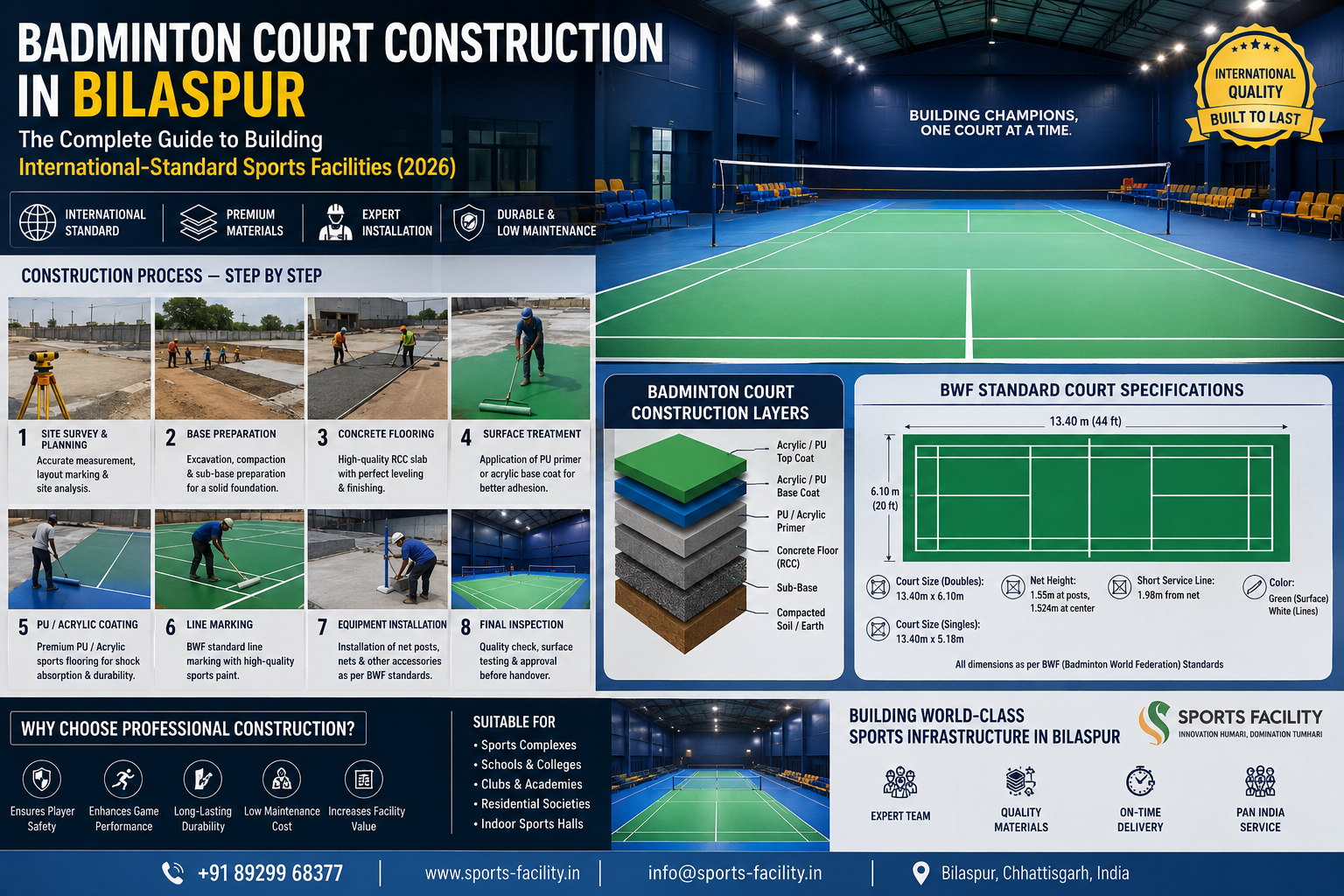
Standard Badminton Court Dimensions (BWF Guidelines)
Court dimensions play an important role in creating a professional badminton playing environment.
The Badminton World Federation (BWF) provides official measurements and playing regulations that should be considered when constructing courts for organised competitions and training facilities.
The standard measurements are:
| Specification | Standard measurement |
|---|---|
| Court length | 13.40 metres |
| Singles court width | 5.18 metres |
| Doubles court width | 6.10 metres |
| Net height at posts | 1.55 metres |
| Net height at centre | 1.524 metres |
Apart from the actual playing area, sufficient clearance should be provided around the court to allow players to move safely.
An approximate planning area of 17 metres × 9 metres is sometimes considered for a single court, but the final space requirement should be checked against the intended use and applicable competition requirements.
Additional facilities may include:
-
Spectator seating
-
Player warm-up areas
-
Coaching zones
-
Equipment storage
-
Reception and waiting areas
-
Changing rooms
-
Washrooms
-
Drinking water facilities
-
First-aid arrangements
Planning these facilities in advance makes the sports complex more practical and convenient.
Step-by-Step Badminton Court Construction Process in Bilaspur
Constructing a badminton court requires proper coordination between civil construction work and sports flooring installation.
The process generally involves the following stages.
1. Site Survey and Project Planning
Every project should begin with a detailed inspection of the proposed location.
The construction team evaluates the site to understand its condition and identify the work required before installation.
The inspection may include:
-
Land measurements
-
Site layout planning
-
Soil investigation for outdoor courts
-
Structural assessment for indoor facilities
-
Floor-level checking
-
Drainage planning
-
Electrical arrangements
-
Lighting layout
-
Budget estimation
-
Project scheduling
For indoor courts, roof height, ventilation, humidity and lighting positions also need attention.
Proper planning helps avoid unnecessary changes during construction.
2. Ground Preparation
The construction area must be prepared before the foundation work begins.
Existing vegetation, loose soil, debris, construction waste and other unwanted materials are removed.
A clean and properly prepared site provides a suitable starting point for the next construction stages.
3. Soil Compaction
For outdoor badminton courts, soil compaction is important for creating a stable foundation.
Suitable construction equipment is used to compact the ground according to the site requirements.
Proper compaction helps reduce the possibility of:
-
Uneven settlement
-
Foundation movement
-
Surface cracking
-
Irregular playing levels
The required compaction method should be determined according to the soil condition and engineering design.
4. Drainage Planning
Outdoor badminton courts need an effective drainage arrangement, especially in areas exposed to seasonal rainfall.
Depending on the site, the drainage system may include:
-
Surface slopes
-
Side drainage channels
-
Water outlets
-
Rainwater collection arrangements
Good drainage prevents water from collecting on the playing surface and helps protect the flooring system.
5. RCC Base Construction
After ground preparation, a reinforced cement concrete (RCC) base may be constructed according to the project design.
This base provides structural support for the sports flooring system.
Important considerations include:
-
Proper concrete quality
-
Correct thickness
-
Accurate levelling
-
Suitable surface finish
-
Structural stability
The concrete surface should be prepared according to the requirements of the selected flooring material.
6. Moisture Protection
Moisture can affect certain sports flooring materials, particularly wooden and synthetic systems.
Where required, an appropriate moisture protection system is installed between the concrete base and the flooring.
The correct protection method depends on the flooring manufacturer’s recommendations and the condition of the site.
Sports Flooring Installation
The flooring installation stage has a direct impact on player comfort and the overall performance of the badminton court.
Each flooring material requires a different installation procedure.
PVC Badminton Court Flooring Installation
PVC sports flooring is commonly selected for indoor badminton courts because it offers a practical combination of cushioning, durability and ease of maintenance.
Installation process
Surface preparation: The concrete base is cleaned properly. Dust, moisture and surface irregularities are checked before installation.
Adhesive application: A suitable sports flooring adhesive is applied according to the product manufacturer’s instructions.
PVC flooring installation: Flooring sheets or rolls are carefully positioned to achieve proper alignment and a uniform finish.
Joint finishing: Seams are treated using the recommended installation method. Heat welding may be used where specified.
Court marking: Playing lines are marked according to the required court dimensions.
Following the correct installation procedure helps achieve a neat and durable playing surface.
PU Badminton Flooring Installation
Polyurethane flooring is another option for indoor sports facilities.
Depending on the selected system, installation may involve:
-
Primer application
-
Cushion layer
-
Polyurethane coating
-
Protective wear layer
-
Court marking
Benefits of PU flooring
-
Seamless finish
-
Good durability
-
Comfortable playing surface
-
Impact-resistant construction
-
Relatively easy maintenance
The complete system should be selected according to its technical specifications and suitability for badminton.
Wooden Badminton Court Installation
Wooden sports flooring requires specialist installation and careful attention to the subfloor structure.
The construction generally involves:
Concrete foundation: A suitable concrete base is prepared and levelled.
Shock-absorbing subfloor: A resilient support system is installed to provide cushioning.
Hardwood installation: Selected wooden boards are installed with accurate alignment and spacing.
Surface finishing: The floor is finished with suitable protective coatings to improve durability and playing characteristics.
Proper installation and environmental management help maintain the quality of wooden badminton flooring.
Acrylic Outdoor Badminton Court Installation
Acrylic sports flooring is designed for outdoor playing conditions.
The installation process generally includes:
-
RCC base preparation.
-
Surface cleaning and grinding.
-
Primer application.
-
Cushion layer, where required.
-
Application of acrylic coating layers.
-
Textured surface finishing.
-
UV-resistant protective finish, where specified.
-
Court line marking.
The surface should be installed under suitable weather conditions and allowed to cure properly before use.
Court Marking and Sports Equipment
Accurate court markings are essential for proper badminton gameplay.
The markings should be measured carefully before applying the final line paint.
Important court lines include:
-
Baselines
-
Singles sidelines
-
Doubles sidelines
-
Short service lines
-
Long service lines
-
Centre line
Professional marking materials should provide good visibility and adhesion to the selected sports surface.
Installation of Sports Equipment
A completed badminton court also requires suitable playing equipment.
Badminton net system
-
Appropriate badminton net
-
Stable net posts
-
Adjustable net tension arrangement
LED sports lighting
Proper lighting is important because badminton involves fast shuttle movement and frequent changes in direction.
A suitable lighting arrangement should provide:
-
Uniform illumination
-
Reduced glare
-
Minimal distracting shadows
-
Good shuttle visibility
-
Energy efficiency
Additional facilities
Depending on the project, a badminton facility may also include:
-
Digital scoreboards
-
Umpire chairs
-
Player benches
-
Spectator seating
-
Equipment storage
-
Changing rooms
-
Washrooms
-
Drinking water stations
-
CCTV systems
-
Fire safety equipment
Badminton Court Construction Cost in Bilaspur
The cost of badminton court construction depends on the selected flooring, site condition, construction area and additional facilities.
An outdoor recreational court will generally require a different budget from a fully equipped indoor badminton stadium.
The following figures are indicative estimates from the supplied project information.
Approximate Sports Flooring Cost
| Flooring type | Estimated cost |
|---|---|
| Concrete court | ₹150–₹250 per sq. ft. |
| Acrylic sports flooring | ₹250–₹400 per sq. ft. |
| Synthetic PVC / PU flooring | ₹350–₹600 per sq. ft. |
| Premium wooden flooring | ₹500–₹850 per sq. ft. |
Estimated Total Project Cost
| Court type | Approximate investment |
|---|---|
| Outdoor concrete court | ₹3–₹6 lakh |
| Acrylic outdoor court | ₹5–₹8 lakh |
| Indoor synthetic court | ₹8–₹15 lakh |
| Premium wooden indoor court | ₹15–₹30 lakh |
These are indicative figures, not confirmed current quotations. Actual prices depend on material specifications, site conditions and project requirements.
Additional Infrastructure Costs
Some projects require additional investment for building infrastructure and player facilities.
Indoor building requirements
-
Steel roofing structures
-
Pre-engineered buildings
-
Ceiling arrangements
-
Ventilation systems
-
HVAC equipment
-
Acoustic insulation
Player and visitor facilities
-
Reception area
-
Waiting lounge
-
Locker rooms
-
Changing rooms
-
Washrooms
-
Drinking water facilities
Sports technology
-
Digital scoreboards
-
Online booking systems
-
CCTV surveillance
-
Biometric access control
-
Smart lighting
-
Performance tracking systems
When requesting quotations, ask contractors to clearly explain which items are included in the price and which will be charged separately.
Badminton Court Maintenance Guidelines
Building a good badminton court is only the first step. Regular maintenance is necessary to keep the playing surface clean, comfortable and safe.
The maintenance procedure depends on the flooring material and the amount of daily usage.
Maintenance of PVC and PU Badminton Courts
Synthetic flooring is generally easier to maintain than wooden sports flooring.
Daily cleaning
Remove dust, sand and loose dirt using a soft microfiber mop, suitable vacuum cleaner or non-abrasive cleaning equipment.
Weekly cleaning
Use a flooring cleaner approved by the manufacturer. Avoid harsh chemicals, bleach, acids and abrasive cleaning products.
Regular inspection
Check the surface for:
-
Scratches
-
Open seams
-
Loose edges
-
Adhesive problems
-
Damaged markings
-
Excessive surface wear
Minor problems should be addressed early to avoid more expensive repairs.
Long-term maintenance
Some synthetic flooring systems may require professional resurfacing after approximately 5–8 years. The actual period depends on the product, usage and maintenance conditions.
Maintenance of Wooden Badminton Courts
Wooden flooring requires additional care to maintain its playing quality.
Humidity management
Indoor humidity should be maintained within the limits recommended by the flooring supplier. Excessive moisture or dryness can cause wooden boards to expand, shrink or develop cracks.
Regular cleaning
Use dry microfiber mops or suitable vacuum cleaners. Avoid excessive water during cleaning.
Polishing and refinishing
Professional refinishing may be required periodically to restore the surface finish and maintain suitable playing characteristics.
Regular inspection
Check wooden boards, joints, surface coatings and the shock-absorbing subfloor.
With proper care, a well-built wooden sports floor can remain usable for many years. Actual service life varies according to construction quality and usage.
Maintenance of Outdoor Acrylic Courts
Outdoor courts are regularly exposed to dust, rain and sunlight.
Recommended maintenance practices include:
-
Sweeping leaves and dirt regularly
-
Cleaning the playing surface when necessary
-
Keeping drainage channels clear
-
Checking for cracks
-
Repairing damaged areas
-
Recoating when required
Regular inspection helps prevent small surface problems from becoming major repairs.
Common Challenges in Badminton Court Construction in Bilaspur
Every construction project has different requirements. Understanding possible problems before work begins helps avoid unnecessary expenses and delays.
1. Weather and Moisture Conditions
Outdoor courts need materials and construction methods suitable for local weather conditions.
Proper drainage, surface gradients and weather-resistant coatings are important.
Indoor courts also require suitable ventilation and moisture management to protect the flooring.
2. Foundation Quality
The foundation supports the entire sports flooring system.
Poor construction may result in:
-
Surface cracks
-
Uneven flooring
-
Water accumulation
-
Premature surface damage
Proper site preparation and engineering supervision are important for long-term durability.
3. Flooring Selection
Choosing the wrong flooring can affect player comfort and maintenance expenses.
Before selecting a system, consider:
-
Project budget
-
Indoor or outdoor location
-
Frequency of use
-
Playing requirements
-
Cleaning arrangements
-
Long-term maintenance
4. Lighting Arrangements
Badminton requires clear visibility of the shuttle during fast rallies.
Incorrect lighting positions may create glare, shadows and visibility problems.
A properly planned LED lighting system helps create a comfortable playing environment.
5. Installation Quality
The quality of installation is just as important as the flooring material.
Experienced technicians should ensure accurate measurements, suitable surface preparation, proper adhesive application and precise court markings.
Benefits of Professional Badminton Court Construction
A professionally constructed badminton court offers several advantages to sports institutions, property developers and individual facility owners.
Better Playing Safety
Sports flooring selected for badminton can provide suitable grip and cushioning. Proper court clearance, accurate markings and good lighting also help create safer playing conditions.
Consistent Playing Performance
A level surface, correctly installed flooring and accurate dimensions help players practise under consistent conditions.
Long-Term Durability
Quality materials and correct installation can reduce premature damage and help control long-term maintenance costs.
Support for Sports Competitions
A properly planned court can support coaching sessions, school competitions and organised tournaments, subject to the applicable venue and competition requirements.
Improved Property Appeal
Sports amenities can make residential communities, educational campuses, hotels and corporate facilities more attractive to potential users.
Future Trends in Badminton Court Construction
Sports infrastructure is changing with the introduction of improved flooring materials, energy-efficient systems and digital management solutions.
Eco-Friendly Sports Flooring
Some flooring manufacturers are introducing products that use recycled materials and lower-emission manufacturing methods.
These developments are encouraging more environmentally conscious construction practices.
Smart LED Sports Lighting
Modern LED lighting systems can offer:
-
Energy-efficient operation
-
Automated brightness adjustment
-
Motion-based controls
-
Reduced maintenance
-
Better lighting management
Advanced Shock-Absorbing Flooring
Modern multi-layer sports flooring systems are designed to improve cushioning and playing comfort.
These systems are particularly relevant for facilities that accommodate regular training sessions and extended playing hours.
Multi-Purpose Indoor Sports Complexes
Many institutions are planning indoor halls that can accommodate different sports.
These may include:
-
Badminton
-
Basketball
-
Volleyball
-
Table tennis
-
Pickleball
-
Indoor fitness activities
A multi-purpose facility needs careful flooring and layout planning so that each activity can be accommodated appropriately.
Digital Sports Facility Management
Technology is making sports facility management more convenient.
Modern facilities may use:
-
Online court booking
-
Digital payment systems
-
Electronic scoreboards
-
CCTV monitoring
-
Biometric access
-
Performance analysis tools
These solutions can improve the user experience and simplify daily operations.
Sustainable Sports Infrastructure
Future sports facilities may also incorporate:
-
Solar-powered lighting
-
Rainwater harvesting
-
Energy-efficient buildings
-
Durable construction materials
-
Environmentally responsible building practices
Such measures can help reduce operating costs when properly planned.
Why Choose Professional Badminton Court Construction Experts in Bilaspur?
Selecting the right contractor is an important part of any badminton court project.
An experienced sports infrastructure company should understand civil construction, flooring installation and the specific requirements of badminton facilities.
Complete Turnkey Solutions
Depending on the project, professional contractors may provide:
-
Site inspection
-
Project planning
-
Court layout design
-
Civil construction
-
RCC base preparation
-
Sports flooring installation
-
Court marking
-
Equipment installation
-
Lighting coordination
-
Final quality inspection
Having one team coordinate the main activities can make project management easier.
Quality Sports Flooring Materials
Always ask about the flooring brand, product specifications, warranty and suitability for badminton.
A reliable contractor should be able to explain the advantages and limitations of the proposed system.
Skilled Installation Team
Experienced technicians help ensure proper measurements, surface preparation, flooring installation and finishing.
Their workmanship has a direct impact on the final appearance and performance of the court.
After-Sales Support
Maintenance advice, periodic inspections, repair services and resurfacing support can help protect your investment after the construction work is complete.
Conclusion
Badminton court construction in Bilaspur is becoming an important part of the growing demand for sports and recreational infrastructure. Schools, colleges, sports academies, residential societies and commercial facilities are recognising the value of providing dedicated spaces for badminton.
A successful project requires proper planning, a strong foundation, suitable sports flooring, accurate court markings and appropriate lighting arrangements. Each element contributes to the overall quality and usability of the facility.
Wooden flooring is worth considering for professional indoor venues, while PVC and PU flooring offer practical options for many schools, clubs and coaching centres. Acrylic surfacing is commonly used for outdoor installations when the base and drainage are properly designed.
Choosing suitable materials and experienced installation professionals can help create a badminton facility that serves its users for many years.
If you are planning a new badminton court, begin with a site inspection and a detailed project estimate. This will help you understand the construction requirements, select the right flooring and plan your investment more effectively.
Frequently Asked Questions
1. Which flooring is best for badminton court construction in Bilaspur?
Wooden flooring is commonly preferred for professional indoor courts and advanced training centres. PVC and PU flooring are suitable options for schools, colleges, sports academies and indoor clubs. Acrylic flooring is generally considered for outdoor badminton courts.
2. What is the standard size of a badminton court?
A standard badminton court measures 13.40 metres in length. Its width is 5.18 metres for singles and 6.10 metres for doubles. Additional space is required around the court for safe player movement.
3. How much does badminton court construction cost in Bilaspur?
Based on the indicative estimates in this guide, project costs may range from approximately ₹3 lakh for a basic outdoor concrete court to ₹30 lakh for a premium indoor wooden court. The actual investment depends on flooring, civil construction, roofing, lighting and additional facilities.
4. How much time is required to construct a badminton court?
The estimated construction period in the supplied project information is around 3–8 weeks. The actual timeline depends on site preparation, project size, flooring selection, material availability and weather conditions.
5. Can badminton courts be constructed in schools and residential societies?
Yes. Badminton courts can be developed in schools, colleges, residential societies, corporate campuses, sports academies, hotels and commercial sports complexes. The design should match the available space and expected usage.
6. How often should a badminton court be maintained?
Regular cleaning and periodic inspections are important for every flooring type. Synthetic courts may require professional resurfacing after several years, depending on usage and product specifications. Wooden courts need proper humidity management, cleaning and periodic refinishing.