Introduction
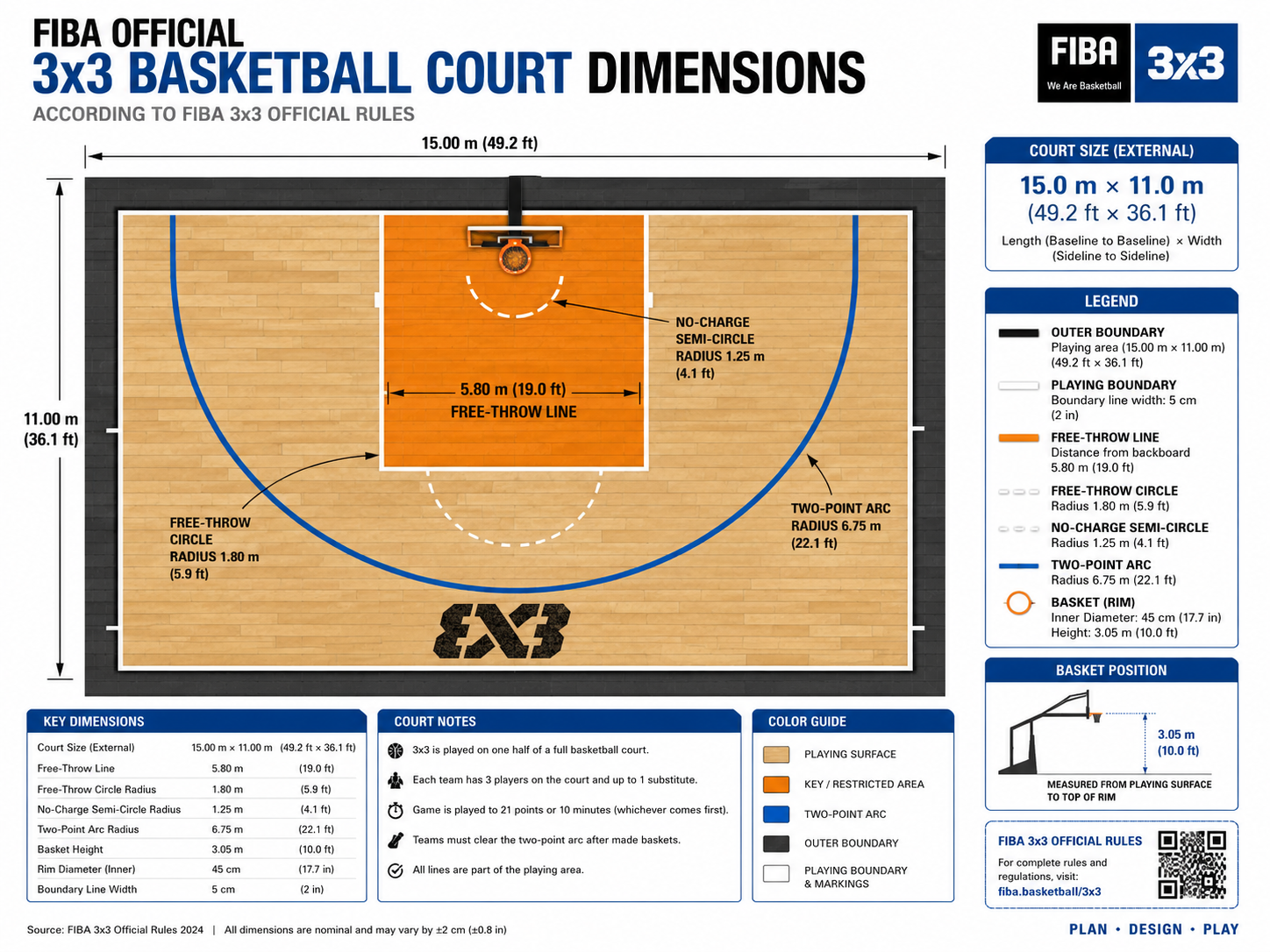
3×3 basketball has transformed from a popular street sport into one of the fastest-growing competitive sports worldwide. Recognized by the FIBA and included in major international competitions, 3×3 basketball offers a faster, more dynamic version of traditional basketball. Its compact playing area, simplified rules, and high-energy gameplay make it attractive for schools, sports academies, recreational facilities, parks, and professional tournaments.
Unlike conventional basketball, which is played on a full-sized court with five players per team, 3×3 basketball uses a half-court format with three players per side. Because of the reduced playing area, every aspect of the court—from dimensions and markings to flooring and safety zones—must be carefully planned to meet official standards.
Whether you are building a new court, upgrading an existing facility, or simply learning about the sport, understanding official 3×3 basketball court dimensions is essential. This guide explains court size, key measurements, playing areas, surface requirements, and design considerations in detail.
What Is 3×3 Basketball?
3×3 basketball is a condensed version of traditional basketball that emphasizes speed, skill, teamwork, and quick decision-making. The game is played on a single basket and half-court, making it ideal for urban environments and locations where space is limited.
The sport has gained global popularity because it:
- Requires less space than a full basketball court
- Promotes continuous action and fast scoring
- Is easy to organize and participate in
- Appeals to players of all ages and skill levels
- Supports both recreational and professional competition
Today, 3×3 basketball is played in schools, community centers, universities, sports clubs, and international tournaments around the world.
Official 3×3 Basketball Court Dimensions
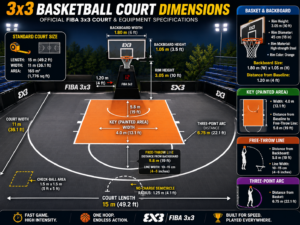
The official court dimensions for competitive 3×3 basketball are designed to create a balance between player movement, offensive opportunities, and defensive strategy.
Standard Court Size
- Court Length: 15 meters (49.2 feet)
- Court Width: 11 meters (36.1 feet)
The playing area occupies approximately 165 square meters (1,776 square feet), making it significantly smaller than a traditional basketball court.
Because the court is compact, players are constantly involved in the action. The reduced space increases game intensity while encouraging faster transitions between offense and defense.
Court Layout and Structure
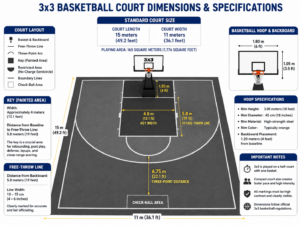
A 3×3 basketball court consists of a half-court configuration with one basket. The layout includes several important zones and markings that help regulate gameplay.
Key court components include:
- Basket and backboard
- Free-throw area
- Three-point arc
- Restricted area
- No-charge semicircle
- Boundary lines
- Check-ball area
Each section plays a critical role in maintaining fairness and consistency during competition.
Basketball Hoop and Backboard Specifications
The basket and backboard used in 3×3 basketball follow the same standards as traditional basketball.
Hoop Height
- Rim Height: 3.05 meters (10 feet)
This universal basketball height is used at professional, amateur, and recreational levels worldwide.
Rim Specifications
- Rim Diameter: 45 centimeters (18 inches)
- Rim Material: High-strength steel
- Rim Color: Typically orange
Backboard Dimensions
- Width: 1.80 meters (6 feet)
- Height: 1.05 meters (3.5 feet)
Backboard Placement
- Distance from Baseline: 1.20 meters (4 feet)
Proper installation ensures player safety while maintaining accurate rebounding and shooting performance.
The Key Area (Painted Area)
The key, often called the painted area, is one of the most important sections of the court.
This area is located directly beneath the basket and serves as a primary zone for:
- Post play
- Rebounding
- Defensive positioning
- Layups and close-range scoring
Key Measurements
- Width: Approximately 4 meters (13.1 feet)
- Distance from Baseline to Free-Throw Line: 5.8 meters (19 feet)
Although smaller than the key on a full-sized basketball court, it remains a crucial tactical area in 3×3 competition.
Players frequently battle for position in this zone because many scoring opportunities occur near the basket.
Free-Throw Line Dimensions
Free throws remain an important scoring element in 3×3 basketball.
The free-throw line is clearly marked and positioned according to official regulations.
Free-Throw Line Measurements
- Distance from Backboard: 5.8 meters (19 feet)
- Line Width: 10–15 centimeters (4–6 inches)
The free-throw line must be highly visible and painted in a contrasting color to ensure easy identification during gameplay.
Accurate free-throw markings help officials enforce rules consistently while maintaining fairness for players.
Three-Point Arc Dimensions
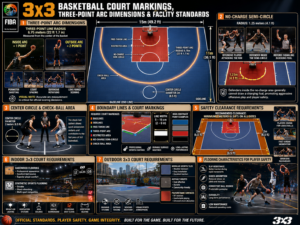
One of the most exciting aspects of 3×3 basketball is long-range shooting.
The three-point line creates strategic opportunities and rewards players with higher-value shots.
Three-Point Line Distance
- Radius: 6.75 meters (22 feet 1.7 inches) from the center of the basket
In official 3×3 scoring:
- Shots inside the arc = 1 point
- Shots outside the arc = 2 points
This scoring structure encourages players to develop perimeter shooting skills while creating additional spacing on the court.
The three-point arc must be accurately measured and clearly marked to ensure proper scoring decisions.
No-Charge Semi-Circle
The no-charge semi-circle is located directly beneath the basket.
Radius
- 1.25 meters (4.1 feet)
This area helps officials determine charging and blocking fouls.
Defenders positioned inside the no-charge area generally cannot draw a charging foul, helping protect offensive players attacking the basket.
This rule promotes aggressive drives and exciting offensive play.
Center Circle and Check-Ball Area
Unlike traditional basketball, 3×3 uses a check-ball system to restart play.
Center Circle Diameter
- 2 meters (6.5 feet)
The check-ball area is typically located near the top of the key.
This designated space allows players to restart possession quickly and efficiently after stoppages.
The check-ball system contributes significantly to the sport’s fast pace.
Boundary Lines and Court Markings
Every official court requires clearly visible boundary lines.
Required Markings Include
- Baselines
- Sidelines
- Free-throw line
- Three-point arc
- Restricted area
- No-charge semicircle
- Check-ball area
Line Width
Most court markings are between:
- 5 and 15 centimeters wide
High-contrast paint colors improve visibility for players, coaches, referees, and spectators.
Professional facilities often use durable sports coatings that resist fading and wear.
Recommended Safety Clearance Around the Court
While the official playing surface measures 15m × 11m, additional safety space is required around the perimeter.
Recommended Clearance
- Minimum 2 meters (6.5 feet) on all sides
This extra space protects players during:
- Fast breaks
- Defensive recoveries
- Diving for loose balls
- Momentum-driven collisions
For tournament venues, larger safety zones are often preferred.
Indoor 3×3 Basketball Court Requirements
Indoor courts provide the highest level of playing consistency and are commonly used for professional competition.
Popular Indoor Flooring Options
Hardwood Flooring
Advantages:
- Excellent ball bounce
- Professional appearance
- Superior player comfort
Synthetic Sports Flooring
Advantages:
- Durable
- Lower maintenance
- Shock absorption
- Multi-sport compatibility
Indoor Facility Considerations
- Adequate lighting
- Ventilation systems
- Ceiling height clearance
- Spectator seating
- Scoreboards and shot clocks
A well-designed indoor facility enhances both player performance and spectator experience.
Outdoor 3×3 Basketball Court Requirements
Outdoor courts are among the most popular installations due to lower construction costs and wider accessibility.
Common Outdoor Surfaces
Modular Sports Tiles
Benefits:
- Weather resistant
- Easy installation
- Low maintenance
- Excellent traction
Asphalt Courts
Benefits:
- Cost-effective
- Durable
- Suitable for community facilities
Polyurethane Surfaces
Benefits:
- Comfortable playing experience
- UV resistance
- Improved shock absorption
Outdoor courts should include proper drainage systems to prevent water accumulation and surface deterioration.
Flooring Characteristics for Player Safety
Regardless of location, the playing surface should provide:
Slip Resistance
Improves traction during rapid movements.
Shock Absorption
Reduces stress on joints and muscles.
Consistent Ball Bounce
Ensures fair gameplay and predictable performance.
Durability
Withstands heavy usage and environmental conditions.
Low Maintenance
Reduces long-term operating costs.
High-quality flooring contributes significantly to player safety and game quality.
Benefits of Building a 3×3 Basketball Court
Space Efficiency
Because the court occupies only a fraction of a traditional basketball court, it is ideal for:
- Schools
- Residential communities
- Urban developments
- Recreation centers
Lower Construction Costs
Smaller dimensions typically reduce:
- Material costs
- Surface installation costs
- Maintenance expenses
Increased Participation
The compact design encourages more frequent use and accommodates players of various ages and skill levels.
Fast-Paced Entertainment
The game’s quick transitions and continuous action create an exciting experience for players and spectators alike.
Tournament Readiness
Courts built according to official specifications can host local, regional, and professional competitions.
Planning Considerations Before Construction
Before building a 3×3 basketball court, consider the following:
Available Space
Ensure enough room for:
- Playing surface
- Safety clearance
- Spectator areas
Surface Selection
Choose flooring based on:
- Budget
- Climate conditions
- Expected usage
Lighting
Proper lighting is essential for:
- Evening games
- Player safety
- Tournament play
Drainage
Outdoor courts require efficient water management systems.
Accessibility
Design should accommodate:
- Players
- Coaches
- Officials
- Spectators
Thoughtful planning increases court longevity and user satisfaction.
Why Official Dimensions Matter
Using official dimensions provides several advantages:
- Consistent player development
- Fair competition
- Improved safety
- Better tournament compatibility
- Professional appearance
Players who train on regulation-sized courts adapt more easily to competitive environments and official events.
Conclusion
3×3 basketball continues to expand globally because of its accessibility, excitement, and efficient use of space. A properly designed court is the foundation of a safe and enjoyable playing environment. By following official court dimensions, maintaining accurate markings, and selecting appropriate flooring materials, facility owners can create a professional-quality venue suitable for recreational play and organized competition.
Whether installed in a school, sports complex, public park, residential development, or tournament venue, a regulation 3×3 basketball court provides an outstanding platform for athletic development, community engagement, and high-energy competition. Investing in proper design and construction ensures players enjoy the game at its highest level while meeting modern standards for performance and safety.
Frequently Asked Questions (FAQs)
1. What are the official dimensions of a 3×3 basketball court?
The official court size is 15 meters long and 11 meters wide, making it significantly smaller than a traditional full-sized basketball court.
2. Is the hoop height different from regular basketball?
No. The basket height remains 3.05 meters (10 feet), identical to standard basketball regulations.
3. How far is the three-point line in 3×3 basketball?
The three-point arc is positioned 6.75 meters from the center of the basket.
4. How much safety space is needed around the court?
A minimum clearance of 2 meters around the court is recommended for safe play and official competitions.
5. Can a 3×3 basketball court be built outdoors?
Yes. Outdoor installations are extremely common and often use modular sports tiles, asphalt, or polyurethane surfaces.
6. What is the best flooring option for indoor courts?
Hardwood flooring remains the preferred choice for professional indoor basketball facilities because of its performance, durability, and player comfort.
7. Why is 3×3 basketball becoming so popular?
The sport requires less space, offers faster gameplay, encourages participation, and delivers an exciting experience for players and spectators alike.