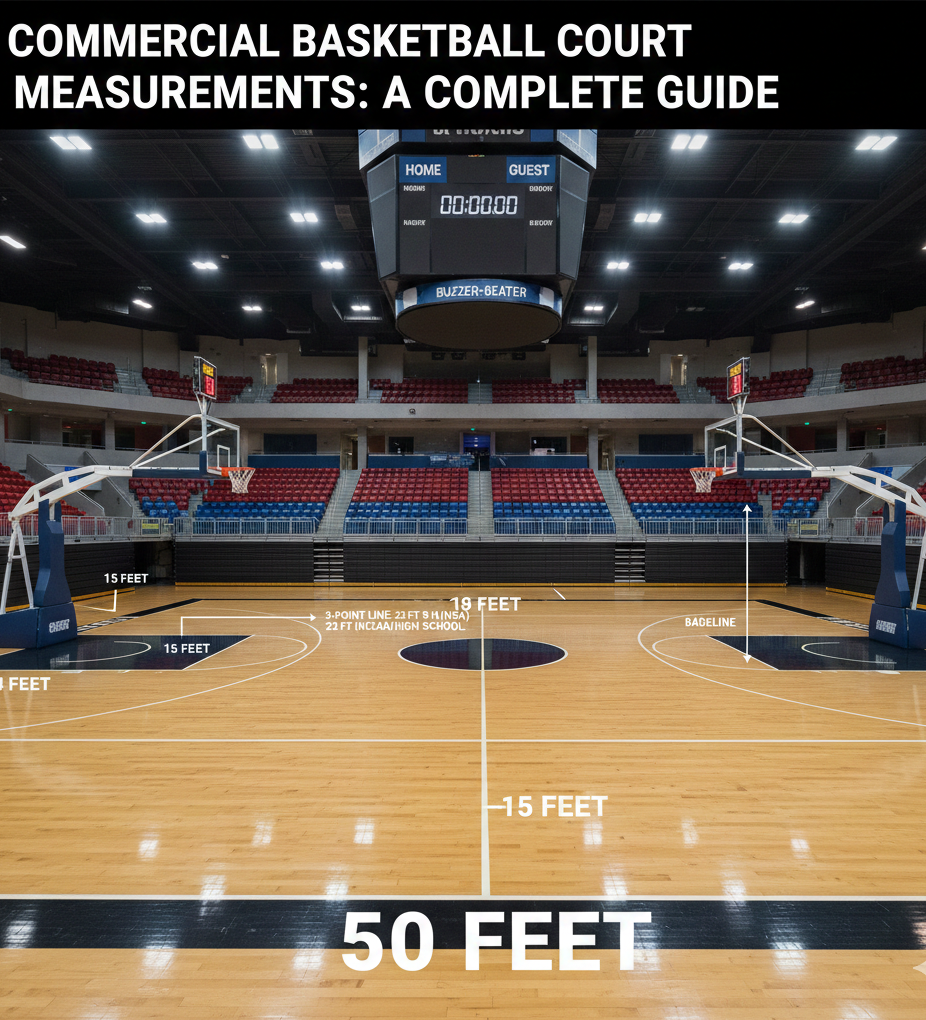
Basketball has grown into one of the most popular sports worldwide, and commercial basketball courts are a central component in gyms, sports complexes, schools, and recreational facilities. Designing a commercial court requires precise measurements to ensure player safety, proper gameplay, and compliance with international standards. This guide provides detailed insights into the dimensions, layout, and key specifications of a professional basketball court.
Standard Dimensions of a Commercial Basketball Court
A commercial basketball court is typically designed following regulations set by the National Basketball Association (NBA), Fédération Internationale de Basketball (FIBA), or local sports authorities. The dimensions may vary slightly depending on the standard being followed, but the most commonly used measurements are:
-
Length: 28 meters (approximately 91.9 feet)
-
Width: 15 meters (approximately 49.2 feet)
For recreational or multipurpose use, slightly smaller courts may be used, but professional commercial courts always adhere to these standards for competitive play.
Key Areas and Their Measurements
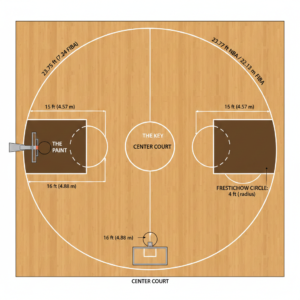
1. The Restricted Area / Paint Area
Also known as the key, this area is crucial for free throws, rebounds, and close-range scoring.
-
Width: 4.9 meters (16 feet) for NBA courts, 4.9 meters (16 feet) for FIBA courts
-
Length: 5.8 meters (19 feet) from the baseline to the free-throw line
The restricted arc, which prevents defensive players from drawing charges too close to the basket, typically has a radius of 1.25 meters (4 feet) from the center of the basket.
2. Free-Throw Line
-
Distance from the baseline: 5.8 meters (19 feet)
-
Width of the free-throw line: 15 cm (6 inches)
This line is critical for free-throw attempts and defines the boundary of the key for offensive and defensive positioning.
3. Three-Point Line
The three-point line marks the area from which a successful shot earns three points:
-
NBA: 7.24 meters (23 feet 9 inches) at the top of the arc; 6.7 meters (22 feet) in the corners
-
FIBA: 6.75 meters (22 feet 1.7 inches) from the basket
The arc creates strategic scoring zones and is essential in modern basketball gameplay.
4. Basket and Backboard Placement
-
Basket Height: 3.05 meters (10 feet) from the floor
-
Backboard Width: 1.8 meters (6 feet)
-
Backboard Height: 1.05 meters (3 feet 6 inches)
-
Distance from baseline to backboard: 1.2 meters (4 feet)
Proper placement ensures accurate gameplay and safety for athletes.
5. Other Court Markings
-
Center Circle: 3.6 meters (12 feet) diameter for jump balls
-
Sidelines and Baselines: Clearly marked with durable lines to define boundaries
-
Free-Throw Circles: Radius of 1.8 meters (6 feet) around the free-throw line
-
No-Charge Semi-Circle: Radius of 1.25 meters (4 feet) from the basket center
All markings must be clearly visible, typically in contrasting paint, to guide gameplay and refereeing.
Flooring and Surface Considerations
A commercial basketball court is more than just measurements; the surface plays a critical role in performance and safety:
-
Material: Hardwood (maple) is preferred for professional courts; synthetic or epoxy flooring is common for multipurpose facilities.
-
Finish: Non-slip, smooth finish with impact absorption to reduce injuries.
-
Maintenance: Regular polishing, cleaning, and line repainting ensure longevity and safety.
Compliance with Standards
For commercial and professional facilities, adherence to NBA, FIBA, or local sports authority standards is crucial. Proper court dimensions enhance the player experience, reduce injury risk, and allow the facility to host official games and tournaments.
Conclusion
Designing a commercial basketball court requires attention to precise measurements, strategic layout, and durable flooring materials. Whether it’s for a school gym, sports complex, or professional arena, ensuring correct dimensions and proper surface quality is vital for creating a safe, enjoyable, and competitive environment for players.
A well-planned commercial basketball court not only supports athletic performance but also elevates the overall reputation of your sports facility.