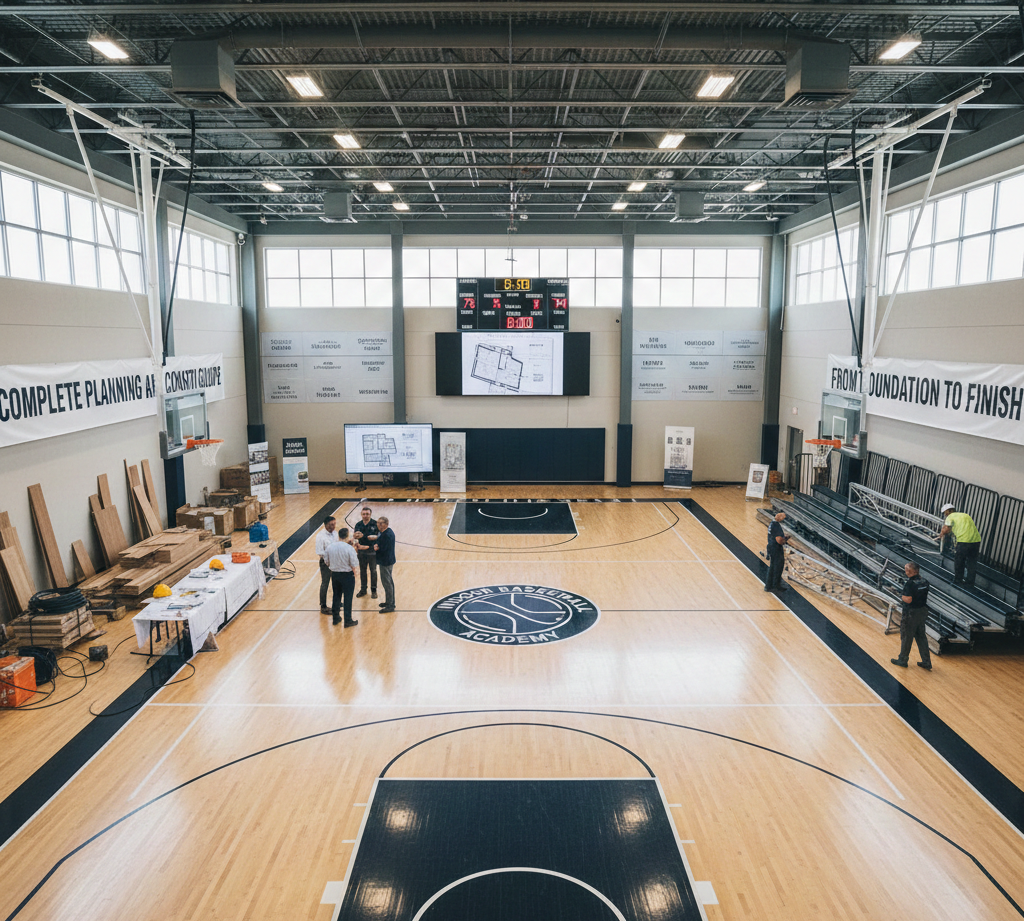
Creating an indoor basketball court is a valuable investment for educational institutions, sports academies, fitness centers, clubs, and luxury residential properties. A professionally designed indoor basketball facility allows uninterrupted play throughout the year, offers superior playing conditions, and ensures athlete safety and surface durability. Whether your goal is competitive play, daily training, or recreational use, careful planning and execution are essential for a successful setup.
This comprehensive guide explains all key aspects of an indoor basketball court setup, including purpose planning, dimensions, flooring systems, subfloor preparation, lighting, ventilation, equipment, installation stages, maintenance, and cost considerations.
1. Defining the Purpose of Your Indoor Basketball Court
Before starting construction, it is crucial to identify how the court will be used. The intended purpose directly influences layout, flooring choice, equipment selection, and budget.
Professional Competition Court
Designed for tournaments and official matches, these courts must comply with NBA or FIBA regulations. They typically feature premium hardwood flooring, professional-grade lighting, electronic scoreboards, and spectator seating.
School or College Court
Educational facilities usually require multi-purpose indoor courts that support basketball along with other sports or physical activities. Durable flooring, flexible markings, and moderate seating capacity are key considerations.
Sports Academy or Training Center
Training facilities prioritize performance and safety. These courts often include high-impact flooring, additional training lines, shooting zones, and adjacent conditioning areas.
Residential Indoor Court
Private indoor courts are usually compact or half-court designs. They emphasize space efficiency, cost control, and customized aesthetics while maintaining safe play conditions.
Clarifying the court’s purpose helps ensure the setup meets functional needs without unnecessary expense.
2. Standard Indoor Basketball Court Dimensions
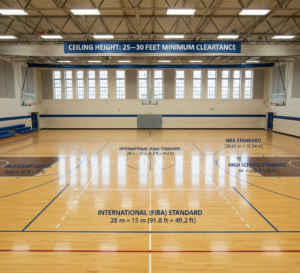
Court dimensions vary based on the governing body and level of play.
International (FIBA) Standard
-
Court Size: 28 m × 15 m (approximately 91.8 ft × 49.2 ft)
NBA Standard
-
Court Size: 94 ft × 50 ft (approximately 28.65 m × 15.24 m)
High School Standard
-
Court Size: 84 ft × 50 ft
Half-Court Layout
Common in residential and training setups, half courts typically measure around 47 ft × 50 ft but can be customized based on available space.
Ceiling Height
A minimum clear ceiling height of 25–30 feet is required to allow safe ball trajectory and uninterrupted gameplay.
3. Flooring Options for Indoor Basketball Courts
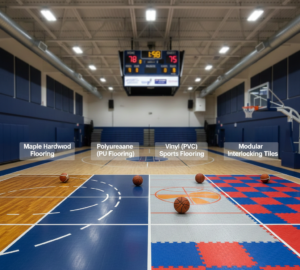
The playing surface is the most critical element of an indoor basketball court, directly influencing performance, comfort, and injury prevention.
Maple Hardwood Flooring
Widely used in professional arenas, hardwood flooring provides consistent ball bounce and excellent aesthetics. It offers superior performance but requires periodic maintenance and humidity control.
Polyurethane (PU) Flooring
PU flooring is seamless, cushioned, and highly durable. It provides excellent shock absorption and is suitable for multi-sport indoor halls with moderate maintenance needs.
Vinyl (PVC) Sports Flooring
Vinyl flooring is a cost-effective option available in rolls or tiles. It offers good grip, comfort, and ease of installation, making it ideal for schools and training facilities.
Modular Interlocking Tiles
These tiles are easy to install and replace. They provide decent traction and ball response, making them suitable for small gyms and residential indoor courts.
Flooring Selection Factors
-
Level of play
-
Budget constraints
-
Maintenance requirements
-
Shock absorption and safety
-
Visual appearance
4. Subfloor and Base Construction
A well-constructed subfloor ensures long-term performance and structural stability.
Key Subfloor Elements
-
Level concrete base
-
Moisture protection layer
-
Cushion or shock-absorbing pads
-
Expansion gaps for hardwood systems
Proper base preparation prevents surface warping, cracking, and uneven ball bounce over time.
5. Wall Padding and Player Safety
Safety features are essential in any indoor basketball setup. Wall padding protects players from impact during fast-paced play.
Padding Specifications
-
Thickness: 1–2 inches minimum
-
Material: High-density foam with fire-resistant vinyl cover
-
Coverage: Baselines, sidelines, corners, and areas near hoops
Adequate safety zones significantly reduce the risk of injury.
6. Lighting Design for Indoor Basketball Courts
Effective lighting enhances visibility, accuracy, and overall gameplay quality.
Recommended Illumination Levels
-
Training and recreational courts: 300–500 lux
-
Competitive matches: 500–800 lux
-
Professional venues and broadcasting: 1000 lux or higher
Lighting Systems
-
LED high-bay fixtures
-
Anti-glare sports lighting
-
Energy-efficient and uniform light distribution
Lights should be positioned to eliminate shadows and glare on the court surface.
7. Ventilation, Temperature, and Humidity Control
Environmental control is vital for both player comfort and flooring longevity.
Ideal Indoor Conditions
-
Temperature: 18–24°C (65–75°F)
-
Relative humidity: 40–60%
Proper ventilation prevents moisture buildup, slippery floors, and poor air quality. HVAC systems are recommended for larger facilities.
8. Essential Basketball Equipment
A complete indoor basketball court setup includes high-quality equipment for safe and professional play.
Basketball Hoops
-
Wall-mounted systems
-
Ceiling-suspended systems
-
Portable indoor units
Backboards
-
Tempered glass (professional standard)
-
Acrylic or polycarbonate (recreational use)
-
Standard size: 72 inches
Rims
-
Breakaway rims to absorb dunking impact
-
Durable, rust-resistant coatings
Court Markings
Accurate markings include center circle, free-throw lines, three-point arcs, key areas, sidelines, and baselines.
Scoreboards and Seating
Optional additions include electronic scoreboards, shot clocks, bleachers, and spectator seating for competitions and training review.
9. Step-by-Step Installation Process
Step 1: Site Evaluation and Planning
Measure space, plan layout, and determine safety clearances.
Step 2: Base Preparation
Level concrete base, install moisture barriers, and prepare the subfloor.
Step 3: Flooring Installation
-
Hardwood floors are nailed or glued
-
Vinyl floors are bonded with adhesives
-
Modular tiles are interlocked
-
PU flooring is poured in layers
Step 4: Finishing and Line Marking
Hardwood floors are sanded and sealed. Court lines are marked with durable sports-grade paint.
Step 5: Equipment Installation
Install hoops, backboards, rims, padding, and scoreboards.
Step 6: Lighting and Ventilation Setup
Install lighting fixtures and adjust HVAC systems.
Step 7: Final Testing and Inspection
Check ball bounce, grip, line accuracy, lighting levels, and safety compliance.
10. Maintenance Best Practices
Regular maintenance extends the life of an indoor basketball court and preserves performance.
Daily Care
-
Dry mopping
-
Immediate spill removal
Monthly Checks
-
Inspect floor joints and seams
-
Check hoop and backboard stability
-
Clean lighting fixtures
Annual Maintenance
-
Recoat hardwood surfaces
-
Repaint faded lines
-
Inspect ventilation systems
Proper upkeep can extend the court’s lifespan by several years.
11. Cost Considerations
The total cost of an indoor basketball court depends on several factors:
-
Court size and layout
-
Flooring system
-
Lighting and HVAC setup
-
Equipment quality
-
Labor and installation
-
Custom branding or logos
Costs can range from basic training setups to premium professional facilities, depending on requirements.
Conclusion
An indoor basketball court setup requires thoughtful planning, skilled execution, and high-quality materials. When designed correctly, it provides a safe, comfortable, and professional environment for athletes to train and compete year-round.
By selecting appropriate flooring, ensuring proper lighting and ventilation, and investing in reliable equipment, your indoor basketball court can deliver long-lasting performance, enhanced safety, and excellent value. Whether for schools, academies, clubs, or private use, a well-built indoor basketball facility is an asset that supports athletic development for years to come.
Frequently Asked Questions (FAQ) – Indoor Basketball Court Setup
1. What are the standard dimensions of an indoor basketball court?
A standard FIBA indoor basketball court measures 28 m × 15 m. For recreational or school courts, dimensions can be slightly adjusted based on available space, but safety clearances should always be maintained.
2. What is the best flooring for an indoor basketball court?
The most recommended flooring options are:
-
Maple wooden sports flooring
-
PU (Polyurethane) sports flooring
-
Synthetic acrylic flooring
-
PVC vinyl sports flooring
PU and wooden floors are preferred for professional play due to better shock absorption and ball bounce.
3. How much space is required including run-off areas?
Apart from the playing area, at least 2 meters of run-off space on all sides is recommended for player safety. The total hall size should ideally be 32 m × 19 m or more.
4. What ceiling height is required for an indoor basketball court?
The minimum ceiling height should be 7 meters for recreational courts and 9–12 meters for professional or tournament-level indoor basketball courts to allow unrestricted ball movement.
5. Is shock absorption important for indoor basketball courts?
Yes, shock absorption is crucial to reduce joint stress and injury risk. Professional indoor courts use cushioned systems or elastic layers that meet international sports performance standards.
6. What type of lighting is best for indoor basketball courts?
LED sports lighting is ideal for indoor courts as it provides uniform brightness, low glare, and energy efficiency. Proper lighting ensures clear visibility of the ball and lines during fast gameplay.
7. Can an indoor basketball court be installed over an existing floor?
Yes, indoor basketball flooring can be installed over existing concrete or RCC floors, provided the base is level, crack-free, and structurally sound. A primer and leveling compound are usually applied first.
8. How long does it take to set up an indoor basketball court?
The installation timeline depends on flooring type:
-
Synthetic or PVC flooring: 7–10 days
-
PU flooring system: 10–15 days
-
Wooden flooring system: 15–20 days
9. What is the cost of setting up an indoor basketball court?
In India, indoor basketball court setup costs typically range from ₹1,200 to ₹6,000 per sq. meter, depending on flooring material, thickness, branding, and performance requirements.
10. What maintenance is required for indoor basketball courts?
Indoor courts require minimal maintenance, such as regular dust cleaning, occasional damp mopping, and periodic inspection of line markings and joints. Wooden floors may need polishing over time.
11. Are indoor basketball courts suitable for multi-sport use?
Yes, many indoor courts are designed as multi-purpose courts and can be used for volleyball, badminton, futsal, or training activities with proper line markings.
12. How long does an indoor basketball court last?
With proper installation and maintenance:
-
PU and synthetic floors last 8–12 years
-
Wooden basketball floors can last 15–20 years