Basketball is one of the world’s most dynamic and physically demanding indoor and outdoor sports. Every jump, sprint, bounce, and sudden directional change places tremendous pressure on the player’s body—and the quality of the flooring directly impacts the performance, safety, and durability of the game environment. Basketball court flooring is specifically engineered to provide optimal traction, shock absorption, ball bounce, and consistent playability. From professional leagues to school courts and commercial sports facilities, choosing the right flooring system is one of the most important elements of building a safe and high-performance basketball court.
This complete guide explains what basketball court flooring is, its types, essential features, installation basics, and the benefits it brings to both players and facility owners.
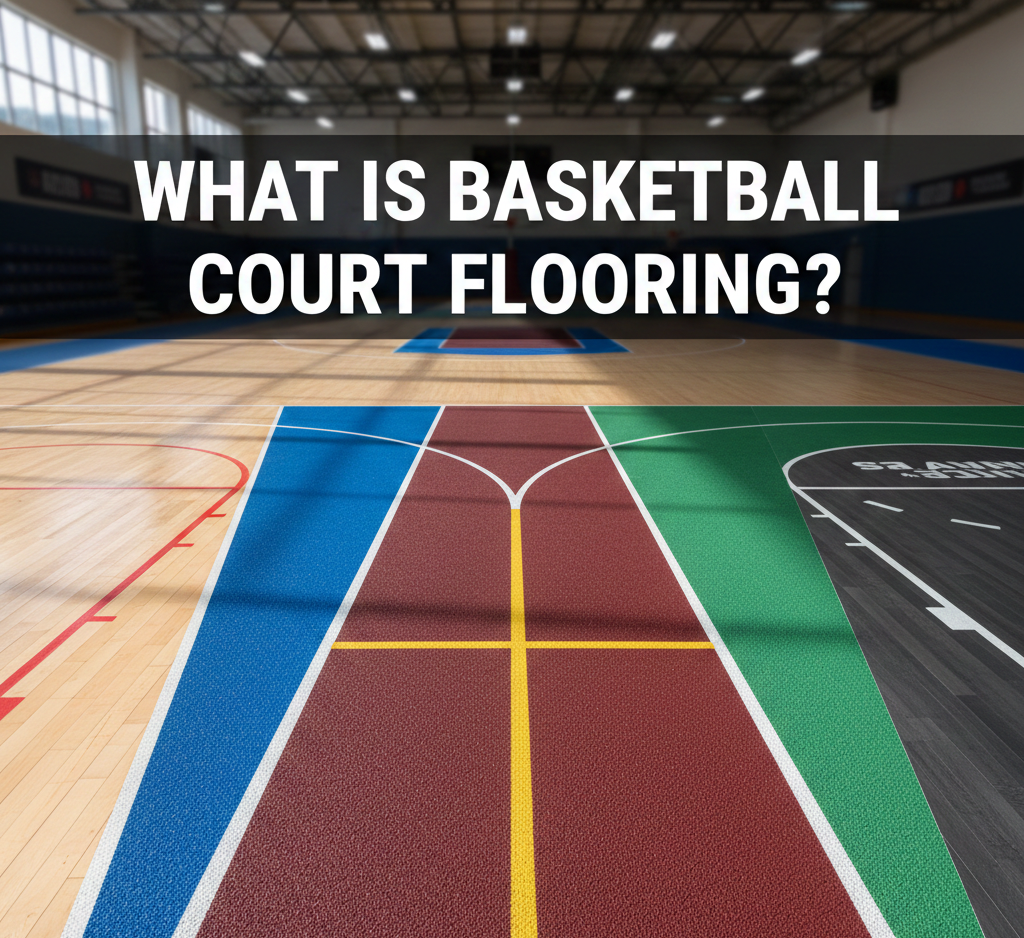
What Is Basketball Court Flooring?
Basketball court flooring refers to the specialized surface on which the sport is played. Unlike regular flooring, basketball flooring is engineered to offer:
-
High shock absorption
-
Perfect ball bounce
-
Slip resistance
-
Stability for player movement
-
Durability under heavy foot traffic
-
Aesthetically professional appearance
Basketball flooring must support the sport’s fast and intense nature. Players run at high speeds, make sharp cuts, jump frequently, and land with full body weight. A poor surface increases injury risks, reduces ball bounce consistency, and negatively affects player confidence. Therefore, basketball flooring is designed with customized materials and multi-layer construction to enhance safety and performance.
Types of Basketball Court Flooring
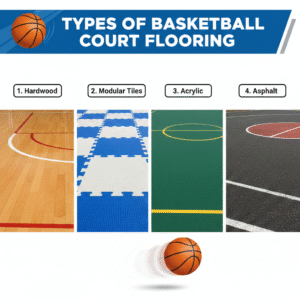
Basketball court flooring is available in multiple materials depending on whether the court is indoor or outdoor, the level of play, and the facility budget. Each type offers its own advantages.
1. Indoor Wooden Basketball Flooring
This is the most preferred and iconic flooring used in professional and international basketball arenas, including NBA courts.
Materials Used:
-
Hard Maple Wood (most common)
-
Beech or Oak (in some facilities)
Key Features:
-
Excellent shock absorption
-
Perfect, consistent ball bounce
-
Smooth but non-slippery surface
-
Long-lasting performance
Benefits:
-
Ideal for competitive tournaments
-
Provides professional-level play
-
Highly durable when maintained
Wooden courts usually have an elastic subfloor system that enhances cushioning and reduces the impact on the athlete’s joints.
2. Synthetic PVC / Vinyl Basketball Flooring
PVC or vinyl sports flooring is widely used for schools, colleges, gyms, clubs, and multi-purpose indoor courts. It is more affordable than hardwood yet delivers excellent performance.
Features:
-
Multi-layer construction with foam backing
-
Cushioning for comfortable footwork
-
Anti-slip surface
-
Impact-resistant
Benefits:
-
Easy to install
-
Low maintenance
-
Suitable for multi-sport activities
PVC basketball flooring is ideal for facilities that want performance without the high cost of hardwood.
3. Polyurethane (PU) Sports Flooring
PU sports flooring is a seamless, poured flooring system used in many indoor courts.
Features:
-
Seamless finish
-
High elasticity
-
Strong shock absorption
-
Long lifespan
Benefits:
-
Uniform playing surface
-
Hygienic and easy to clean
-
Resistant to wear and tear
PU flooring is often chosen for premium sports complexes and training centers.
4. Rubber Sports Flooring
Rubber flooring is commonly used in training areas and some indoor courts where multi-functional activity takes place.
Benefits:
-
High shock absorption
-
Slip resistance
-
Long-lasting
-
Suitable for heavy foot traffic
Though not the top choice for professional courts, it works well in recreation centers and workout areas.
5. Outdoor Acrylic Basketball Flooring
For outdoor basketball courts, acrylic flooring is the most popular option. It is installed on concrete and provides a durable, weather-resistant playing surface.
Features:
-
UV-resistant
-
Weatherproof
-
Anti-skid surface
Benefits:
-
Suitable for schools, parks, societies, and public courts
-
Affordable and long-lasting
Acrylic basketball flooring can be customized in multiple colors and provides good ball bounce for outdoor play.
6. Interlocking PP Tiles (Modular Tiles)
These tiles are designed for outdoor basketball courts and withstand rain, sun, and heavy usage.
Features:
-
Quick installation
-
Drainage design
-
UV and weather resistant
Benefits:
-
Can be repaired tile-by-tile
-
Portable and easy to maintain
Modular tiles are a great option for community courts, residential complexes, and sports academies.
Key Performance Features of Basketball Court Flooring
To support high-performance basketball gameplay, the flooring must meet certain technical standards.
1. Shock Absorption
A good basketball floor minimizes the impact on players’ knees, ankles, and hips. Hardwood, PU, and PVC floors often include cushioning layers that reduce injury risks.
2. Ball Bounce Consistency
Basketball requires predictable and accurate ball response. The flooring must offer:
-
Even bounce
-
Surface uniformity
-
Correct hardness level
This ensures smooth dribbling and responsive gameplay.
3. Slip Resistance
The surface should provide stability for:
-
Sudden directional changes
-
Fast lateral movements
-
High-speed sprints
Special coatings and textures improve grip and stop players from slipping.
4. Durability
Basketball courts receive continuous foot traffic and ball impact. Good flooring:
-
Resists wear
-
Stays smooth over time
-
Withstands scratches and pressure
Durability also reduces long-term maintenance costs.
5. Surface Comfort
Flooring must balance firmness and cushioning. Too hard causes injuries, and too soft reduces bounce quality. Professional-grade floors maintain an ideal comfort ratio for athletes.
Construction & Installation Overview
Building a basketball court involves a multi-step approach:
1. Base Preparation
All flooring types—wood, vinyl, PU, acrylic—require a properly leveled base. Concrete is most commonly used.
Base surface must be:
-
Level
-
Crack-free
-
Moisture-controlled
-
Smooth
A bad base will ruin even the best flooring.
2. Installation of Flooring System
Wooden courts:
-
Install elastic shock pads
-
Fix wooden battens
-
Install maple planks
-
Sand & polish
-
Apply polyurethane coating
PVC courts:
-
Roll and glue the flooring
-
Seal joints
-
Ensure bubble-free installation
Outdoor courts:
-
Apply acrylic coats or install PP tiles
-
Add anti-skid texture
-
Finish with weatherproof topcoat
3. Court Marking
Official basketball markings include:
-
Free-throw line
-
Three-point arc
-
Center circle
-
Key (paint area)
-
Sidelines & baselines
Markings are applied using PU or acrylic paint for long-term performance.
4. Finishing & Polishing
Finishing layers enhance:
-
Grip
-
Shine
-
Protection
-
Durability
Indoor courts often use polyurethane finishes, while outdoor courts use UV-resistant topcoats.
Benefits of High-Quality Basketball Court Flooring
Investing in a premium flooring system offers major advantages:
-
Enhanced player performance
-
Reduced injury risks
-
Suitable for high-intensity tournaments
-
Long-lasting with low maintenance
-
Professional and visually appealing appearance
-
Increased value of the sports facility
Good flooring not only improves the game experience but also attracts players, events, and academy enrollments.
Conclusion
Basketball court flooring is much more than a surface—it is the foundation of the entire game experience. Whether installed indoors or outdoors, the flooring plays a vital role in safety, performance, ball behavior, and comfort. With options like hardwood, PVC, PU, acrylic, and modular tiles, every facility can choose a system that matches its budget and purpose.
High-quality basketball flooring ensures consistent gameplay, long-term durability, and a professional sporting environment. Whether you’re building a training academy, sports complex, school court, or community playground, investing in the right flooring system guarantees superior performance and long-lasting value.
Frequently Asked Questions (FAQ)
What Is Basketball Court Flooring?
1. What is basketball court flooring?
Basketball court flooring refers to the specialized surface used for playing basketball. It is designed to provide proper ball bounce, player traction, shock absorption, and durability. The flooring material varies depending on whether the court is indoor or outdoor.
2. What material is used for indoor basketball court flooring?
Indoor basketball courts are typically made from hardwood, especially maple. Professional leagues like the National Basketball Association use high-quality maple wood because it offers excellent durability, smoothness, and consistent ball response.
3. Why is maple wood preferred for basketball courts?
Maple is dense and tightly grained, which makes it:
-
Strong and long-lasting
-
Resistant to splinters
-
Ideal for uniform ball bounce
-
Easy to sand and refinish
This makes it the top choice for professional and competitive play.
4. What is a sprung floor system in basketball courts?
A sprung floor system is a layered structure installed beneath the hardwood surface. It includes cushioning materials that absorb impact, reducing stress on players’ joints and lowering injury risk.
5. What flooring is used for outdoor basketball courts?
Outdoor courts are usually made from concrete or asphalt with acrylic coatings. These surfaces are weather-resistant and textured to provide grip, though they do not offer the same shock absorption as indoor wooden courts.
6. Are synthetic basketball floors available?
Yes. Synthetic sports flooring made from PVC or polyurethane is commonly used in schools, gyms, and multi-purpose sports halls. These surfaces are easier to maintain and can be more cost-effective than hardwood.
7. What are the main features of basketball court flooring?
Key features include:
-
Non-slip surface
-
Shock absorption
-
Consistent ball bounce
-
Durability
-
Clear court markings
Professional standards are often influenced by organizations such as FIBA.
8. How thick is basketball court flooring?
Hardwood planks are typically around 18–22 mm thick. When combined with a subfloor system, the total floor system can be significantly thicker to enhance cushioning and stability.
9. How is basketball court flooring maintained?
Maintenance includes:
-
Daily cleaning
-
Regular inspections
-
Periodic refinishing (for hardwood courts)
-
Repainting court lines when needed
Professional courts, especially those used in the National Basketball Association, are carefully maintained to ensure safety and performance.
10. Can basketball flooring be used for other sports?
Yes. Many gymnasium floors are multi-purpose and can support volleyball, badminton, and other indoor sports, provided they meet safety and performance standards.