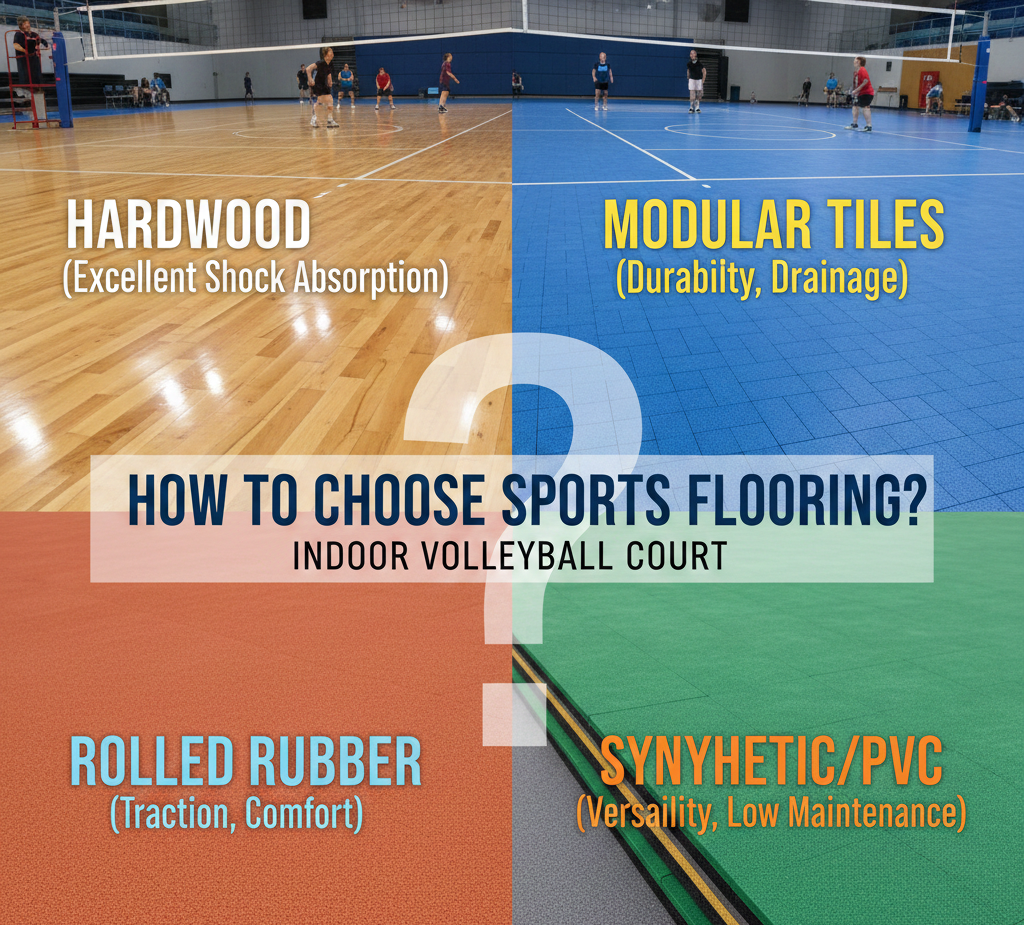
Choosing the right sports flooring for an indoor volleyball court is one of the most important decisions in court construction. The right surface doesn’t just enhance gameplay — it protects athletes from injury, improves performance, and ensures long-term durability for your facility.
Whether you’re designing a professional volleyball arena, a school sports hall, or a recreational training center, understanding what makes a great volleyball court floor is key to creating a safe and high-performing environment.
At Sports Facility India, we specialize in providing advanced indoor volleyball court flooring solutions that meet international standards and cater to diverse needs, budgets, and spaces.
🎯 Why the Right Flooring Matters
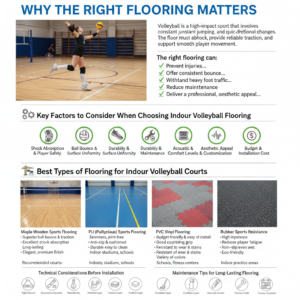
Volleyball is a high-impact sport that involves constant jumping, sliding, and quick directional changes. The floor must absorb shock, provide reliable traction, and support smooth player movement.
The right flooring can:
-
✅ Prevent injuries caused by hard or uneven surfaces
-
✅ Offer consistent bounce and traction
-
✅ Withstand heavy foot traffic and equipment movement
-
✅ Reduce maintenance and increase court lifespan
-
✅ Deliver a professional, aesthetic appeal to your indoor space
⚙️ Key Factors to Consider When Choosing Indoor Volleyball Flooring
When selecting flooring for your indoor volleyball court, several factors must be evaluated carefully. Let’s explore each in detail:
1. Shock Absorption & Player Safety
Player safety is always the top priority. The flooring must reduce impact stress on the knees, ankles, and spine during jumps and dives.
-
Wooden and PU floors are known for excellent shock absorption.
-
Look for flooring that meets EN 14904 standards (international standard for indoor sports floors).
-
A cushioning underlayer (rubber or foam) can enhance player comfort and reduce injury risks.
2. Ball Bounce & Surface Uniformity
Volleyball requires a surface with consistent bounce and minimal vibration. Uneven or hard floors can disrupt gameplay and reduce control.
-
Choose floors with smooth, seamless finishes and uniform elasticity.
-
Maple wood and PU sports flooring systems provide excellent rebound properties ideal for professional matches.
3. Slip Resistance & Grip
The surface should provide firm grip and traction for players to move swiftly without slipping.
-
Avoid overly glossy finishes that can become slippery with sweat.
-
Synthetic surfaces like PVC or PU come with anti-slip coatings for extra safety.
-
Wooden surfaces can be treated with special polish to maintain ideal friction levels.
4. Durability & Maintenance
Indoor volleyball courts are used daily for training, tournaments, and sometimes multi-sport activities. The flooring must be built to last.
-
Go for materials that are scratch, moisture, and impact-resistant.
-
PU synthetic flooring and engineered wood systems require minimal upkeep.
-
Regular cleaning and re-coating can further extend the floor’s lifespan.
5. Acoustic & Comfort Levels
Good indoor sports flooring reduces noise levels and provides a comfortable environment for players and spectators.
-
Cushioned PU floors absorb sound effectively and minimize echo.
-
Wooden floors with underlayment layers also improve acoustics.
6. Aesthetic Appeal & Customization
Your volleyball court’s look contributes to the experience. Branded or color-customized courts enhance the professional appeal.
-
Choose from multiple color options for surface coatings and game markings.
-
Add logos, branding, and border highlights to match your institution or team’s identity.
7. Budget & Installation Cost
Budget plays a major role in choosing the right flooring. While high-end maple wood offers unmatched performance, synthetic flooring is more affordable and easier to maintain.
Consider not just the installation cost, but also the long-term maintenance and replacement costs over time.
🏗️ Best Types of Flooring for Indoor Volleyball Courts
Let’s compare the top flooring options used for indoor volleyball courts across India and internationally.
1. Maple Wooden Sports Flooring
Maple wood is the gold standard for indoor volleyball courts. It’s used in professional and international tournaments due to its high performance and classic look.
Advantages:
-
Superior ball bounce and traction
-
Excellent shock absorption and player safety
-
Long-lasting with proper maintenance
-
Elegant, premium finish
Recommended For:
Professional courts, sports academies, and high-end facilities.
2. PU (Polyurethane) Sports Flooring
PU flooring is a seamless synthetic surface popular for both volleyball and multi-sport indoor courts. It combines performance with easy maintenance.
Advantages:
-
Seamless, joint-free finish
-
Anti-slip and cushioned surface
-
Available in multiple thickness levels
-
Durable and easy to clean
-
Water-resistant and low maintenance
Recommended For:
Indoor stadiums, schools, and sports clubs looking for a professional yet cost-effective option.
3. PVC Vinyl Flooring
PVC sports flooring offers a balance between affordability and comfort. It’s available in rolls or tiles and can be installed over a level base.
Advantages:
-
Budget-friendly and easy to install
-
Good cushioning and grip
-
Resistant to wear, stains, and moisture
-
Variety of colors and textures available
Recommended For:
Schools, fitness centers, and community halls with moderate usage.
4. Rubber Sports Flooring
Rubberized surfaces provide strong shock absorption and slip resistance, making them ideal for training and recreational play.
Advantages:
-
High impact resistance and comfort
-
Reduces player fatigue
-
Non-slip even when wet
-
Eco-friendly and recyclable
Recommended For:
Indoor practice areas, training facilities, and multi-purpose halls.
📐 Technical Considerations Before Installation
A successful flooring installation begins with proper preparation. Here’s what to ensure before beginning construction:
-
Base Surface Quality:
The subfloor must be smooth, level, and moisture-free. For wooden floors, a vapor barrier is recommended. -
Humidity Control:
Indoor humidity levels should remain stable to prevent expansion or contraction of flooring materials. -
Proper Line Markings:
Use FIVB-standard court dimensions (18m x 9m) and apply UV-resistant, anti-skid paint for game lines. -
Underlay Material:
Cushion underlays or foam layers beneath the main surface improve comfort and safety.
🧰 Maintenance Tips for Long-Lasting Flooring
Keeping your indoor volleyball court flooring in top condition ensures longer life and better play quality.
-
Clean regularly with a soft mop or vacuum.
-
Avoid using harsh chemicals or excess water.
-
Re-coat or polish the surface as needed (especially for wooden floors).
-
Inspect joints, lines, and base periodically for wear and tear.
-
Maintain stable indoor temperature and humidity.
With proper care, a good volleyball court surface can last 10–15 years or more.
🌟 Why Choose Sports Facility India?
At Sports Facility India, we bring years of expertise in indoor volleyball court construction and flooring installation across schools, colleges, stadiums, and sports complexes.
Our Strengths:
-
Expert consultation and site evaluation
-
Use of world-class certified materials
-
Professional installation and finishing
-
Custom design, branding & color options
-
Affordable pricing and nationwide service
We offer end-to-end solutions — from design and base preparation to flooring, line marking, and accessories installation.
🏆 Ideal Applications
-
Indoor Volleyball Arenas
-
School and College Gyms
-
Sports Academies and Coaching Centers
-
Multi-Purpose Sports Halls
-
Indoor Stadiums & Recreation Clubs
📞 Build the Perfect Indoor Volleyball Court with Us!
Ready to construct a professional-grade indoor volleyball court that meets safety and international standards?
At Sports Facility India, we help you choose and install the best flooring tailored to your space, usage, and budget.