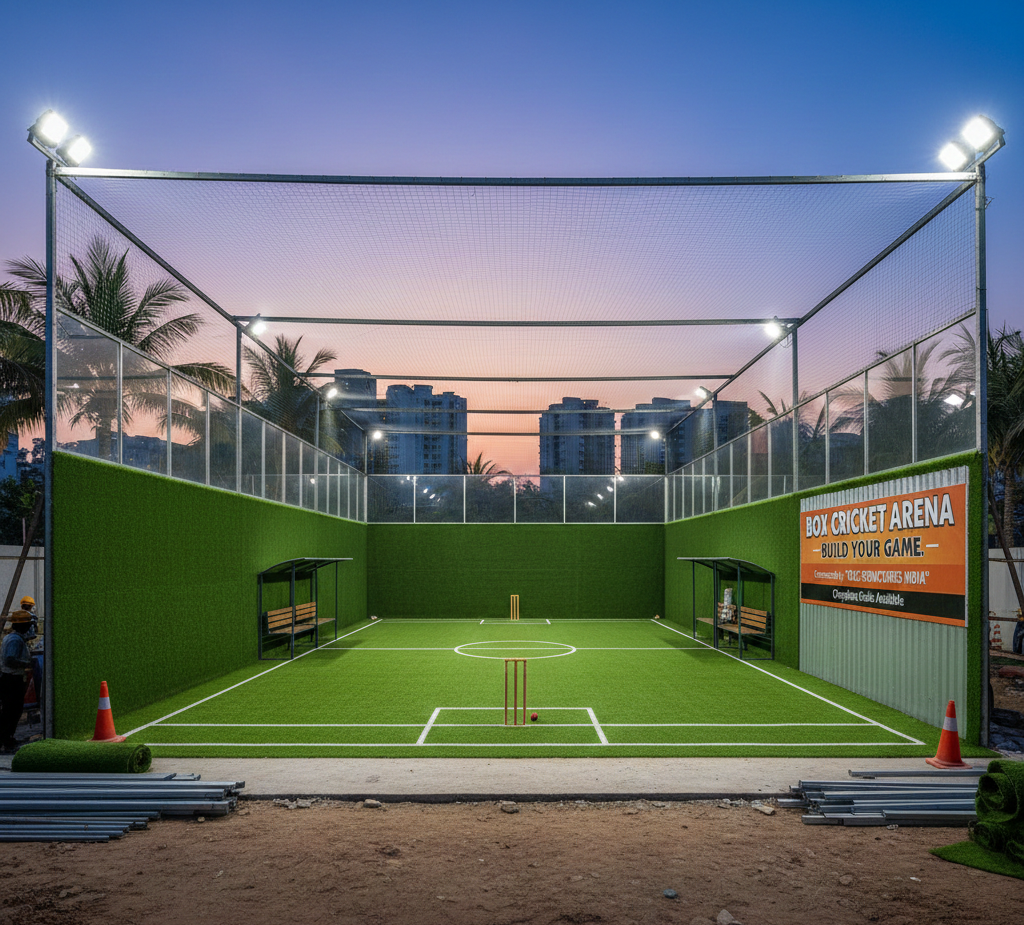
Box cricket has become one of India’s fastest-growing urban sports trends. Combining the excitement of traditional cricket with compact playing areas, box cricket is ideal for city life—where space is limited but enthusiasm is limitless. Whether it’s in residential complexes, schools, corporate campuses, or sports clubs, a well-designed box cricket court offers unmatched entertainment, fitness, and community engagement.
In this guide, we’ll explore everything involved in box cricket court construction—from planning and surface options to safety standards and maintenance. If you’re considering building a court, this article will help you understand the process, costs, and key design choices to ensure a premium playing experience.
What is a Box Cricket Court?
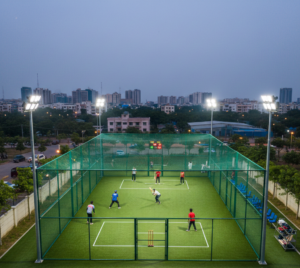
A box cricket court is a smaller, enclosed version of a cricket ground designed for fast-paced games with fewer players. The court is typically surrounded by high nets or fencing to keep the ball within the play area, ensuring uninterrupted gameplay and improved safety.
Unlike traditional cricket, box cricket focuses on short matches, quick scoring, and intense gameplay. It’s perfect for modern lifestyles, where people want sports entertainment without the time and space requirements of a full-size cricket ground.
Standard Dimensions
Box cricket courts are highly flexible in size, but typical dimensions include:
-
Court Length: 60–120 feet
-
Court Width: 30–60 feet
-
Pitch Length: 22 yards (20.12 meters)
-
Net Height: 15–20 feet
These measurements can be customized based on available space and the type of gameplay desired.
Why Box Cricket Courts Are Becoming Popular
There are several reasons why box cricket courts have become so popular in India:
1. Space Efficiency
Urban areas rarely have large open grounds. Box cricket courts maximize limited space while still delivering an intense cricket experience.
2. Faster Matches
Box cricket is designed for quick gameplay. With fewer players and shorter matches, it’s ideal for busy schedules.
3. Safety and Control
The enclosed design prevents the ball from going outside the court, minimizing injuries and property damage.
4. Community Engagement
A box cricket court becomes a social hub—bringing residents, students, and employees together for recreation and fitness.
Box Cricket Court Construction: The Complete Process
Building a box cricket court requires precision planning, skilled engineering, and high-quality materials. Here’s a step-by-step look at the construction process.
1. Site Evaluation & Planning
Before construction begins, a thorough site evaluation is essential. Engineers inspect:
-
Ground dimensions
-
Soil quality and compaction
-
Drainage patterns
-
Slope and leveling requirements
-
Surrounding structures and accessibility
Based on the evaluation, a detailed design is created with the right pitch orientation, net placement, and drainage system. A good layout ensures balanced gameplay and long-term court durability.
2. Base Preparation
A strong base is the foundation of any sports court. Base preparation includes:
-
Excavation of the surface area
-
Layering of soil, gravel, and stone dust
-
Compaction using heavy machinery
-
Ensuring proper slope for drainage
A solid base prevents surface cracks, waterlogging, and uneven play areas.
3. Surface Installation
The playing surface is the most critical element of a box cricket court. The right surface improves ball bounce, player comfort, and safety. Here are the most popular surface options:
A. Synthetic Turf Flooring (Best for Outdoor Courts)
Synthetic turf is the most popular choice for outdoor box cricket courts. It provides natural ball bounce and a comfortable playing feel.
Advantages:
-
Low maintenance
-
Durable in outdoor weather conditions
-
Provides natural grip and cushioning
-
Ideal for community and residential courts
Considerations:
-
Requires proper drainage underneath
-
Needs periodic cleaning to prevent dust buildup
B. Acrylic Flooring System (Best for Indoor Courts)
Acrylic flooring is a high-performance surface suitable for indoor box cricket courts. It offers shock absorption and smooth ball movement.
Advantages:
-
Excellent grip and shock absorption
-
Low maintenance
-
Long-lasting surface
-
Perfect for indoor sports complexes
Considerations:
-
Requires professional installation
-
Can be costlier than basic surfaces
C. PU (Polyurethane) Flooring (Premium Choice)
PU flooring is a seamless surface that offers superior cushioning and excellent grip. It is ideal for modern indoor arenas and multi-sport halls.
Advantages:
-
Seamless and smooth surface
-
Excellent shock absorption
-
High durability
-
Easy to clean and maintain
Considerations:
-
Higher initial cost
-
Requires skilled installation
D. Cement or Concrete Surface (Budget-Friendly Option)
Concrete surfaces are the most economical choice for box cricket courts. They provide a long-lasting and sturdy playing field.
Advantages:
-
Lowest cost option
-
Durable and long-lasting
-
Suitable for outdoor courts
Considerations:
-
Hard surface increases injury risk
-
Requires additional shock absorption systems
4. Net Enclosure & Fencing
The enclosure is what makes box cricket unique. A well-designed net system keeps the ball within the court and protects players and surroundings.
Key features of a good net enclosure:
-
Galvanized steel poles for strong support
-
UV-stabilized nylon or HDPE nets
-
High tensile strength to withstand impact
-
Proper net height (15–20 feet)
A strong enclosure ensures long-lasting durability and reduces maintenance costs.
5. Lighting & Accessories
To make the court match-ready, professional lighting and accessories are essential.
Common accessories include:
-
Floodlights for night play
-
Scoreboards
-
Seating benches
-
Boundary markings
-
Storage and equipment racks
Good lighting ensures safe play during evenings and enhances the overall court experience.
Why Choose Professional Box Cricket Construction?
A professionally built court ensures long-term performance, safety, and durability. Here’s why choosing a professional contractor matters:
End-to-End Solutions
From design and planning to construction and final setup, professional contractors manage the entire process.
High-Quality Materials
Using premium materials ensures long-term durability and performance.
Quick Installation
Experienced teams can complete projects within minimal timelines without compromising quality.
Custom Design
Courts can be customized to match space, budget, and player needs.
All-Weather Playability
Proper drainage and high-quality surfaces ensure the court remains playable in all seasons.
Maintenance Support
Professional contractors provide resurfacing, net replacement, and maintenance services.
Ideal Locations for Box Cricket Courts
Box cricket courts fit perfectly in:
-
Residential societies
-
Schools and colleges
-
Corporate parks
-
Sports academies
-
Resorts and clubs
These courts enhance community life, promote fitness, and provide recreational value.
Conclusion
Box cricket court construction is an investment that offers high returns in terms of community engagement, fitness, and entertainment. Whether you want a budget-friendly outdoor court or a premium indoor arena, choosing the right surface and design is crucial for performance and safety.
With the right planning and construction, your box cricket court can become a dynamic sports hub that attracts players of all ages and skill levels.
Frequently Asked Questions (FAQ)
🏏 Box Cricket Court Construction – India
1. What is box cricket court construction?
Box cricket court construction involves designing and building a compact, high-performance cricket court using specialized flooring, netting, lighting, drainage, and safety systems for urban play.
2. What are the key components of a box cricket court?
A typical box cricket court includes:
-
High-performance sports flooring (turf, acrylic, or modular tiles)
-
Boundary netting and fencing
-
LED floodlights
-
Drainage and waterproofing
-
Safety padding
-
Player benches and seating (optional)
3. What are the standard sizes of a box cricket court?
Common court sizes in India include:
-
20m x 10m
-
24m x 12m
-
30m x 15m
Court size can be customized depending on available space and intended use.
4. How long does it take to build a box cricket court?
Construction time usually ranges from 3 to 8 weeks, depending on site preparation, flooring type, weather conditions, and additional features like lighting and seating.
5. What is the cost of building a box cricket court in India?
Costs vary widely based on court size and materials. On average, construction may range from:
-
₹10 lakh to ₹40 lakh
Higher-end courts with premium flooring, lighting, and amenities can cost more.
6. Which flooring is best for box cricket courts?
Popular flooring options include:
-
Artificial turf (most common and comfortable)
-
Acrylic or PU surfaces (durable and low maintenance)
-
Rubber or interlocking tiles (good for multi-use courts)
7. Can box cricket courts be built indoors and outdoors?
Yes. Box cricket courts can be built in:
-
Indoor halls
-
Rooftops
-
Basements
-
Open grounds
-
Residential clubhouses
Each location may require different flooring and drainage solutions.
8. Is drainage important in court construction?
Yes. Proper drainage prevents waterlogging, reduces damage to the flooring, and ensures the court is safe to play on after rain.
9. Do box cricket courts need professional lighting?
Yes. Proper lighting is essential for evening play and improves visibility, safety, and court utilization. LED floodlights are commonly used for energy efficiency.
10. How do you ensure safety during construction?
Safety measures include:
-
Proper foundation and leveling
-
Non-slip flooring
-
Secure netting and fencing
-
Adequate padding on walls and boundaries
-
Safe electrical wiring for lights
11. Can box cricket courts be customized?
Yes. Courts can be customized in:
-
Size and layout
-
Surface type
-
Netting height and strength
-
Lighting intensity
-
Branding, logos, and color themes
12. What maintenance is required after construction?
Maintenance includes:
-
Regular cleaning and brushing of turf
-
Checking netting and fencing for wear
-
Lighting maintenance
-
Periodic replacement of worn turf or surface
-
Repair of drainage systems if needed
13. Do you provide warranty and after-sales support?
Most professional construction companies offer:
-
Warranty on flooring and installation
-
After-sales support for repairs and maintenance
-
Periodic inspection and service packages
14. Can box cricket courts be used for other sports?
Yes. With proper design, courts can be multi-use for:
-
Futsal
-
Basketball
-
Volleyball
-
Badminton
This helps maximize usage and revenue.