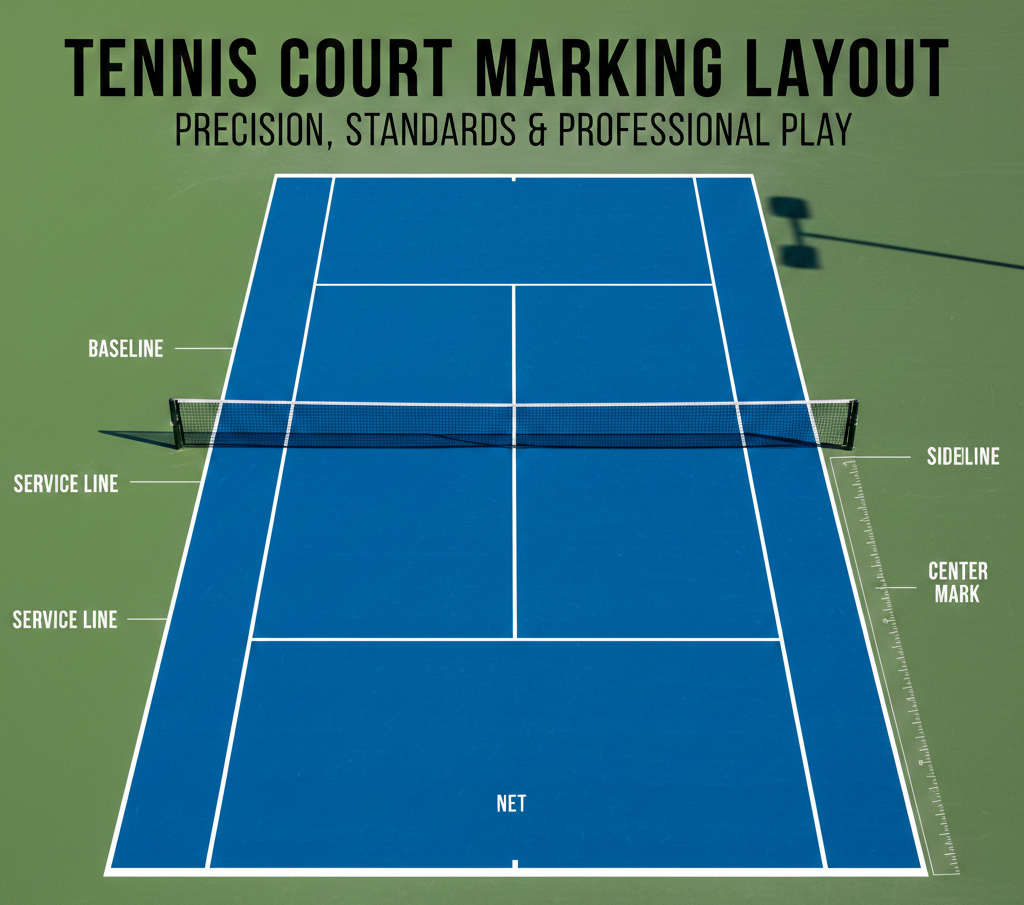
At [sports-facility.in], we specialize in designing and implementing accurate tennis court marking layouts that comply with International Tennis Federation (ITF) standards. Proper marking is essential for fair play, professional tournaments, coaching, and recreational matches, ensuring players can compete safely and confidently.
Whether for hard courts, clay courts, grass courts, PU courts, or modular tile courts, our marking services provide precision, durability, and clear visibility for all types of tennis facilities.
Importance of Tennis Court Markings
The marking layout defines the boundaries, service areas, and playable zones of a tennis court. Correct markings are crucial because they:
-
Ensure Fair Play: Accurate lines determine legal play and scoring.
-
Facilitate Professional Matches: ITF-compliant markings are mandatory for tournaments.
-
Enhance Player Safety: Clearly defined zones reduce risk of collisions and errors.
-
Support Coaching & Training: Helps in drills, serves, and tactical practice.
-
Improve Court Aesthetics: Well-marked lines enhance the visual appeal of the court.
Standard Tennis Court Marking Layout
A professional tennis court marking layout includes the following:
1. Baselines
-
The lines at the back of the court where rallies begin and end.
-
Full width of the court for singles (27 ft / 8.23 m) and doubles (36 ft / 10.97 m).
2. Sidelines
-
Define the side boundaries of the court for singles and doubles play.
-
Parallel to the net and extend from baseline to baseline.
3. Service Boxes
-
Two rectangles on each side of the net, divided by the center service line.
-
Players must serve the ball into the diagonally opposite service box.
4. Center Mark
-
A small line at the midpoint of each baseline.
-
Guides proper positioning and placement during service.
5. Net Line & Net Posts
-
Divides the court into two equal halves.
-
Net height: 3 ft (0.914 m) at the center, 3.5 ft (1.07 m) at posts.
6. Doubles Alley
-
4.5 ft (1.37 m) wide lanes along each side of the court.
-
Used exclusively in doubles matches to expand playable area.
Marking Specifications
-
Line Width: 2 inches (5.08 cm) for singles and doubles play.
-
Color: Typically white or yellow for maximum visibility.
-
Durability: Weather-resistant paint suitable for all court surfaces (hard, clay, grass, PU, or modular tiles).
-
Precision: Markings measured and applied according to ITF standards for tournament-grade courts.
Types of Tennis Court Surfaces We Mark
We provide marking layouts for all types of tennis courts:
-
Hard Court: Acrylic or cushioned surfaces for fast, consistent play.
-
Clay Court: Markings using white synthetic lines or removable tape for easy maintenance.
-
Grass Court: Painted lines or removable rope lines for flexibility.
-
PU / Cushioned Court: Durable acrylic paint over elastic surfaces for professional bounce.
-
Modular Tile Court: Pre-marked tiles or painted lines for quick and precise installation.
Benefits of Professional Tennis Court Marking
🎾 Enhanced Gameplay: Accurate lines ensure proper scoring and gameplay.
🦶 Player Safety: Well-defined zones minimize confusion and potential injuries.
🌦️ Weather-Resistant: Long-lasting markings withstand sun, rain, and heavy usage.
💧 Easy Maintenance: Painted or taped lines are simple to clean and maintain.
🏆 Tournament-Ready: Complies with ITF and professional standards for competitive events.
Applications of Tennis Court Marking Layouts
Professional marking layouts are applied to a wide range of facilities:
-
Sports Clubs and Tennis Academies
-
Schools, Colleges, and Universities
-
Private Residences and Villas
-
Resorts, Hotels, and Recreational Facilities
-
Corporate and Government Sports Complexes
-
Public Parks and Community Courts
Every marking layout is customized to court dimensions, surface type, and intended use, ensuring accurate and professional-grade results.
Why Choose [sports-facility.in]?
At [Your Company Name], we deliver tennis court marking layouts that are:
✅ ITF-compliant and professional-grade
✅ Durable, weather-resistant, and visually clear
✅ Accurate for all types of surfaces: hard, clay, grass, PU, and modular tiles
✅ Customizable in color, width, and design for branding or aesthetics
✅ Installed by skilled professionals with precision measurement
Our markings not only enhance gameplay and safety but also give your court a polished, tournament-ready appearance.
Professional Tennis Court Marking Services
Whether you are setting up a new tennis court or refurbishing an existing facility, our marking services ensure:
-
Accurate layout based on standard or customized dimensions
-
High-quality, durable paint or pre-marked materials
-
Compliance with professional or recreational standards
-
Complete installation, inspection, and maintenance support
📞 Contact us today for consultation, court evaluation, or a detailed quotation.
Let [sports-facility.in] provide precise, professional, and long-lasting tennis court markings that elevate your facility’s performance and aesthetics.
(FAQ) – Tennis Court Marking Layout
1. What is a tennis court marking layout?
A tennis court marking layout refers to the precise arrangement of all lines on a tennis court, including boundaries, service boxes, center service lines, baselines, and sidelines. These lines ensure the court meets official dimensions and rules for singles and doubles play.
2. What are the standard dimensions for a tennis court?
-
Overall court size: 78 ft (23.77 m) long × 27 ft (8.23 m) wide for singles, 36 ft (10.97 m) wide for doubles
-
Service line distance from net: 21 ft (6.40 m)
-
Net height: 3 ft (0.914 m) at center, 3.5 ft (1.07 m) at posts
-
Baseline to baseline distance: 78 ft (23.77 m)
Accurate marking ensures fair play according to ITF regulations.
3. What lines are included in a tennis court marking layout?
Key lines include:
-
Baselines: The back boundary lines for each end of the court
-
Sidelines: Outer boundaries for singles and doubles matches
-
Service lines: Parallel to the net, marking the service box
-
Center service line: Divides each service box into left and right sections
-
Center mark: A short line at the midpoint of each baseline for service positioning
4. Can the layout be customized?
Yes, courts can be customized for:
-
Recreational play vs. professional tournaments
-
Surface color combinations for aesthetics or branding
-
Logos or club markings on non-play areas
However, the actual dimensions of lines for play must comply with ITF standards for official use.
5. How is a tennis court marking layout done?
-
Measure the court accurately according to standard dimensions
-
Apply lines using paint, thermoplastic, or tape depending on surface type
-
Ensure straight, visible, and uniform line widths (usually 2 inches / 5 cm)
-
Allow curing/drying time if using paint before court usage
6. How often should court markings be refreshed?
-
Outdoor courts: Every 1–3 years depending on wear, weather exposure, and surface type
-
Indoor courts: Every 2–4 years or when lines start fading
Regular maintenance ensures lines are clearly visible and comply with official regulations.
7. What type of paint or material is used for tennis court markings?
-
Acrylic paint: Most common for synthetic, cushioned, and acrylic courts
-
Thermoplastic or tape: Sometimes used on modular or temporary courts
-
Clay courts: Lines are made of white synthetic tape or painted clay powder
8. Why is accuracy important in tennis court marking layout?
Accurate line placement ensures:
-
Fair play according to ITF rules
-
Proper measurement for singles and doubles matches
-
Consistent ball bounce and court playability
9. Can professionals install a tennis court marking layout?
Yes. Professional contractors provide:
-
Precise measurement and marking
-
Use of quality materials for long-lasting lines
-
Alignment with ITF standards for competitive play
-
Optional customization without compromising regulation dimensions
10. How much does it cost to mark a tennis court?
The cost varies based on:
-
Court size (singles or doubles)
-
Surface type (acrylic, cushioned, clay, synthetic)
-
Material used (paint, thermoplastic, or tape)
-
Contractor and labor charges
Routine repainting or refreshing lines is less expensive than full resurfacing.