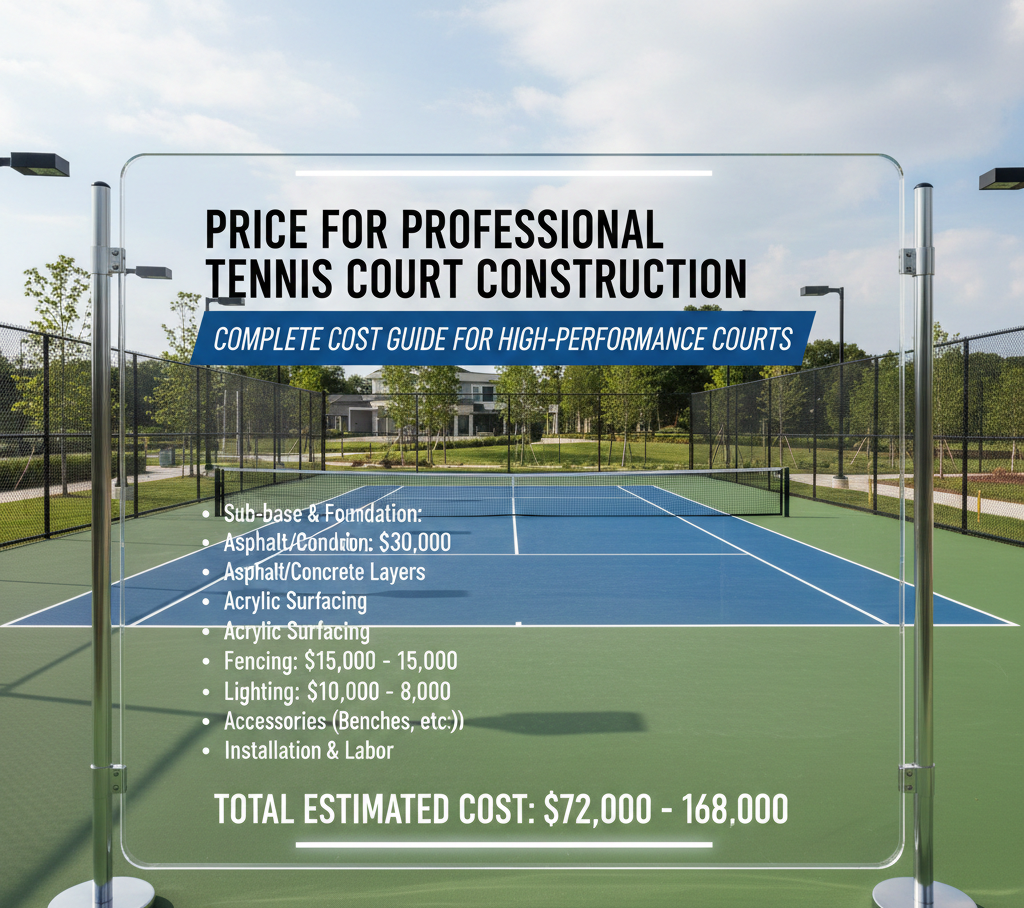
Constructing a professional tennis court is a strategic investment that combines engineering precision, premium materials, and expert execution. Whether the project is for a sports academy, school, club, resort, government facility, or private residence, understanding the price for professional tennis court construction is essential for effective planning and long-term success.
Tennis courts are performance-driven sports surfaces. The quality of construction directly affects ball bounce, player movement, safety, durability, and maintenance costs. While pricing can vary significantly depending on surface type and project requirements, investing in professional construction ensures compliance with international standards, superior playability, and extended lifespan.
This guide explains the complete cost structure of professional tennis court construction, the factors influencing pricing, and how to make an informed investment decision.
What Determines the Price for Professional Tennis Court Construction?
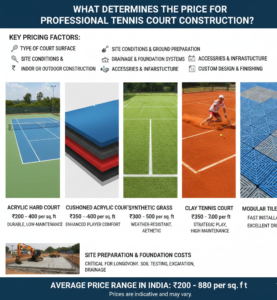
The total cost of constructing a professional tennis court depends on multiple technical and material-related factors. Unlike basic playgrounds, tennis courts require precise dimensions, engineered bases, advanced surfacing systems, and specialized installation techniques.
Key pricing factors include:
-
Type of court surface
-
Site conditions and ground preparation
-
Indoor or outdoor construction
-
Drainage and foundation systems
-
Accessories and infrastructure
-
Custom design and finishing
Each of these elements contributes to the final price and overall court performance.
Average Price Range for Professional Tennis Court Construction in India
The price for professional tennis court construction in India typically ranges between ₹200 and ₹800 per sq. ft., depending on surface type and project complexity.
A standard tennis court measures approximately 7,200–7,800 sq. ft., including run-off areas. Below is an estimated total cost range:
| Court Type | Approx. Cost per Sq. Ft. | Estimated Total Cost |
|---|---|---|
| Acrylic Hard Court | ₹200 – ₹400 | ₹15 – ₹30 lakh |
| Cushioned Acrylic Court | ₹350 – ₹600 | ₹25 – ₹45 lakh |
| Synthetic Grass Court | ₹300 – ₹500 | ₹22 – ₹38 lakh |
| Clay Tennis Court | ₹400 – ₹700 | ₹30 – ₹55 lakh |
| Modular Tile Court | ₹350 – ₹600 | ₹25 – ₹45 lakh |
Prices are indicative and may vary by location, material quality, and site conditions.
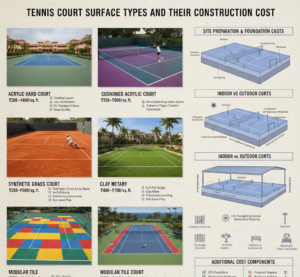
Tennis Court Surface Types and Their Construction Cost
1. Acrylic Hard Tennis Courts
Price Range: ₹200 – ₹400 per sq. ft.
Acrylic courts are the most widely used tennis surfaces worldwide. They are durable, low-maintenance, and suitable for both recreational and professional play.
Cost factors include:
-
Number of acrylic coating layers
-
Cushioning level
-
UV-resistant color systems
-
Base quality and leveling
Acrylic courts offer excellent value for money and are commonly used in schools, clubs, and sports academies.
2. Cushioned Acrylic Tennis Courts
Price Range: ₹350 – ₹600 per sq. ft.
Cushioned courts include multiple elastic layers beneath the acrylic surface to reduce impact on joints and muscles.
Higher pricing is due to:
-
Shock-absorbing rubber layers
-
Advanced resin systems
-
Enhanced player comfort
These courts are ideal for professional training centers and long-duration play environments.
3. Synthetic Grass Tennis Courts
Price Range: ₹300 – ₹500 per sq. ft.
Synthetic grass courts combine aesthetics with comfort and consistent play. They are weather-resistant and suitable for outdoor installations.
Cost depends on:
-
Turf pile height and density
-
Infill material
-
Sub-base preparation
They are commonly chosen for resorts, private properties, and recreational facilities.
4. Clay Tennis Courts
Price Range: ₹400 – ₹700 per sq. ft.
Clay courts are premium installations requiring specialized construction techniques and drainage systems.
Higher cost is due to:
-
Multi-layer stone and clay base
-
Precision leveling
-
Continuous moisture management
Clay courts are preferred for advanced training and strategic play but require regular maintenance.
5. Modular Tile Tennis Courts
Price Range: ₹350 – ₹600 per sq. ft.
Modular tile systems offer faster installation and excellent drainage. They are suitable for multi-sport environments and temporary or semi-permanent setups.
Pricing varies based on:
-
Tile quality and thickness
-
Locking system technology
-
UV and load resistance
Site Preparation and Foundation Costs
Base construction is one of the most critical and cost-influencing elements in professional tennis court construction.
Foundation work typically includes:
-
Soil testing and site analysis
-
Excavation and compaction
-
Concrete or asphalt base
-
Drainage slope engineering
A poorly constructed base leads to cracks, uneven bounce, and water stagnation. Professional builders allocate a significant portion of the budget to foundation work, which ensures surface longevity and performance.
Indoor vs. Outdoor Tennis Court Construction Cost
Outdoor Courts
Outdoor tennis courts generally have lower construction costs but require:
-
UV-resistant coatings
-
Weatherproof materials
-
Advanced drainage systems
Additional Cost Components
Several additional features influence the final price for professional tennis court construction:
-
Fencing and enclosures
-
LED floodlighting systems
-
Net posts and accessories
-
Spectator seating
-
Branding and color customization
While optional, these features enhance functionality, safety, and visual appeal.
Why Professional Tennis Court Builders Cost More—but Save Money
Professional tennis court builders may quote higher prices than local contractors, but the value they deliver justifies the investment:
-
Accurate ITF-compliant dimensions
-
Engineered slope and drainage
-
Premium materials with warranties
-
Reduced repair and resurfacing costs
-
Long-term structural stability
Cheaper construction often results in frequent repairs, surface failures, and poor playing experience, increasing total lifetime cost.
Maintenance Costs and Long-Term Value
Well-constructed tennis courts have lower maintenance expenses and longer resurfacing cycles.
Typical maintenance costs include:
-
Cleaning and inspection
-
Recoating every 4–6 years (acrylic)
-
Minor crack repairs
Choosing quality construction reduces downtime and preserves playing performance for years.
Budget Planning Tips for Tennis Court Projects
-
Define court usage (recreational or professional)
-
Select surface based on climate and intensity
-
Avoid compromising on base preparation
-
Include drainage and safety features upfront
-
Choose experienced professionals with proven expertise
Smart planning ensures optimal cost control without sacrificing quality.
Conclusion
The price for professional tennis court construction depends on surface type, site conditions, materials, and design complexity. While initial investment may vary, professionally built tennis courts deliver unmatched performance, safety, and durability.
Whether for competitive training, institutional use, or private recreation, investing in expert tennis court construction ensures long-term value, consistent playability, and a facility built to international standards—designed for the game and built for the future.
Professional Tennis Court Construction – FAQs
1. What is professional tennis court construction?
Professional tennis court construction involves designing, preparing, and building a high-quality tennis court that meets performance, safety, and durability standards. It includes:
-
Site preparation
-
Base construction (asphalt, concrete, or soil)
-
Surface installation (acrylic, cushioned acrylic, synthetic, or clay)
-
Line marking, fencing, and optional lighting
2. What types of tennis court surfaces can be built?
Professional tennis courts are typically built with:
-
Acrylic courts (outdoor & indoor, fast-dry, UV-resistant)
-
Cushioned acrylic courts (shock-absorbing layers for player comfort)
-
Synthetic or artificial grass courts (low maintenance, slower play)
-
Clay or artificial clay courts (preferred for slower, controlled gameplay)
-
PU or vinyl indoor courts (for multi-sport use and seamless finish)
3. What factors influence the cost of professional tennis court construction?
Key factors include:
-
Surface type and material quality
-
Site preparation (leveling, drainage, soil stabilization)
-
Base construction type (asphalt, concrete, or compacted soil)
-
Court size and layout
-
Fencing, lighting, and accessories
-
Geographic location and labor costs
4. What is the ideal base for a professional tennis court?
A strong base ensures durability and consistent performance:
-
Outdoor courts: Asphalt or concrete base with proper leveling and drainage
-
Indoor courts: Concrete or engineered base with moisture control
-
Proper sub-base preparation prevents cracks and surface irregularities
5. How long does tennis court construction take?
Construction timelines depend on:
-
Court type and surface
-
Site preparation requirements
-
Weather conditions (for outdoor courts)
Typical timelines:
-
Outdoor acrylic court: 4–8 weeks
-
Cushioned acrylic: 5–9 weeks
-
Clay or synthetic turf: 4–8 weeks
6. Can existing courts be renovated or resurfaced instead of rebuilt?
Yes. Many existing tennis courts can be:
-
Resurfaced with new acrylic or cushioned layers
-
Upgraded to modern shock-absorbing systems
-
Converted from clay to acrylic or synthetic surfaces
Renovation is generally more cost-effective than complete reconstruction.
7. What maintenance is required for professional tennis courts?
Maintenance depends on surface type:
-
Acrylic/cushioned courts: Sweep debris, hose down, occasional recoating
-
Clay courts: Regular rolling, leveling, watering
-
Synthetic turf: Brushing and debris removal
-
Proper maintenance extends court life and improves playability
8. Are professional tennis courts suitable for tournaments?
Yes. Professionally built courts meet international or national standards for:
-
Ball bounce
-
Court speed and traction
-
Player safety
-
Line markings
They can host club, league, or international competitions.
9. Is lighting included in professional tennis court construction?
Optional professional-grade lighting includes:
-
LED floodlights for even, glare-free illumination
-
Energy-efficient systems for night play
-
Correct lumen levels for tournament-quality visibility
10. Can professional tennis courts be customized?
Yes. Customization options include:
-
Court color and surface finish
-
Shock-absorbing layers for comfort
-
Line markings for multiple sports
-
Branding or logo integration
-
Fencing and spectator areas