Complete Guide to Tennis Court Construction, Design, Surfacing, Drainage, Lighting, and Cost
Tennis remains one of the most prestigious and widely played sports across the world. From recreational clubs and educational institutions to luxury residential developments and professional sports academies, the demand for high-quality tennis facilities continues to grow. However, constructing a tennis court involves far more than installing a playing surface. It requires careful planning, engineering expertise, premium materials, and strict adherence to international standards.
When you build a tennis court, every element—from site preparation and foundation design to surfacing systems, drainage infrastructure, fencing, and lighting—must work together to create a facility that delivers exceptional performance, player safety, and long-term durability. A professionally constructed tennis court enhances the playing experience, minimizes maintenance costs, and adds significant value to the property.
Whether you are planning a private court, a commercial sports facility, a school sports complex, or a tournament-level venue, understanding the complete tennis court construction process is essential. This comprehensive guide explores every aspect of building a tennis court that meets modern performance requirements while maintaining world-class quality standards.
Why Professional Tennis Court Construction Matters
A tennis court is a specialized sports facility designed to provide consistent ball bounce, optimal traction, and reliable playing conditions throughout its lifespan. Poor construction practices can result in uneven surfaces, drainage failures, structural cracks, and increased maintenance expenses.
Professional tennis court construction offers several advantages:
- Consistent ball performance
- Enhanced player safety
- Superior durability
- Reduced maintenance costs
- Improved aesthetics
- Better weather resistance
- Long-term investment value
- Compliance with international sports standards
A properly engineered court not only improves gameplay but also creates a professional environment suitable for training, competition, and recreational use.
Understanding Standard Tennis Court Dimensions
Before beginning construction, it is important to understand the official dimensions recognized by international tennis organizations.
Singles Court Dimensions
A standard singles tennis court measures:
- Length: 23.77 meters (78 feet)
- Width: 8.23 meters (27 feet)
Doubles Court Dimensions
A standard doubles court measures:
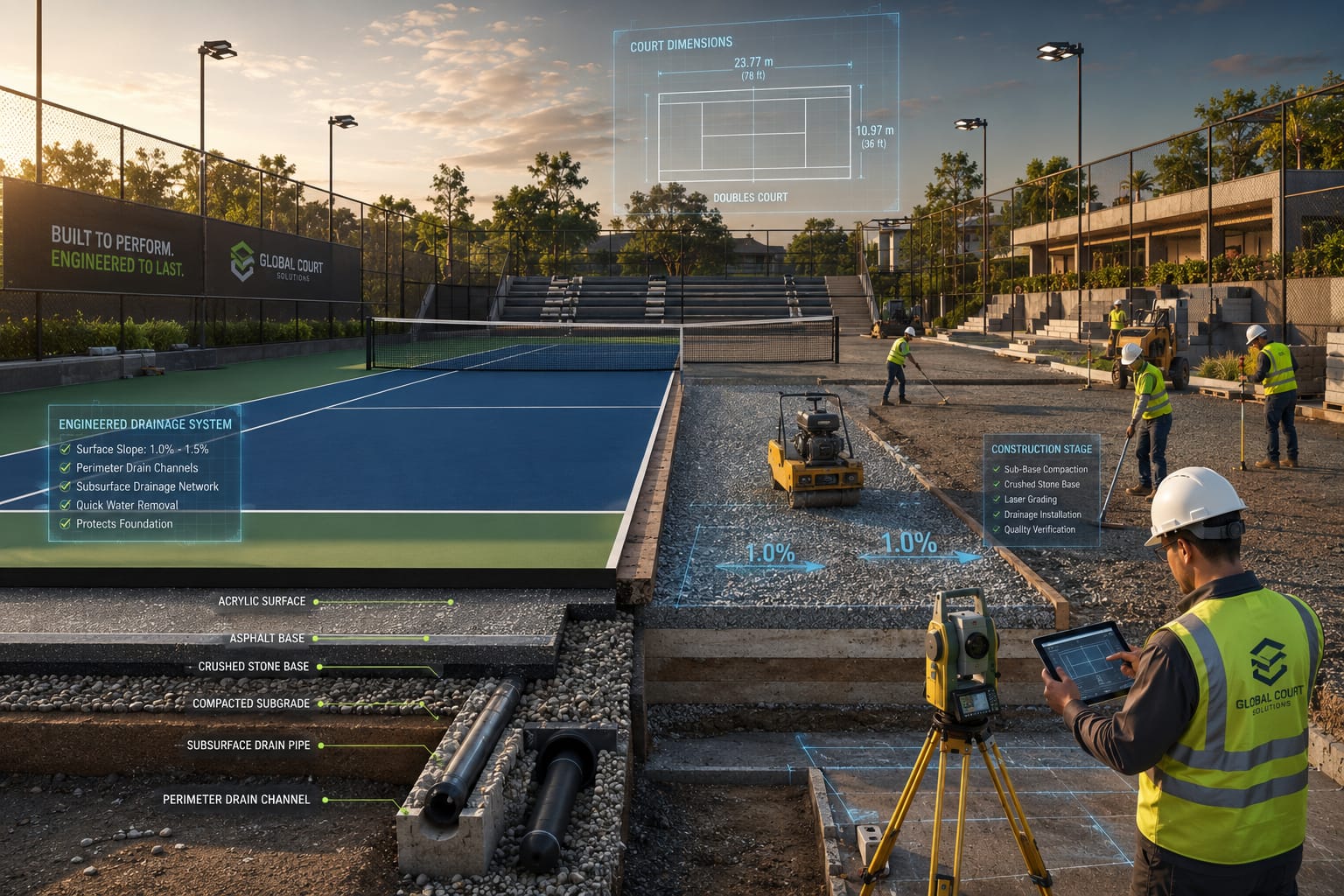
- Length: 23.77 meters (78 feet)
- Width: 10.97 meters (36 feet)
Recommended Total Playing Area
For comfortable movement and player safety, additional space should surround the court.
Recommended minimum court enclosure:
- Length: 36.6 meters
- Width: 18.3 meters
This includes run-off areas that allow players to move freely beyond the playing boundaries.
Choosing the Ideal Location to Build a Tennis Court
The success of any tennis court project begins with selecting the right site.
Several environmental and technical factors influence long-term court performance.
Important Site Selection Considerations
Before construction begins, professionals evaluate:
- Soil stability
- Surface drainage conditions
- Groundwater levels
- Accessibility
- Sun orientation
- Wind exposure
- Available utility connections
- Future expansion opportunities
A properly selected site reduces future maintenance requirements and helps maintain surface integrity for many years.
Site Survey and Ground Investigation
Comprehensive site analysis is one of the most critical stages when planning to build a tennis court.
Professional engineers conduct detailed assessments to determine:
Soil Conditions
Testing identifies:
- Soil composition
- Bearing capacity
- Compaction requirements
- Moisture content
Topographic Analysis
Surveying helps determine:
- Existing elevations
- Natural drainage patterns
- Required grading adjustments
Drainage Assessment
Proper drainage planning prevents:
- Water accumulation
- Surface deterioration
- Foundation instability
Accurate site investigations provide the technical data necessary for successful construction.
Tennis Court Foundation Construction
The foundation serves as the structural backbone of the entire court system.
Without a stable base, even the highest-quality surfacing materials can fail prematurely.
Excavation and Earthwork
The process begins with:
- Vegetation removal
- Site clearing
- Excavation
- Subgrade preparation
Unsuitable materials are removed and replaced with engineered fill where necessary.
Soil Compaction
Mechanical compaction ensures:
- Uniform density
- Structural stability
- Reduced settlement risks
- Improved load distribution
Compaction quality directly affects long-term court performance.
Base Layer Installation
Most professional tennis courts utilize:
- Crushed stone sub-base
- Aggregate foundation layers
- Asphalt or reinforced concrete base
These components create a stable platform for surface installation.
Types of Tennis Courts
Different surface systems create unique playing characteristics. Selecting the right surface is one of the most important decisions when building a tennis court.
Hard Tennis Courts
Hard courts are among the most popular tennis court systems worldwide.
They are commonly used in:
- Sports academies
- Schools
- Tennis clubs
- Residential communities
- Professional training centers
Construction System
Hard courts typically consist of:
- Compacted sub-base
- Asphalt or concrete foundation
- Acrylic surface coatings
Advantages
- Consistent ball bounce
- High durability
- Low maintenance
- Excellent weather resistance
- Suitable for competitive play
Hard courts are widely used in professional tournaments due to their reliable playing characteristics.
Acrylic Tennis Courts
Acrylic sports flooring is one of the most widely installed tennis court surfaces globally.
Benefits
- UV resistance
- Anti-slip properties
- Color customization
- Excellent durability
- Reduced maintenance requirements
Acrylic systems provide predictable ball behavior and are ideal for outdoor sports facilities.
Synthetic Tennis Courts
Synthetic surfaces are designed to improve comfort and reduce physical stress on players.
Key Features
- Enhanced shock absorption
- Consistent surface performance
- Weather resistance
- Reduced joint impact
- Long service life
These courts are particularly suitable for high-usage facilities.
Clay Tennis Courts
Clay courts offer a unique style of play focused on endurance, strategy, and extended rallies.
Characteristics
- Slower ball speed
- Higher bounce
- Reduced joint impact
- Excellent sliding control
Construction Requirements
Professional clay courts require:
- Specialized drainage systems
- Precision grading
- Premium clay materials
- Regular maintenance programs
Clay surfaces remain popular among competitive players seeking a more tactical game experience.
Grass Tennis Courts
Grass courts are regarded as one of the most prestigious playing surfaces in the sport.
Benefits
- Fast gameplay
- Low ball bounce
- Premium appearance
- Traditional tennis experience
Construction Challenges
Grass courts require:
- Specialized turf selection
- Advanced irrigation systems
- Precision grading
- Intensive maintenance
These courts are often found in private clubs, luxury properties, and elite sports facilities.
Tennis Court Surfacing Process
Surface installation is one of the most critical stages in court construction.
Each surface system follows specific engineering procedures to ensure durability and performance.
Step 1: Base Preparation
The structural base is inspected for:
- Level accuracy
- Slope consistency
- Surface stability
Step 2: Surface Application
Depending on the chosen court type, contractors install:
- Acrylic coating systems
- Synthetic surfacing materials
- Clay layers
- Natural grass systems
Step 3: Texture and Cushion Layers
Additional layers may provide:
- Shock absorption
- Slip resistance
- Enhanced player comfort
Step 4: Color Finishing
Professional-grade coatings create:
- Uniform appearance
- UV protection
- Long-lasting color retention
Step 5: Court Line Marking
Court markings are applied according to international regulations using durable sports-grade paints.
Tennis Court Drainage Design
Proper drainage is essential for preserving court performance and longevity.
Water infiltration can cause:
- Surface damage
- Structural movement
- Cracking
- Premature wear
Effective Drainage Solutions
Professional tennis court drainage systems include:
- Surface slopes
- Perimeter drains
- Underground drainage networks
- Water collection channels
A well-designed drainage system allows courts to remain playable after rainfall while protecting the underlying structure.
Tennis Court Fencing Systems
Fencing plays an important role in functionality and safety.
Benefits of Tennis Court Fencing
- Prevents ball loss
- Enhances security
- Defines court boundaries
- Improves spectator safety
Most facilities utilize galvanized or powder-coated chain-link fencing for long-term durability.
Tennis Court Lighting Design
Modern tennis facilities often require evening and night-time usability.
Professional sports lighting ensures consistent visibility across the entire court.
Advantages of LED Tennis Court Lighting
- Energy efficiency
- Uniform illumination
- Reduced glare
- Long operational lifespan
- Lower maintenance costs
Lighting systems should be designed to meet recreational, training, or tournament standards depending on the facility’s intended use.
Additional Tennis Court Amenities
Many facilities enhance the player experience through complementary infrastructure.
Popular additions include:
- Spectator seating
- Player benches
- Shade structures
- Scoreboards
- Umpire chairs
- Equipment storage rooms
- Landscaped surroundings
These features improve functionality and create a professional sports environment.
Tennis Court Maintenance Requirements
Proper maintenance protects the investment and ensures consistent playing conditions.
Hard Court Maintenance
Recommended activities include:
- Surface cleaning
- Debris removal
- Crack inspections
- Periodic resurfacing
Clay Court Maintenance
Clay surfaces require:
- Daily brushing
- Watering
- Surface leveling
- Regular rolling
Grass Court Maintenance
Grass courts need:
- Frequent mowing
- Irrigation management
- Fertilization
- Turf repair
Routine maintenance significantly extends court lifespan and preserves performance quality.
Estimated Cost to Build a Tennis Court
Construction costs vary based on location, materials, court type, and additional infrastructure.
Approximate Tennis Court Construction Costs in India
Acrylic Tennis Court
₹15 lakh – ₹30 lakh
Synthetic Tennis Court
₹18 lakh – ₹35 lakh
Clay Tennis Court
₹20 lakh – ₹40 lakh
Premium Grass Tennis Court
₹25 lakh – ₹50 lakh+
Additional investments may include:
- Lighting systems
- Fencing
- Seating areas
- Landscaping
- Clubhouse integration
- Water management infrastructure
A detailed site assessment provides the most accurate project estimate.
Choosing the Right Tennis Court Construction Company
The success of your project depends heavily on selecting experienced professionals.
What to Look For
Choose a contractor that offers:
- Proven sports infrastructure expertise
- Strong project portfolio
- Certified construction teams
- Premium materials
- International standards compliance
- Warranty support
- End-to-end project management
An experienced company ensures every stage of construction meets technical and performance requirements.
Benefits of Building a Professional Tennis Court
A professionally constructed tennis court provides long-term advantages for both owners and players.
Enhanced Playing Experience
Premium surfaces deliver:
- Reliable ball bounce
- Consistent traction
- Improved movement
Improved Player Safety
Modern sports flooring reduces:
- Joint strain
- Slip hazards
- Impact injuries
Increased Property Value
A tennis court enhances:
- Residential developments
- Sports academies
- Clubs and resorts
- Educational institutions
Revenue Generation Opportunities
Commercial facilities can generate income through:
- Coaching programs
- Memberships
- Court rentals
- Tournament hosting
- Sports events
Conclusion
Building a tennis court requires a combination of technical expertise, professional planning, precision engineering, and high-quality materials. From site selection and foundation preparation to surfacing, drainage, fencing, lighting, and maintenance planning, every detail contributes to the overall success of the facility.
Whether you are developing a private residential court, a sports academy, a luxury club, or a professional tournament venue, investing in expert tennis court construction ensures superior performance, enhanced safety, and long-term durability. A professionally built tennis court not only creates an outstanding playing environment but also adds significant value to the property and supports the growth of tennis for years to come.
Frequently Asked Questions (FAQs)
1. What is the standard size of a tennis court?
A doubles court measures 23.77m × 10.97m, while a singles court measures 23.77m × 8.23m.
2. How much does it cost to build a tennis court?
Depending on the surface and infrastructure requirements, costs generally range from ₹15 lakh to ₹50 lakh or more.
3. Which tennis court surface is most popular?
Acrylic hard courts are among the most widely used due to their durability, performance, and low maintenance.
4. How long does tennis court construction take?
Most projects require approximately 30–60 days, depending on site conditions and surface selection.
5. Can a tennis court be constructed indoors?
Yes. Indoor tennis courts are widely used for year-round play and require specialized flooring, lighting, and structural design.
6. Why is drainage important in tennis court construction?
Proper drainage prevents water damage, improves longevity, and maintains consistent playing conditions.
7. What type of fencing is recommended?
Galvanized or powder-coated chain-link fencing is commonly used for durability and security.
8. How often should a tennis court be resurfaced?
Most acrylic hard courts require resurfacing every 5–8 years, depending on usage levels.
9. Can existing land be converted into a tennis court?
Yes. Open plots, school grounds, and recreational areas can often be transformed into professional tennis facilities.
10. Is a tennis court a good investment?
Absolutely. Tennis courts increase property value, support recreational activities, and can generate revenue through rentals, memberships, and events.