Introduction
When planning a badminton court—whether for a school, sports academy, club, or private facility—the choice of surface material plays a decisive role in the court’s success. Beyond layout and markings, durability is the factor that determines how long the court performs safely, consistently, and cost-effectively.
A badminton court experiences continuous foot movement, sudden direction changes, jumps, and repeated impact. If the flooring material is not durable, it can wear out quickly, become slippery, or lose shock absorption—leading to injuries and frequent repairs. Selecting the right badminton court material ensures optimal playing conditions, reduced maintenance costs, and long-term value for your investment.
This detailed guide explains the most durable badminton court materials, their performance characteristics, lifespan, advantages, and complete cost and budget insights to help you make an informed, future-proof decision.
Why Durability Matters in Badminton Court Flooring
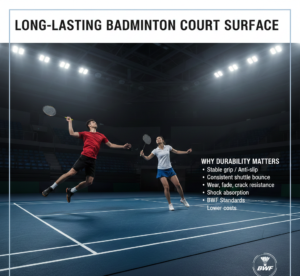
Badminton is a fast-paced sport that demands agility, balance, and speed. The flooring must support these movements while protecting players from strain and impact injuries. Durability in badminton court material means the surface can withstand years of intensive use without losing performance quality.
A long-lasting badminton court surface offers:
-
Stable grip and anti-slip performance
-
Consistent shuttle bounce and foot response
-
Resistance to wear, fading, and cracking
-
Reliable shock absorption for joint safety
-
Compliance with BWF (Badminton World Federation) standards
-
Lower long-term maintenance and replacement costs
Choosing a durable surface at the planning stage prevents costly renovations and ensures uninterrupted play for many years.
Key Factors That Influence Durability
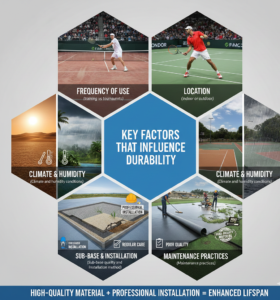
Before selecting a material, it is important to understand what affects durability:
-
Frequency of use (training vs tournaments)
-
Indoor or outdoor location
-
Climate and humidity conditions
-
Sub-base quality and installation method
-
Maintenance practices
A high-quality material combined with professional installation significantly enhances the court’s lifespan.
Most Durable Badminton Court Materials
Different environments and budgets require different flooring solutions. Below are the most trusted and durable materials used in badminton court construction.
1. Wooden Sports Flooring (Maple, Teak, or Beech)
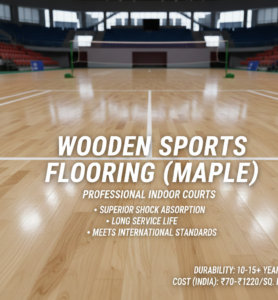
Best suited for: Professional indoor courts, academies, international tournaments
Overview:
Wooden sports flooring is widely regarded as the gold standard for indoor badminton courts. Made from high-quality hardwood such as maple or teak, this flooring system is installed over a shock-absorbing substructure with air cushions or elastic pads.
The natural elasticity of wood provides excellent energy return, comfort, and player safety, making it the preferred choice for professional play.
Durability:
10–15 years or more with proper maintenance
Maintenance Requirements:
Regular polishing, moisture control, and periodic refinishing
Approximate Cost (India):
₹700 – ₹1,200 per sq. ft.
Advantages:
-
Superior shock absorption
-
Professional appearance and feel
-
Long service life
-
Meets international competition standards
2. Synthetic Vinyl Sports Flooring
Best suited for: Schools, colleges, training centers, community halls
Overview:
Vinyl badminton flooring is a popular alternative to wood due to its affordability and durability. It consists of multiple layers, including a wear-resistant top layer, fiberglass reinforcement, and cushioned foam backing.
Available in roll or tile form, vinyl flooring offers reliable grip, comfort, and ease of installation, making it ideal for both permanent and temporary courts.
Durability:
7–10 years depending on usage intensity
Maintenance Requirements:
Simple cleaning with minimal upkeep
Approximate Cost (India):
₹250 – ₹450 per sq. ft.
Advantages:
-
Cost-effective and durable
-
Slip-resistant surface
-
Easy installation and replacement
-
Suitable for multi-sport use
3. Polyurethane (PU) Sports Flooring
Best suited for: Commercial indoor stadiums and multi-sport complexes
Overview:
PU sports flooring is a seamless, liquid-applied system known for its excellent elasticity and uniform performance. It creates a smooth, joint-free surface that enhances comfort and durability while reducing the risk of surface damage.
PU flooring is resistant to abrasion, moisture, and chemicals, making it suitable for high-traffic badminton facilities.
Durability:
8–12 years
Maintenance Requirements:
Routine cleaning and occasional recoating
Approximate Cost (India):
₹350 – ₹600 per sq. ft.
Advantages:
-
Seamless and aesthetically appealing
-
Excellent shock absorption
-
High durability under heavy usage
-
Easy to maintain
4. Acrylic Sports Flooring
Best suited for: Outdoor badminton courts and all-weather facilities
Overview:
Acrylic flooring systems are designed specifically for outdoor sports surfaces. These multi-layer coatings provide UV resistance, weather protection, and slip resistance.
While acrylic surfaces offer less cushioning compared to indoor systems, they are highly durable against sunlight, rain, and temperature variations.
Durability:
5–8 years
Maintenance Requirements:
Periodic cleaning and repainting
Approximate Cost (India):
₹150 – ₹300 per sq. ft.
Advantages:
-
Weatherproof and UV-stable
-
Affordable outdoor solution
-
Non-slip surface
-
Custom color options
5. Rubber Sports Flooring
Best suited for: Training areas, gyms, recreational courts
Overview:
Rubber flooring is made from natural or recycled rubber and provides excellent shock absorption and slip resistance. It is commonly used in gyms and training zones where comfort and durability are priorities.
Although not ideal for professional tournaments, rubber flooring performs well in practice and recreational badminton settings.
Durability:
8–10 years
Maintenance Requirements:
Easy cleaning with mild detergents
Approximate Cost (India):
₹250 – ₹500 per sq. ft.
Advantages:
-
High impact resistance
-
Comfortable and noise-reducing
-
Eco-friendly options available
-
Long-lasting and safe
Cost Factors in Badminton Court Construction
Several elements influence the total project cost:
-
Material type and thickness
-
Court size (standard court: 13.4m × 6.1m)
-
Sub-base preparation and leveling
-
Installation expertise and labor charges
-
Accessories (net posts, markings, padding)
-
Location and logistics costs
A well-prepared base is essential to maximize the durability of any surface material.
Average Cost Comparison (India)
| Flooring Type | Cost Range (₹ / sq. ft.) | Suitable Use |
|---|---|---|
| Wooden Flooring | 700 – 1,200 | Professional indoor courts |
| Vinyl Flooring | 250 – 450 | Schools & multipurpose halls |
| PU Flooring | 350 – 600 | Commercial stadiums |
| Acrylic Flooring | 150 – 300 | Outdoor courts |
| Rubber Flooring | 250 – 500 | Training & gym areas |
Estimated Total Project Cost
-
Indoor Badminton Court: ₹6 lakh – ₹12 lakh
-
Outdoor Badminton Court: ₹3 lakh – ₹7 lakh
(Prices vary based on material quality, region, and finish level.)
Tips for Selecting the Right Badminton Court Material
-
Choose wooden or PU flooring for professional and competitive play
-
Opt for vinyl or rubber if budget and versatility are priorities
-
Use acrylic systems for outdoor and weather-exposed courts
-
Ensure materials meet slip resistance and shock absorption standards
-
Always hire experienced installers for maximum durability
Conclusion
Selecting a durable badminton court material is a long-term investment in safety, performance, and financial efficiency. The right surface enhances player confidence, reduces injury risk, and minimizes maintenance costs over time.
Whether you are building a professional indoor arena, a school court, or an outdoor sports facility, prioritizing durability ensures your badminton court remains functional, safe, and visually appealing for years to come.