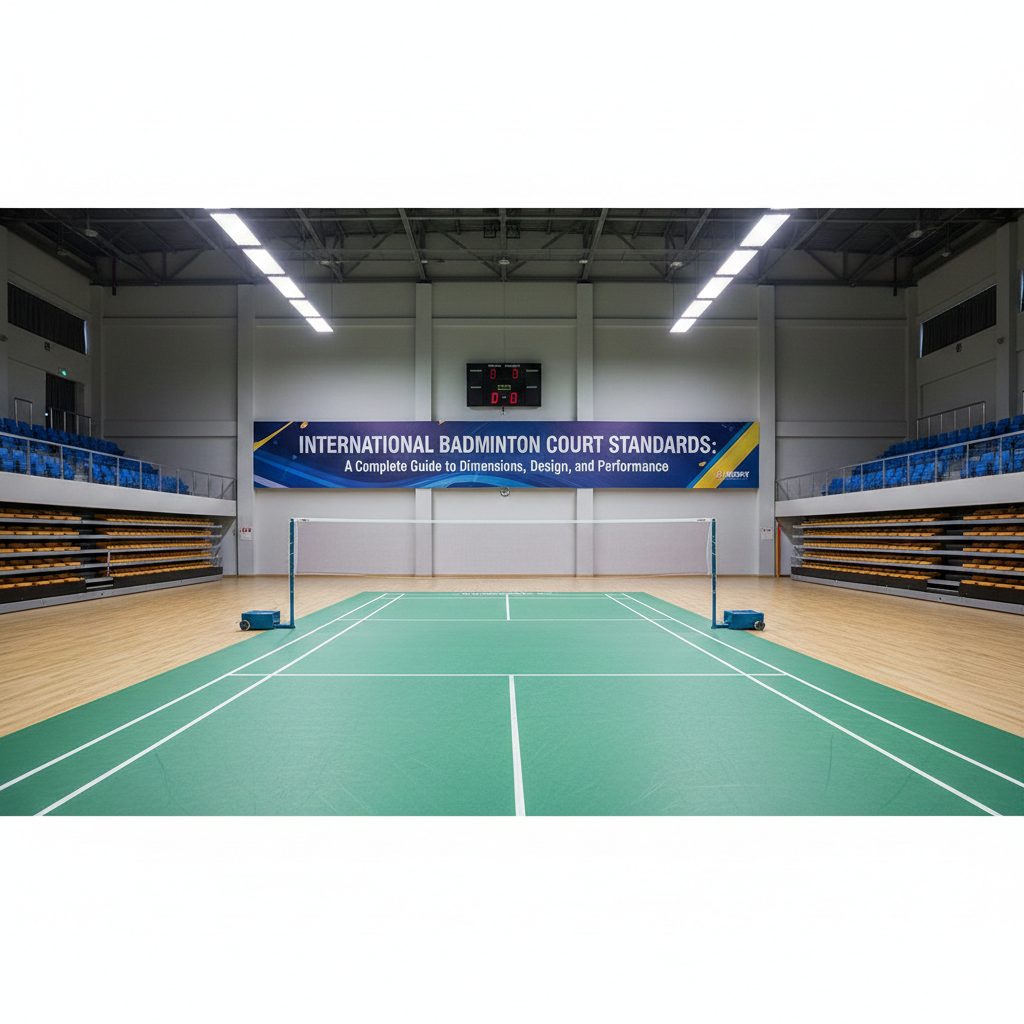
Badminton is one of the most widely played indoor sports across the globe, celebrated for its speed, agility, and technical precision. Whether played recreationally or at an elite competitive level, badminton demands accuracy—not only from the players but also from the court itself. To ensure fairness, safety, and consistency worldwide, the Badminton World Federation (BWF) has established strict international badminton court standards.
These standards govern everything from court dimensions and net height to flooring, lighting, and safety clearances. Understanding and following these international guidelines is essential for players, coaches, architects, sports facility managers, and institutions planning to build or upgrade badminton courts. This blog provides a comprehensive overview of international badminton court standards and explains why each specification matters.
Importance of International Badminton Court Standards
Standardized badminton court specifications ensure uniform playing conditions regardless of location. When courts follow international standards, players can rely on consistent spacing, shot angles, movement patterns, and service rules. This consistency is crucial for professional tournaments, training academies, and even grassroots development.
Deviation from official standards can negatively affect gameplay, increase injury risks, and disqualify courts from hosting sanctioned tournaments. International standards also help maintain fairness, allowing athletes to compete on equal footing anywhere in the world.
Standard Badminton Court Dimensions
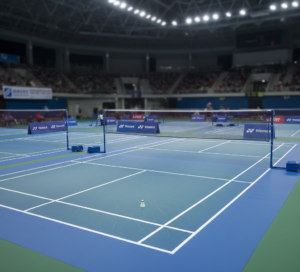
According to BWF regulations, a badminton court is rectangular and divided into two equal halves by a net. While the length remains the same for both singles and doubles, the width varies.
Official Court Measurements
-
Court Length: 13.40 meters (44 feet)
-
Court Width (Doubles): 6.10 meters (20 feet)
-
Court Width (Singles): 5.18 meters (17 feet)
The singles court is narrower, with the doubles sidelines acting as out-of-bounds for singles play.
Line Width and Markings
All court lines must be 40 mm wide and clearly visible. White or yellow is commonly used to ensure strong contrast with the flooring. Lines are considered part of the playing area, meaning a shuttle landing on a line is “in.”
Service Court Specifications
Service courts are crucial to badminton rules and gameplay, particularly during serves.
Each side of the court is divided by:
-
A center line
-
A short service line
-
A long service line
For doubles, the long service line is positioned closer to the net than in singles, creating different service boundaries. Accurate marking of service courts is essential to prevent faults and ensure compliance with service rules.
Net and Post Standards
The badminton net is a defining feature of the court and must meet strict international requirements.
Net Height
-
1.55 meters at the posts
-
1.524 meters at the center
The slight dip at the center ensures uniformity across courts worldwide.
Net Construction
-
Made of fine, dark-colored cord
-
Mesh size small enough to prevent the shuttle from passing through
-
The top of the net must be bound with a white tape, approximately 75 mm wide
Posts Placement
Net posts must be placed directly on the doubles sidelines, even for singles matches. Posts should be stable and vertical to maintain correct net height throughout play.
Flooring Standards for Badminton Courts
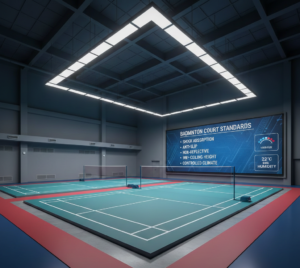
Flooring is one of the most critical components of international badminton court standards, directly affecting player safety and performance.
Recommended Flooring Types
-
Synthetic PVC or Vinyl Sports Flooring
-
PU (Polyurethane) Sports Flooring
-
Wooden Sports Flooring (with proper shock absorption systems)
Key Flooring Requirements
-
Shock Absorption: Reduces stress on joints and muscles
-
Anti-Slip Surface: Prevents slipping during fast lateral movements
-
Seamless or Smooth Finish: Ensures consistent footwork
-
Non-Reflective Surface: Minimizes glare under bright lighting
Concrete or stone surfaces are not permitted for professional badminton due to the high risk of injury.
Lighting Requirements for International Badminton Courts
Lighting plays a vital role in visibility, shuttle tracking, and player comfort. Poor lighting can affect reaction time and cause eye strain.
International Lighting Standards
-
Minimum Illumination:
-
Training courts: 300–500 lux
-
Competitive courts: 750–1000 lux
-
-
Uniform Distribution: No dark spots or excessive brightness
-
Glare Control: Lights positioned to avoid direct glare in players’ line of sight
LED lighting systems are widely preferred due to their energy efficiency and consistent brightness.
Court Surroundings and Safety Clearances
International standards emphasize not just the court itself but also the surrounding space.
Clearance Around the Court
-
Side Clearance: Minimum 1.5–2 meters
-
Rear Clearance: Minimum 2–3 meters
Adequate clearance ensures player safety during lunges, dives, and backward movements.
Ceiling Height Requirements
-
Minimum Ceiling Height: 9 meters
-
Recommended for International Events: 12 meters or more
Sufficient ceiling height allows players to execute high clears and powerful smashes without obstruction.
Environmental Conditions and Indoor Climate Control
Professional badminton courts must maintain controlled indoor conditions.
-
Humidity Control: Prevents slippery floors and shuttle instability
-
Ventilation: Ensures fresh air without strong air currents
-
Temperature Stability: Improves player comfort and endurance
Excessive airflow or temperature fluctuations can significantly affect shuttle speed and flight.
Maintenance and Court Care Standards
Maintaining a badminton court according to international standards is just as important as proper installation.
Regular Maintenance Practices
-
Daily cleaning to remove dust and sweat
-
Periodic inspection of lines, net, and posts
-
Checking floor grip and shock absorption
-
Repainting faded markings when required
Long-Term Care
-
Re-coating synthetic or PU floors periodically
-
Replacing worn-out nets and damaged posts
-
Monitoring lighting levels and replacing faulty fixtures
Consistent maintenance ensures the court remains safe, compliant, and visually professional.
Importance of Compliance for Tournaments and Training
Courts that meet international badminton standards are eligible to host:
-
National and international tournaments
-
Professional training camps
-
Ranking events and league matches
For academies and institutions, compliance also enhances credibility and attracts serious players and coaches.
Benefits of Following International Badminton Court Standards
-
Fair and Consistent Gameplay
-
Reduced Injury Risk
-
Professional Training Environment
-
Eligibility for Official Events
-
Long-Term Facility Value
Standardized courts support the growth of badminton at all levels, from grassroots to elite competition.
Conclusion
International badminton court standards form the foundation of fair, safe, and high-performance gameplay. From precise court dimensions and net specifications to flooring quality, lighting levels, and safety clearances, every detail plays a vital role in the sport’s integrity.
Players, coaches, architects, and facility managers must understand and implement these guidelines to create courts that meet global expectations. By adhering to BWF standards and maintaining courts properly, badminton facilities can deliver an exceptional playing experience and contribute to the continued growth of the sport worldwide.
Frequently Asked Questions (FAQ) – International Badminton Court Standards
1. What are the official dimensions of a badminton court?
According to BWF (Badminton World Federation) standards:
-
Singles court: 13.4 m × 5.18 m
-
Doubles court: 13.4 m × 6.1 m
-
Total recommended clearance: At least 2 m on all sides for safety and proper play
2. What is the recommended height of a badminton court?
-
Minimum height clearance: 9 meters from the floor to the ceiling
-
Adequate height ensures uninterrupted shuttle flight during play
3. What type of flooring is used in international badminton courts?
-
PU (Polyurethane) sports flooring – shock-absorbing, professional-grade
-
Vinyl or synthetic mats (PVC) – portable and cost-effective
-
Wooden flooring (maple) – used in some professional indoor arenas
The flooring must provide slip resistance, cushioning, and consistent bounce.
4. What is the standard color for badminton courts?
-
Court surface is typically green or blue with white or yellow boundary lines for clear visibility
-
Non-reflective finishes are preferred to reduce glare
5. How thick should the badminton court flooring be?
-
Synthetic flooring: 4–10 mm thick
-
PU or cushioned flooring: 6–15 mm, depending on shock absorption requirements
-
Wooden flooring: 22–28 mm
6. What are the net and post standards?
-
Net height at the center: 1.524 meters
-
Net height at the posts: 1.55 meters
-
Net width: 0.76 meters, extending across the full width of the court
-
Posts should be stable, non-obstructive, and positioned outside court boundaries
7. What lighting standards are required for international courts?
-
Minimum illumination: 500 lux for professional indoor play
-
Uniform lighting without shadows or glare is essential
-
Light should not interfere with the players’ vision or shuttle visibility
8. How much clearance is needed around the court?
-
Side clearance: At least 2 meters
-
End clearance: Minimum 2 meters behind the baseline
-
Clearance ensures player safety and regulation-compliant space for tournaments
9. Are international badminton courts suitable for multi-sport use?
Yes, with removable mats or multi-purpose flooring, courts can be adapted for volleyball, futsal, or indoor training, while maintaining BWF compliance.
10. How is maintenance handled for international standard courts?
-
Daily cleaning to remove dust and debris
-
Regular inspection of flooring and net posts
-
Repainting lines and markings as needed
-
Controlling humidity and moisture to prevent surface damage
11. Who designs courts according to international standards?
-
Certified sports flooring contractors and architects follow BWF guidelines for design, materials, dimensions, lighting, and safety requirements.
12. How long does an international standard badminton court last?
-
PU or synthetic flooring: 8–12 years
-
Wooden flooring: 15–20 years
Lifespan depends on usage intensity, maintenance, and material quality.
13. Can indoor courts meet BWF tournament requirements in India?
Yes, with correct flooring, net systems, lighting, and clearances, indoor badminton courts can host national and international tournaments.