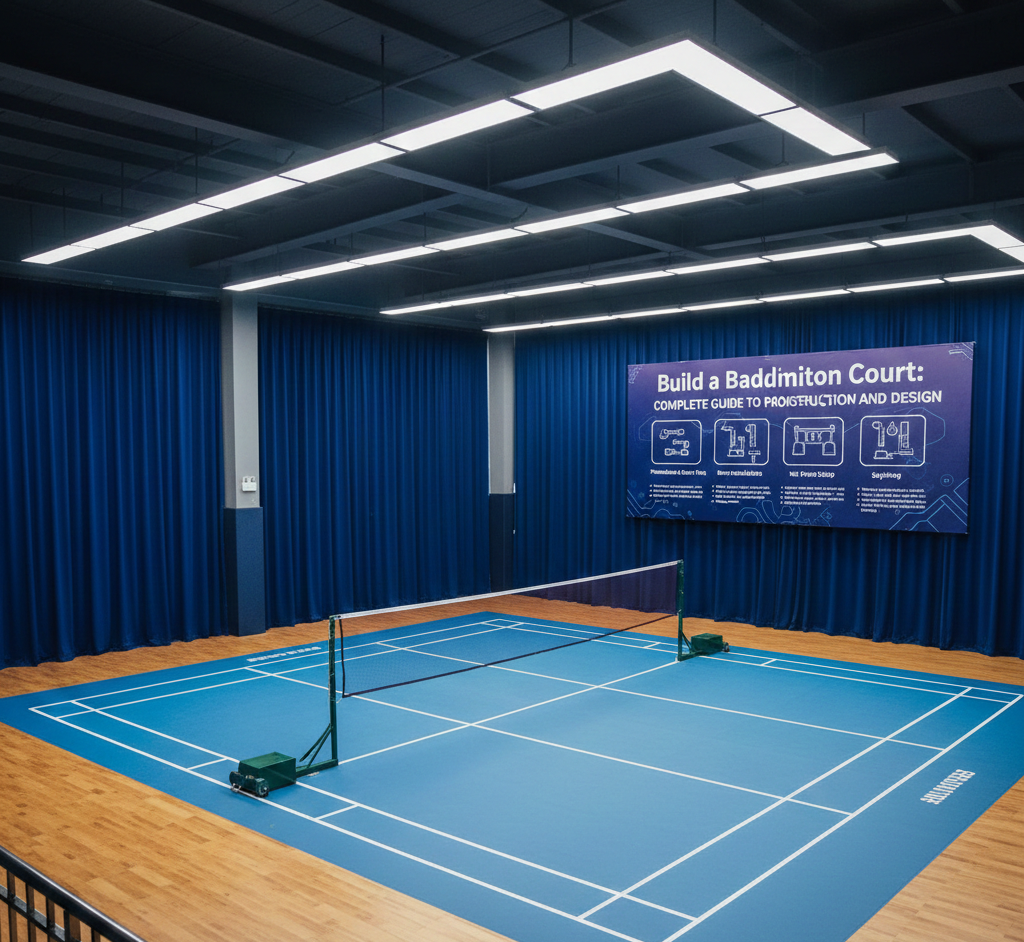
Building a badminton court is much more than laying a surface and drawing lines. A high-quality badminton court is a carefully engineered sports facility where design accuracy, material science, and player safety come together. Whether the court is intended for a school, sports academy, club, or residential complex, professional construction ensures consistent performance, reduced injury risk, and long-term durability.
This comprehensive guide explains the entire process of building a badminton court—from planning and layout to flooring selection, lighting, cost considerations, and maintenance—so you can create a facility that meets both functional and professional standards.
1. Understanding Badminton Court Dimensions and Layout
Accurate dimensions are the foundation of a well-built badminton court. International standards defined by the Badminton World Federation (BWF) ensure fairness, consistency, and proper gameplay.
Standard Badminton Court Measurements
-
Court Length: 13.4 meters (44 feet)
-
Court Width:
-
Doubles: 6.1 meters (20 feet)
-
Singles: 5.18 meters (17 feet)
-
-
Net Height:
-
1.55 meters (5 ft 1 in) at the posts
-
1.524 meters (5 ft) at the center
-
Clear and precise line markings are essential. Incorrect spacing or misaligned lines can disrupt gameplay and disqualify the court from competitive use.
2. Site Selection and Ground Preparation
The success of badminton court construction begins with choosing the right site and preparing a strong foundation.
Site Selection Guidelines
-
Flat and obstruction-free area
-
Adequate ventilation (especially for indoor courts)
-
Proper natural or artificial lighting
-
Sufficient clearance around the playing area
For outdoor courts, drainage and weather exposure must be carefully evaluated to prevent water accumulation and surface damage.
Ground Preparation Process
-
Removal of debris, vegetation, and loose soil
-
Soil compaction for structural stability
-
Construction of a sub-base using crushed stone or concrete
-
Precision leveling to create a uniform surface
A well-prepared base prevents cracking, uneven flooring, and moisture penetration—issues that directly affect play quality and surface lifespan.
3. Choosing the Right Type of Badminton Court
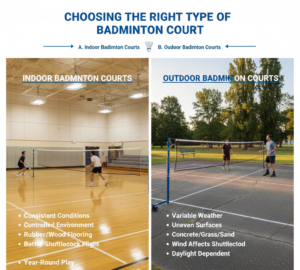
The type of badminton court you build depends on location, usage, and budget. Flooring selection plays a major role in performance and maintenance.
A. Indoor Badminton Courts
Indoor courts provide consistent playing conditions and are preferred for professional training and competitive matches.
Common Indoor Flooring Options:
-
Wooden Flooring (Maple or Teak):
Premium choice offering excellent grip, shock absorption, and shuttle response. Commonly used in international tournaments. -
Synthetic Flooring (PVC or PU):
Durable, seamless, and cost-effective alternative to wood. Provides reliable traction and cushioning. -
Vinyl Flooring:
Budget-friendly option suitable for schools and community halls with moderate usage.
B. Outdoor Badminton Courts
Outdoor courts are economical and suitable for schools, parks, and recreational areas.
Popular Outdoor Surface:
-
Acrylic Flooring:
Weather-resistant, slip-resistant, and low maintenance. Performs well under Indian climate conditions.
4. Badminton Court Construction Process
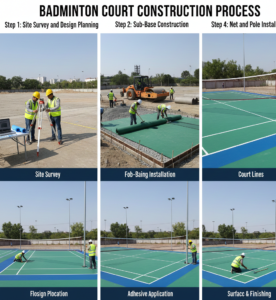
Professional badminton court construction follows a structured and technical approach.
Step 1: Site Survey and Design Planning
Experts evaluate the site, take measurements, and prepare detailed layout drawings. Design planning ensures optimal space utilization and compliance with standards.
Step 2: Sub-Base Construction
A robust sub-base is built using concrete or compacted aggregates to provide a stable platform for the playing surface.
Step 3: Flooring Installation
-
Wooden courts use shock-absorbing underlays and precision-fitted planks
-
Synthetic and vinyl surfaces are installed using adhesives or welding techniques over the concrete base
Proper installation ensures uniform bounce, grip, and durability.
Step 4: Line Marking and Surface Finishing
BWF-approved line markings are painted using non-slip, high-visibility coatings. Protective top layers are applied to enhance safety and longevity.
Step 5: Net and Pole Installation
High-quality poles and adjustable nets are installed at regulation height. Safety padding is added to prevent injuries during play.
5. Lighting and Ceiling Design
Lighting is a critical component of badminton court design. Poor lighting affects visibility and player performance.
Indoor Court Lighting
-
LED lights with 300–500 lux illumination
-
Uniform light distribution without shadows
-
Fixtures positioned at 45-degree angles to minimize glare
-
Minimum ceiling height of 7.5 to 12 meters to allow free shuttle movement
Outdoor Court Lighting
-
Weatherproof LED floodlights
-
Pole-mounted systems with proper beam focus
-
Energy-efficient lighting for night play
6. Fencing and Court Accessories
Additional elements enhance functionality and safety:
-
BWF-approved badminton nets and posts
-
Player benches and rest areas
-
Scoreboards and storage racks
-
Wall and column padding for indoor courts
-
Side fencing for outdoor facilities
These features improve usability and create a professional sports environment.
7. Cost of Building a Badminton Court
The cost of constructing a badminton court depends on materials, design complexity, and location.
Approximate Cost Estimates in India
-
Wooden Indoor Court: ₹12 – ₹18 lakhs
-
Synthetic Indoor Court: ₹6 – ₹10 lakhs
-
Outdoor Acrylic Court: ₹4 – ₹8 lakhs
Although premium courts require higher initial investment, they offer better durability and lower maintenance costs over time.
8. Maintenance for Long-Term Performance
Regular maintenance keeps the court safe, attractive, and playable.
Maintenance by Surface Type
-
Wooden Flooring:
Regular cleaning, polishing, and humidity control -
Synthetic & Vinyl Flooring:
Gentle mopping, inspection, and occasional recoating -
Outdoor Acrylic Courts:
Periodic washing, crack inspection, and resurfacing
Preventive maintenance reduces repair costs and extends the life of the court significantly.
9. Benefits of a Professionally Built Badminton Court
-
Consistent playing performance
-
Enhanced player safety and comfort
-
Attractive and professional appearance
-
Long service life with minimal maintenance
-
Increased participation and facility value
A well-constructed court reflects commitment to quality sports infrastructure and player satisfaction.
10. Why Professional Construction Matters
Badminton court construction requires technical expertise and strict adherence to standards. Professional contractors offer:
-
Expert site analysis and planning
-
Certified, high-quality materials
-
Skilled installation teams
-
Timely project completion
-
Ongoing maintenance support
Working with professionals ensures your court meets international guidelines and delivers reliable performance for years.
Conclusion
Building a badminton court is a thoughtful blend of precision engineering, material selection, and player-centric design. Every layer—from foundation to final finish—plays a vital role in shaping the playing experience.
Whether you are developing a sports academy, upgrading a school facility, or adding value to a residential project, investing in a professionally built badminton court is an investment in performance, safety, and long-term reliability.
Frequently Asked Questions (FAQ)
1. What are the standard dimensions of a badminton court?
A standard badminton court measures 44 feet × 20 feet for doubles and 44 feet × 17 feet for singles. Adequate clearance height of at least 20 feet is recommended for indoor courts.
2. How much does it cost to build a badminton court?
The cost depends on whether the court is indoor or outdoor, flooring type, lighting, and location. On average, construction costs range from ₹3 lakhs to ₹15+ lakhs.
3. Which flooring is best for a badminton court?
Popular options include PVC vinyl flooring, wooden flooring, and synthetic flooring.
4. How long does it take to build a badminton court?
A badminton court can usually be constructed within 10 to 30 days, depending on site conditions and chosen materials.
5. Can a badminton court be built outdoors?
Yes, outdoor badminton courts are possible, but wind and weather can affect play.
6. What lighting is required for a badminton court?
LED lights with uniform brightness and anti-glare positioning are recommended. Indoor courts usually require 200–500 lux, depending on usage level.
7. Is proper drainage necessary for badminton court construction?
Yes. Proper drainage is essential, especially for outdoor courts, to prevent water accumulation and surface damage.
8. Can an existing space be converted into a badminton court?
Yes. Existing halls, warehouses, schools, or community spaces can be converted into badminton courts with proper leveling and flooring installation.
9. Does building a badminton court require regular maintenance?
Maintenance is minimal and includes cleaning the surface, checking net tension, and periodic inspection of flooring and lighting.
10. Is building a badminton court a profitable investment?
Yes. Badminton courts are in high demand and can generate steady income through hourly rentals, coaching programs, tournaments, and memberships.