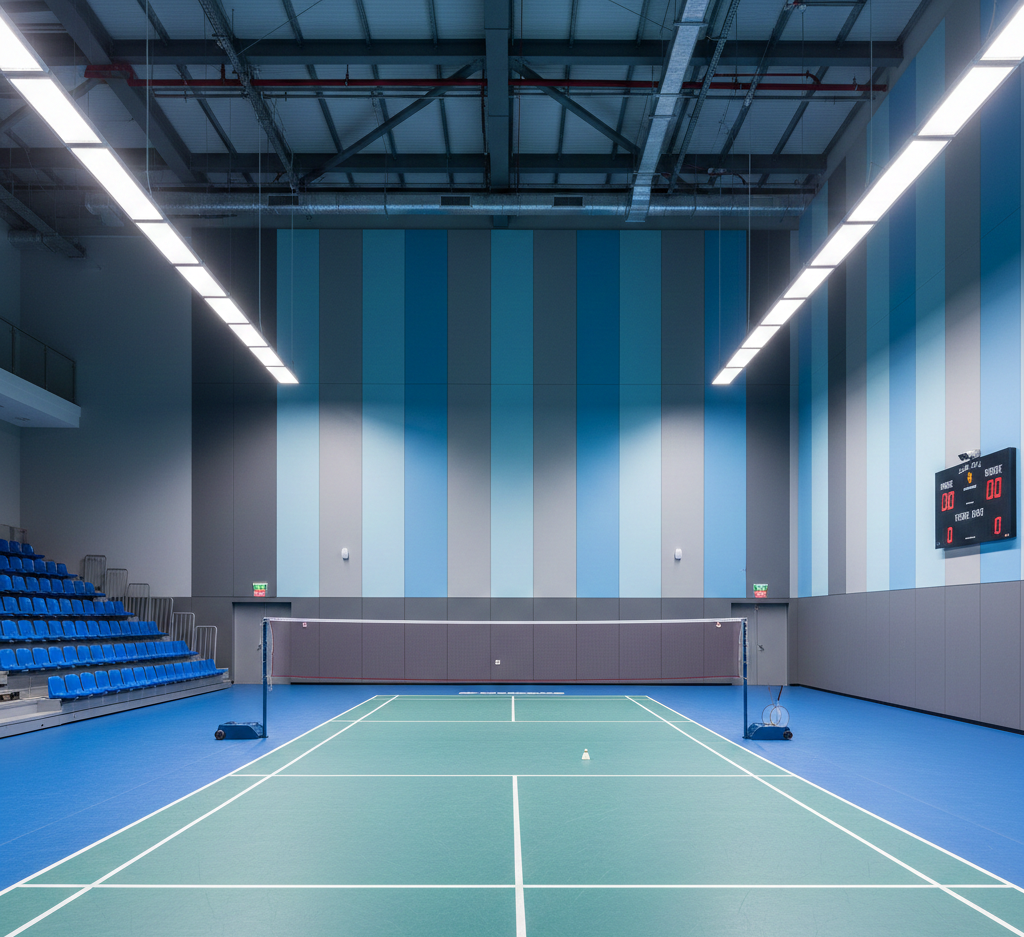
Badminton is one of the world’s most popular racquet sports, enjoyed by players of all ages for its speed, agility, and fitness benefits. Whether played recreationally or at a professional level, the quality and accuracy of the badminton court play a crucial role in ensuring fair competition, player safety, and consistent performance.
A badminton court is far more than a marked surface. It is a precisely engineered playing area, where every measurement, line, and material follows standards established by the Badminton World Federation (BWF).
This comprehensive guide explains everything you need to know about a badminton court—its dimensions, layout, surface types, materials, and construction process.
Understanding a Badminton Court
A badminton court is a rectangular playing area divided by a central net, where players strike a shuttlecock across the court using racquets. The court layout includes separate boundary lines for singles and doubles, service courts, center lines, and back boundaries that govern gameplay.
Accurate court design directly affects:
-
Shuttle movement
-
Player footwork and balance
-
Match fairness and safety
Standard Dimensions of a Badminton Court (BWF Approved)
The Badminton World Federation has established uniform court dimensions used worldwide.
Official Court Measurements
| Category | Measurement |
|---|---|
| Total Length | 13.40 meters (44 feet) |
| Total Width (Doubles) | 6.10 meters (20 feet) |
| Total Width (Singles) | 5.18 meters (17 feet) |
| Short Service Line | 1.98 meters (6.5 feet) from the net |
| Long Service Line (Doubles) | 0.76 meters (2.5 feet) from back boundary |
| Net Height | 1.55 m at posts, 1.524 m at center |
The net divides the court into two equal halves, forming service and rally zones on each side.
Court Layout and Line Markings
Each line on a badminton court serves a specific function and must be clearly visible and accurately placed.
Key Court Markings
1. Center Line
Divides the court into left and right service courts. It runs from the back boundary line to the short service line.
2. Short Service Line
Marks the front boundary of the service court. Serves landing short of this line are faults.
3. Long Service Line
Used primarily in doubles play to limit the depth of the serve.
4. Side Lines
-
Inner side lines: Used for singles matches
-
Outer side lines: Used for doubles matches
5. Back Boundary Line
Defines the rear limit of the court for both singles and doubles play.
6. Net and Net Posts
The net separates the court halves. Net posts are positioned outside the doubles sidelines to prevent obstruction during play.
Types of Badminton Courts
Badminton courts are categorized based on location and surface material, each offering different performance characteristics.
1. Indoor Badminton Court
Indoor courts are the preferred choice for competitive and professional play due to controlled playing conditions.
Flooring Options
-
Hardwood wooden flooring (maple or teak)
-
PVC vinyl sports flooring
-
Polyurethane (PU) synthetic systems
Advantages
-
Excellent shock absorption and grip
-
Consistent shuttle behavior
-
Protection from wind, rain, and sunlight
Ideal For
-
Professional tournaments
-
Sports academies and training centers
-
Schools and indoor stadiums
2. Outdoor Badminton Court
Outdoor courts are suitable for recreational use where indoor facilities are unavailable.
Surface Options
-
Acrylic sports flooring
-
Concrete or asphalt base
-
Interlocking modular sports tiles
Considerations
-
Wind affects shuttle flight
-
Weather exposure impacts play consistency
Ideal For
-
Parks and community spaces
-
Residential complexes
-
School playgrounds
Badminton Court Flooring Materials
Flooring selection significantly affects player comfort, safety, and injury prevention.
1. Wooden Flooring
-
Preferred for professional indoor courts
-
Made from high-quality hardwood
-
Excellent shock absorption and elasticity
-
Requires regular polishing and maintenance
2. PVC Vinyl Flooring
-
Multi-layer synthetic surface
-
Easy installation in roll form
-
Cost-effective and durable
-
Suitable for schools and recreational halls
3. Polyurethane (PU) Flooring
-
Seamless and cushioned system
-
Long lifespan and high wear resistance
-
Ideal for multi-sport indoor facilities
4. Acrylic Flooring (Outdoor)
-
UV-resistant and weatherproof
-
Non-slip and easy to maintain
-
Ideal for outdoor badminton courts
Badminton Court Construction Process
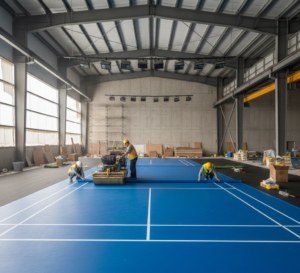
Constructing a high-quality badminton court requires precision, expertise, and strict adherence to standards.
Step 1: Site Preparation
-
Clear debris and vegetation
-
Level the ground accurately
-
Ensure proper drainage for outdoor courts
Step 2: Base Construction
-
Build a stable base using concrete or asphalt
-
For indoor courts, apply a smooth cement screed
-
Ensure the base is crack-free and perfectly level
Flooring Installation
-
Install selected flooring material (wood, PVC, PU, etc.)
-
Apply adhesives and shock-absorbing underlayers
-
Ensure uniform surface thickness
Court Marking
-
Paint boundary and service lines using non-slip, high-contrast paint
-
Maintain standard line width of 40 mm
Net and Post Installation
-
Fix net posts outside doubles sidelines
Finishing Touches
-
Install proper lighting for indoor courts
-
Final inspection for surface uniformity and safety
Cost of Badminton Court Construction (India)
The cost varies depending on surface type, location, and indoor or outdoor installation.
Approximate Cost Range
-
Indoor Wooden Court: ₹10 – ₹18 lakh
-
PVC Synthetic Court: ₹7 – ₹12 lakh
-
Outdoor Acrylic Court: ₹4 – ₹8 lakh
Additional costs may include lighting, nets, posts, seating, and maintenance equipment.
Importance of a Well-Constructed Badminton Court
Key Benefits
-
Accurate dimensions ensure fair gameplay
-
Quality flooring reduces injury and fatigue
-
Proper layout improves visibility and movement
-
Professional construction extends court lifespan
Conclusion
A badminton court forms the backbone of one of the most dynamic indoor and outdoor sports. From precise dimensions and professional-grade flooring to expert construction and maintenance, every detail contributes to an optimal playing experience.
Investing in a well-designed badminton court ensures safety, performance, durability, and long-term value, whether for competitive tournaments, training academies, or recreational play.
FAQ – Badminton Court: Complete Guide for Players and Construction
1. What are the standard dimensions of a badminton court?
A standard badminton court measures 13.4 meters (44 ft) in length and:
- 6.1 meters (20 ft) wide for doubles matches
- 5.18 meters (17 ft) wide for singles matches
The net height is 1.55 meters (5 ft 1 in) at the edges and 1.524 meters (5 ft) at the center.
2. What are the different types of badminton courts?
- Indoor Badminton Court – Standard professional courts with wooden or synthetic flooring
- Outdoor Badminton Court – Made with synthetic mats, tiles, or compacted soil
- Recreational/Compact Court – Flexible design for schools, residential areas, or multipurpose halls
3. What type of flooring is used in badminton courts?
- Wooden Flooring – Maple or oak, professional standard, shock-absorbing
- PVC or Synthetic Flooring – Common for schools, gyms, and recreational courts
- Outdoor Mats / Modular Tiles – Durable, weather-resistant, ideal for outdoor use
4. Can a badminton court be used for both singles and doubles?
Yes. A regulation-sized court accommodates both singles and doubles. Lines are clearly marked to differentiate boundaries for singles and doubles play.
5. How much space is needed around a badminton court?
It is recommended to have at least 2 meters of clearance around the court for player safety, smooth gameplay, and professional standards.
6. How is a badminton court constructed?
Construction involves:
- Site Preparation – Leveling, drainage, and base formation
- Flooring Installation – Wooden, synthetic, or modular tiles
- Net and Posts Setup – Correct height and tension
- Marking Lines – Clearly painting singles, doubles, and service lines
7. What safety features should a badminton court include?
- Non-slip flooring
- Shock-absorbing surface to prevent joint injuries
- Adequate lighting for indoor courts
- Proper clearance around the court for free movement