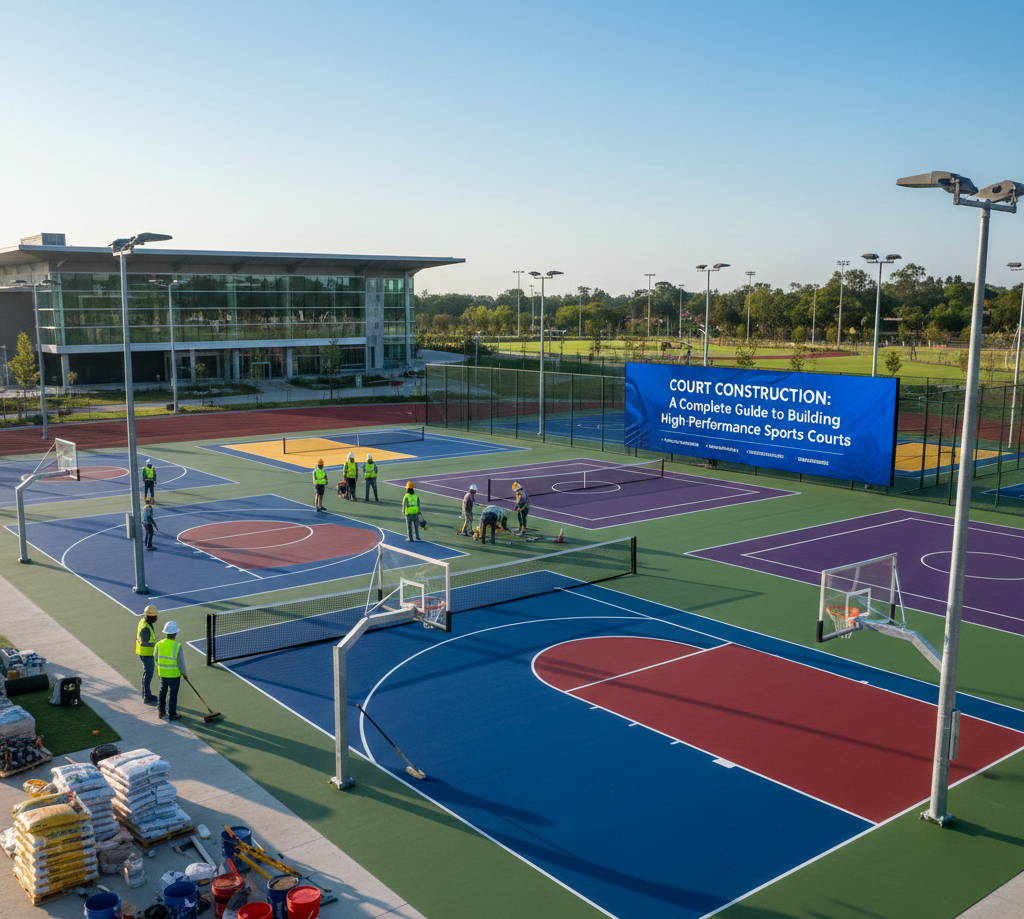
Sports today go far beyond recreation. They are an essential part of physical fitness, skill development, community engagement, and professional athletic growth. From schools and residential communities to sports academies and commercial facilities, well-designed sports courts form the foundation of safe and high-performing athletic environments.
Court construction is a specialized engineering process that combines technical precision, material science, and sports-specific design standards. A properly constructed court improves gameplay quality, minimizes injury risks, withstands climatic challenges, and enhances the overall value of a facility.
This comprehensive guide explains the entire court construction process, types of sports courts, materials used, technical standards, maintenance practices, and cost considerations—helping you make informed decisions when planning a sports court project.
1. Understanding Court Construction
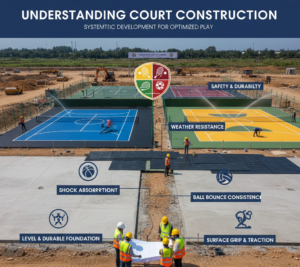
Court construction is the systematic development of a level, durable, and performance-optimized playing surface designed for specific sports such as tennis, basketball, badminton, volleyball, futsal, or multi-purpose use.
Unlike conventional flooring, sports courts must meet precise requirements related to:
-
Surface grip and traction
-
Shock absorption and player comfort
-
Ball bounce consistency
-
Weather resistance
-
Safety and durability
Each sport has unique standards for dimensions, surface texture, and cushioning. Therefore, court construction requires careful planning, expert execution, and adherence to national and international guidelines.
A professionally built court not only enhances athlete performance but also reduces long-term maintenance costs and extends surface lifespan.
2. Types of Sports Courts and Their Requirements
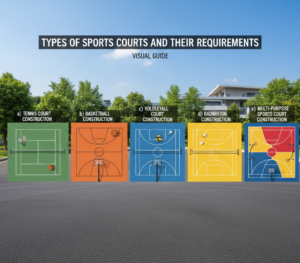
Different sports demand different surface properties and layouts. Selecting the right court type depends on usage frequency, level of play, budget, and indoor or outdoor conditions.
a) Tennis Court Construction
Tennis courts are among the most technically demanding sports surfaces.
-
Standard Dimensions: 23.77 m × 10.97 m (doubles)
-
Popular Surfaces: Acrylic synthetic, artificial turf, clay, grass, or asphalt
-
Key Requirements:
-
Controlled slope (1:100 max) for drainage
-
Uniform ball bounce
-
Cushioned layers to reduce joint impact
-
ITF-compliant line markings
-
Tennis courts must balance speed, grip, and comfort to suit training and competition.
b) Basketball Court Construction
Basketball courts require excellent shock absorption and surface grip due to fast movements and frequent jumping.
-
Standard Dimensions: 28 m × 15 m (FIBA)
-
Surface Options: PU flooring, acrylic synthetic, or wooden maple (indoor)
-
Design Focus:
-
High slip resistance
-
Strong impact absorption
-
Accurate rebound characteristics
-
Durable line markings
-
Indoor basketball courts often use wooden or PU surfaces, while outdoor courts rely on acrylic systems.
c) Volleyball Court Construction
Volleyball courts demand uniform surface texture and proper net alignment.
-
Dimensions: 18 m × 9 m
-
Surface Types: Synthetic vinyl, acrylic, or wooden flooring
-
Key Considerations:
-
Consistent traction
-
Shock absorption
-
Accurate net post anchoring
-
Clear boundary lines
-
Both indoor and outdoor volleyball courts must minimize player fatigue and ensure safe landing.
d) Badminton Court Construction
Badminton courts require high-quality cushioning and precise markings due to quick footwork and agility-based movements.
-
Dimensions: 13.4 m × 6.1 m (doubles)
-
Preferred Surface: Wooden flooring with PVC synthetic mat overlay
-
Performance Needs:
-
Excellent grip
-
Low glare
-
Shock absorption
-
BWF-approved line marking standards
-
Ceiling height and lighting also play a critical role in badminton court design.
e) Multi-Purpose Sports Court Construction
Multi-purpose courts are ideal for schools, residential complexes, and community spaces.
-
Sports Covered: Basketball, volleyball, tennis, futsal, handball
-
Surface Materials: Acrylic, EPDM, or PU
-
Advantages:
-
Cost-effective
-
Space-efficient
-
Flexible usage
-
Easy maintenance
-
Multi-sport courts require thoughtful line planning and balanced surface performance.
3. Key Stages of Court Construction
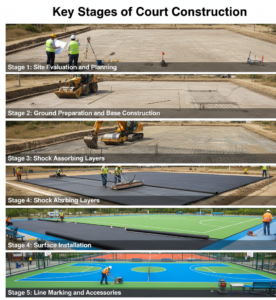
Stage 1: Site Evaluation and Planning
-
Soil testing and load-bearing assessment
-
Area measurement and layout planning
-
Drainage and slope design
-
Identification of indoor or outdoor requirements
This stage determines the long-term success of the court.
Stage 2: Ground Preparation and Base Construction
A strong base is the backbone of any sports court.
-
Excavation and leveling
-
Compacted stone or concrete base
-
Asphalt or RCC base layer
-
Precision slope for water drainage
Poor base preparation leads to cracks, uneven bounce, and surface failure.
Stage 3: Shock Absorbing Layers
Elastic layers or rubber mats are installed to:
-
Reduce stress on joints
-
Improve player comfort
-
Enhance surface resilience
This step is especially important for tennis, basketball, and badminton courts.
Stage 4: Surface Installation
Depending on the chosen material:
-
Acrylic coatings are layered and textured
-
PU systems are poured and cured
-
Wooden floors are installed with underlays
-
Synthetic mats are bonded or interlocked
Uniform thickness and proper curing are essential.
Stage 5: Line Marking and Accessories
-
Sport-specific line painting
-
Net posts and anchor systems
-
Goal posts or basketball poles
-
Fencing, seating, and lighting installation
All markings must follow official standards.
4. Materials Used in Court Construction
-
Acrylic Coatings: Durable, weather-resistant, cost-effective
-
Polyurethane (PU): Seamless, cushioned, premium finish
-
EPDM Rubber: Excellent for multi-purpose and children’s courts
-
Wooden Flooring: Professional indoor sports
-
PVC/Vinyl Mats: Badminton and indoor courts
Material selection impacts performance, lifespan, and maintenance cost.
5. Maintenance and Surface Longevity
Even the best courts require regular care.
-
Daily cleaning to remove dust and debris
-
Periodic inspection for cracks or wear
-
Line repainting every 2–3 years
-
Drainage system cleaning
-
Re-coating acrylic or PU surfaces every 5–7 years
With proper maintenance, courts can last 15–20 years or more.
6. Cost of Court Construction in India
The cost varies based on surface type, size, and accessories.
| Court Type | Surface | Approx. Cost (₹/sq.ft.) | Avg. Total Cost |
|---|---|---|---|
| Tennis Court | Acrylic | ₹900–₹1,200 | ₹6.5–₹8 lakh |
| Basketball Court | PU/Acrylic | ₹1,000–₹1,400 | ₹7–₹9 lakh |
| Badminton Court | Wooden + PVC | ₹1,200–₹1,800 | ₹5–₹8 lakh |
| Volleyball Court | Synthetic | ₹800–₹1,200 | ₹4–₹6 lakh |
| Multi-Purpose Court | Acrylic | ₹1,000–₹1,400 | ₹6–₹8 lakh |
Costs may vary based on location, base condition, and customization.
7. Advantages of Professional Court Construction
-
Compliance with international sports standards
-
Improved athlete safety and comfort
-
Reduced long-term repair costs
-
Enhanced visual appeal
-
Increased institutional and property value
Professional execution ensures performance consistency and durability.
8. Conclusion
Court construction is not just about laying a surface—it is about creating a high-performance sporting environment. Every stage, from site evaluation to surface finishing, plays a vital role in ensuring safety, durability, and professional-level play.
By choosing the right materials, following international standards, and working with experienced professionals, sports courts can serve athletes and communities for decades.
Whether for schools, residential complexes, academies, or clubs, investing in quality court construction promotes fitness, discipline, and sporting excellence—building spaces where performance and passion come together.