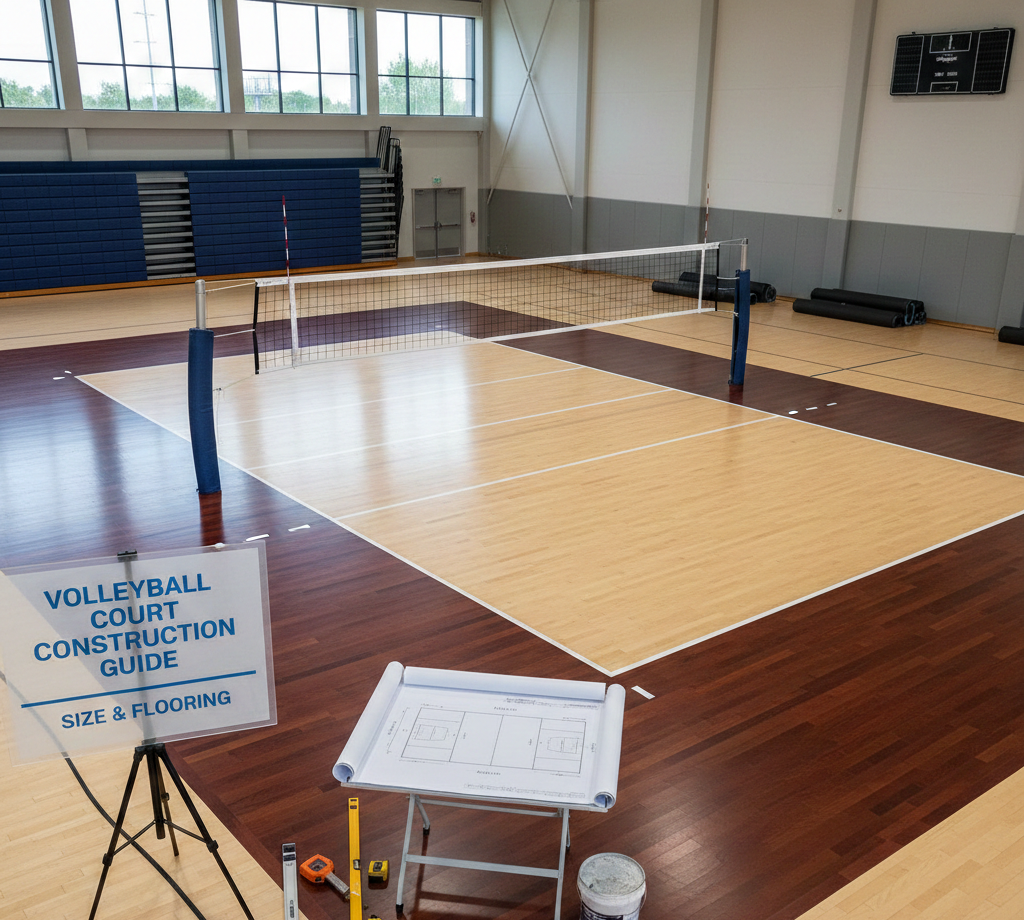
Volleyball is a globally recognized sport that combines agility, teamwork, and strategy. With the growing popularity of volleyball in schools, colleges, residential communities, and sports academies, constructing a professional-standard volleyball court has become essential. A well-built court not only ensures fair play but also promotes safety and durability.
This guide provides detailed insights into volleyball court size specifications and flooring options, ensuring you can plan and build a court that meets international standards.
1. Volleyball Court Dimensions
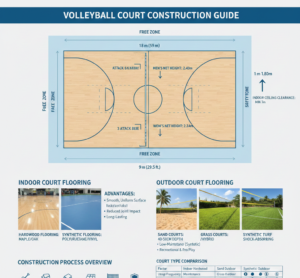
The first step in volleyball court construction is defining the correct size and layout, as per international standards established by the Fédération Internationale de Volleyball (FIVB).
Standard Court Dimensions:
-
Court Length: 18 meters (59 feet)
-
Court Width: 9 meters (29.5 feet)
-
Center Line: Divides the court into two halves of 9 × 9 meters each
-
Attack Line: 3 meters (9.8 feet) from the center line, separating the front and back zones
-
Free Zone: Minimum 3 meters around the court to allow player movement
-
Safety Zone: Recommended 5 meters outside the boundaries for competitive play
-
Net Height:
-
Men: 2.43 meters (7 feet 11 5/8 inches)
-
Women: 2.24 meters (7 feet 4 1/8 inches)
-
-
Net Width: 1 meter
-
Antennae: 1.80 meters above the net at the sidelines
Ceiling and Overhead Clearance (Indoor Courts)
-
Minimum recommended height: 7 meters
-
Ensures unimpeded gameplay and reduces interference from lighting or structural elements
By adhering to these dimensions, you can construct a court suitable for recreational play, training, or professional tournaments.
2. Volleyball Court Flooring Options
Flooring is a critical aspect of volleyball court construction. The right surface improves player performance, reduces injury risk, and ensures long-term durability.
a) Indoor Court Flooring
Indoor volleyball courts require smooth, resilient surfaces for optimal performance:
-
Hardwood Flooring (Maple or Oak):
-
Most commonly used in professional indoor courts
-
Provides excellent bounce and traction for players
-
Shock-absorbing underlayers reduce joint strain
-
Requires periodic polishing and cleaning for maintenance
-
-
Synthetic Flooring (Polyurethane or Vinyl):
-
Durable and low-maintenance alternative to hardwood
-
Resistant to humidity and temperature fluctuations
-
Offers consistent grip and cushioning
-
Suitable for multi-purpose sports halls
-
Advantages of Indoor Flooring:
-
Smooth, uniform surface for predictable ball behavior
-
Reduced impact on joints and muscles
-
Long-lasting with proper care
b) Outdoor Court Flooring
Outdoor courts must withstand environmental conditions, including rain, sunlight, and temperature variations.
-
Sand Courts (Beach Volleyball):
-
Depth: 40–50 cm for safety and comfort
-
Soft surface reduces injury risk on falls
-
Must be free from debris or stones
-
Provides an authentic beach volleyball experience
-
-
Grass Courts:
-
Natural or hybrid grass for recreational play
-
Requires regular irrigation and maintenance
-
Bounce may be inconsistent compared to indoor surfaces
-
-
Synthetic Turf:
-
Artificial turf with a shock-absorbing layer
-
Durable, weather-resistant, and low-maintenance
-
Provides consistent play quality for outdoor use
-
Advantages of Outdoor Flooring:
-
Sand and turf surfaces offer safety during dives and falls
-
Minimal maintenance for synthetic options
-
Can be designed for both recreational and professional-level games
3. Construction Process Overview
Building a volleyball court with the correct size and flooring involves several critical steps:
-
Site Selection & Preparation:
-
Level the ground and remove obstructions
-
Ensure proper drainage for outdoor courts
-
Orient outdoor courts north-south to reduce sun glare
-
-
Foundation & Base:
-
Indoor courts require reinforced concrete with moisture-proof layers
-
Outdoor courts need compacted soil or gravel sub-base for sand/turf courts
-
-
Floor Installation:
-
Lay hardwood panels or synthetic surfaces for indoor courts
-
Spread sand evenly or install artificial turf for outdoor courts
-
-
Net & Equipment Setup:
-
Install posts outside the sidelines with adjustable height
-
Use durable synthetic nets and attach antennae to mark boundaries
-
-
Markings & Boundary Lines:
-
Use 5 cm wide lines in contrasting colors
-
Ensure accurate placement of attack lines, sidelines, and center line
-
-
Safety Measures:
-
Maintain a free zone of at least 3 meters
-
Ensure non-slip surfaces and secure equipment
-
Provide proper lighting and overhead clearance indoors
-
4. Maintenance Recommendations
Maintaining the court ensures longevity and consistent play quality:
-
Indoor Hardwood Courts: Clean daily, polish periodically, and inspect net systems
-
Indoor Synthetic Courts: Clean regularly and check for damage or wear
-
Outdoor Sand Courts: Rake sand, remove debris, and inspect drainage
-
Grass Courts: Mow, irrigate, and treat for pests
-
Artificial Turf Courts: Brush regularly, remove debris, and monitor shock-absorbing layers
5. Choosing the Right Court Type
The choice of flooring and court type depends on:
| Factor | Indoor Hardwood | Synthetic Indoor | Sand Outdoor | Grass Outdoor | Synthetic Outdoor |
|---|---|---|---|---|---|
| Usage Frequency | High | High | Medium | Low | Medium-High |
| Maintenance Requirement | Moderate | Low | Medium | High | Low |
| Player Safety | High | High | High | Medium | High |
| Durability | Very High | High | Medium | Medium | High |
| Cost | High | Medium | Medium | Low | Medium-High |
Conclusion
Constructing a volleyball court requires meticulous planning and precise execution. By following the correct size specifications and selecting the right flooring material, you can create a court that ensures safety, durability, and a professional-level playing experience.
Whether designing an indoor hardwood court for competitive matches or an outdoor sand or synthetic court for recreational play, adhering to international standards guarantees quality and performance. Proper construction combined with regular maintenance promotes volleyball as a safe and enjoyable sport for players of all ages and skill levels.
FAQ: Volleyball Court Construction Guide – Size & Flooring
1. What are the official dimensions of a volleyball court?
-
Court size: 18 m × 9 m (59 ft × 29.5 ft)
-
Free zone: Minimum 3 m around the court for safe movement
-
Ceiling height (indoor courts): Minimum 7 m; professional play ideally 9–12 m
-
Attack line: 3 m from the centerline
These dimensions comply with FIVB regulations.
2. What types of volleyball courts can be constructed?
-
Indoor Courts – Maple wood, synthetic vinyl, or rubberized sports flooring for professional and recreational play.
-
Outdoor Sand Courts (Beach Volleyball) – Fine sand, minimum 40 cm depth, with proper drainage.
-
Outdoor Grass or Synthetic Turf Courts – Multi-use recreational courts; lower maintenance.
-
Multi-purpose Courts – Can accommodate volleyball, badminton, basketball, or futsal with modular markings.
3. What flooring options are available for indoor volleyball courts?
-
Maple wood flooring: Premium option with shock absorption and uniform bounce; preferred for professional tournaments.
-
Vinyl or synthetic sports flooring: Durable, low maintenance, and cost-effective for schools and clubs.
-
Rubberized sports flooring: Suitable for recreational or multi-sport courts; provides good grip and comfort.
4. What subfloor preparation is needed for indoor courts?
-
Ensure a level, smooth surface for uniform gameplay.
-
Install shock-absorbing underlay to reduce injuries.
-
Include moisture barrier if over concrete to prevent warping or damage.
5. What is the recommended flooring for outdoor volleyball courts?
-
Sand: For beach volleyball, leveled and debris-free; depth ≥ 40 cm.
-
Synthetic turf or grass: For recreational or school courts; ensure good drainage.
6. How long does volleyball court construction take?
-
Outdoor sand court: 1–2 weeks
-
Indoor synthetic court: 2–4 weeks
-
Indoor wooden court: 3–6 weeks including subfloor preparation
7. What is the approximate cost of construction?
-
Outdoor sand court: ₹5–12 lakh
-
Indoor synthetic court: ₹15–30 lakh
-
Professional wooden indoor court: ₹30–50 lakh
Costs vary with flooring type, lighting, ventilation, and additional features.
8. What safety features should be included in construction?
-
Non-slip flooring
-
Padding on net posts and walls
-
Adequate free zone (≥ 3 m)
-
Even lighting and proper ventilation
-
Smooth and debris-free playing surface
9. Can volleyball courts be multi-purpose?
Yes. Indoor and outdoor courts can be designed to host multiple sports such as badminton, basketball, and futsal by using clear line markings and modular equipment.
10. What maintenance is required for volleyball court flooring?
-
Wooden floors: Polishing, recoating, and cleaning regularly
-
Synthetic/vinyl floors: Sweeping, wet mopping, minor repairs
-
Sand courts: Leveling, debris removal, moisture management
-
Synthetic turf: Brushing and repainting lines as needed