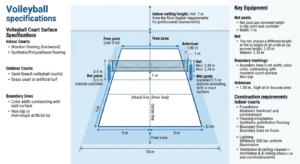
Volleyball is one of the most widely played sports in schools, colleges, residential communities, and professional arenas. The growth of competitive volleyball in India has created a rising demand for courts that adhere to international standards. Constructing a volleyball court is not just about marking an area and installing a net—it requires precise technical specifications to ensure player safety, consistency, and adherence to official rules.
This guide provides an in-depth look at the technical specifications of volleyball courts, covering dimensions, materials, equipment, and construction requirements for both indoor and outdoor courts.
1. Standard Volleyball Court Dimensions
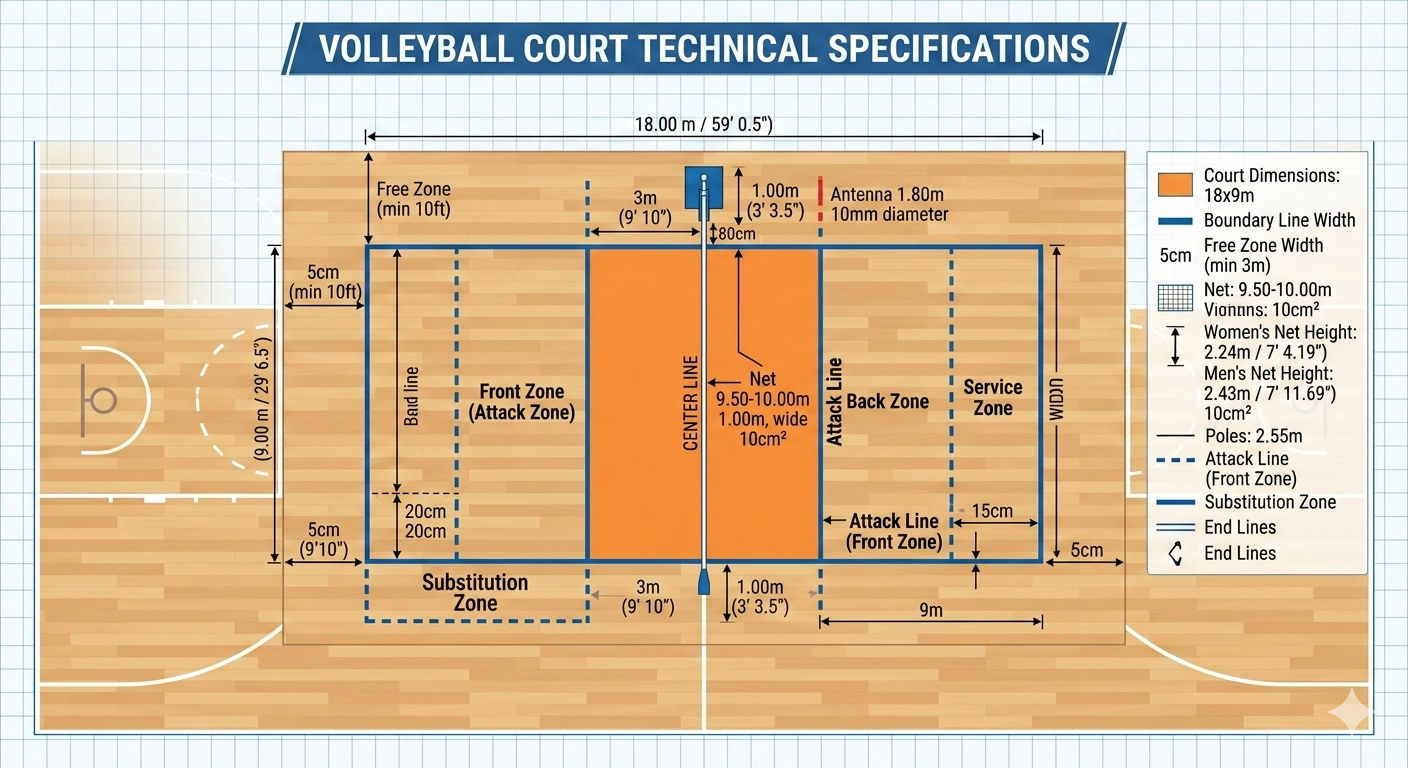
The technical specifications of a volleyball court are defined by the Fédération Internationale de Volleyball (FIVB) for international competitions. Understanding these dimensions is crucial for designing a court suitable for professional or recreational play.
-
Overall Court Size: 18 meters (length) × 9 meters (width)
-
Center Line: Divides the court into two equal halves of 9 × 9 meters each
-
Attack Line (3-Meter Line): Positioned 3 meters from the center line on each side; separates the front zone from the back zone
-
Free Zone: Minimum 3 meters wide on all sides of the court to allow players safe movement
-
Safety Zone: Recommended 5 meters outside the boundary lines, particularly for competitive indoor courts
-
Ceiling Height (Indoor Courts): Minimum 7 meters from the floor; higher for professional tournaments
-
Net Height:
-
Men: 2.43 meters
-
Women: 2.24 meters
-
-
Net Width: 1 meter
-
Antennae: 1.80 meters high, fixed at the edges of the net to indicate in-bounds area
Adhering to these dimensions ensures consistency in gameplay, accurate officiating, and reduced risk of injury.
2. Volleyball Court Surface Specifications
The choice of surface is critical to performance, injury prevention, and maintenance. Volleyball courts are categorized based on indoor and outdoor surfaces.
a) Indoor Court Surfaces
Indoor courts require materials that provide shock absorption, consistent bounce, and durability:
-
Wooden Flooring (Hardwood):
-
Most common choice for professional indoor courts
-
Usually made from maple wood, known for durability and smooth finish
-
Shock-absorbing underlayers prevent joint injuries
-
Requires regular polishing and cleaning
-
-
Synthetic/Polyurethane Flooring:
-
Durable and low-maintenance alternative
-
Provides consistent grip and cushioning
-
Resistant to humidity and temperature changes
-
Suitable for multi-purpose sports halls
-
b) Outdoor Court Surfaces
Outdoor courts are exposed to weather, requiring resilient materials:
-
Sand (Beach Volleyball Courts):
-
Fine sand with good drainage
-
Depth: 40–50 cm recommended for safety and performance
-
Soft landing reduces injury risk
-
-
Grass Courts:
-
Natural grass or hybrid grass surfaces
-
Cost-effective and eco-friendly
-
Requires irrigation and regular maintenance
-
Bounce may be inconsistent
-
-
Artificial Turf:
-
Durable and low-maintenance
-
Shock-absorbing layers enhance safety
-
Usable in all weather conditions
-
3. Volleyball Court Equipment Specifications
The court’s equipment also has defined technical specifications:
-
Net Posts:
-
Must be stable and adjustable in height
-
Made from corrosion-resistant metal
-
Installed at a distance of 0.5 meters outside the sidelines
-
-
Net:
-
Height: 2.43 m (men), 2.24 m (women)
-
Width: 1 meter
-
Mesh: 10 cm square openings
-
Material: Durable synthetic fiber
-
-
Boundary Markings:
-
Width: 5 cm lines
-
Color: Contrasting with the court surface for visibility
-
Non-slip paint recommended for indoor courts
-
-
Antennae:
-
Height: 1.80 meters above the net
-
Diameter: 10 mm
-
Color: Red and white, striped for visibility
-
4. Construction Requirements for Indoor Courts
Indoor volleyball courts require precise construction for performance and player safety:
-
Foundation:
-
Reinforced concrete base for stability
-
Moisture-proof layer to prevent damage to the flooring
-
-
Flooring Installation:
-
Wooden panels laid over shock-absorbing underlayer
-
Synthetic flooring installed with proper adhesives and anti-slip coating
-
-
Boundary Lines:
-
Painted or taped accurately as per FIVB dimensions
-
Should not be raised above floor level to avoid tripping hazards
-
-
Lighting:
-
Minimum 500 lux uniform illumination
-
Evenly distributed to avoid shadows or glare on the court
-
-
Ventilation & Ceiling Clearance:
-
Adequate airflow to maintain indoor comfort
-
Ceiling height minimum 7 meters; higher for professional or tournament-level play
-
5. Construction Requirements for Outdoor Courts
Outdoor courts require attention to weatherproofing and drainage:
-
Sand Courts:
-
Level surface with drainage channels to prevent water accumulation
-
Sand must be free from stones or debris
-
Net posts installed securely in concrete sleeves
-
-
Grass Courts:
-
Soil compacted and leveled for consistent bounce
-
Irrigation system installed for turf maintenance
-
Drainage system to prevent waterlogging
-
-
Artificial Turf Courts:
-
Shock-absorbing underlay for player safety
-
UV-resistant turf to prevent degradation
-
Proper anchoring of net posts
-
6. Safety and Accessibility Considerations
Safety is a top priority in volleyball court design:
-
Free Zones: Ensure at least 3 meters around the court for safe movement
-
Non-slip Surfaces: Essential for indoor courts to prevent falls
-
Emergency Access: Easy entry and exit points for medical emergencies
-
Spectator Areas: Properly separated from playing surface to prevent accidents
7. Maintenance Guidelines
Maintenance is critical to ensure longevity and consistent performance:
-
Indoor Courts:
-
Clean daily to remove dust
-
Polish hardwood floors periodically
-
Check net tension and posts regularly
-
-
Outdoor Courts:
-
Sand courts: Rake regularly, check drainage
-
Grass courts: Mow, irrigate, and treat for pests
-
Synthetic turf: Brush to maintain surface integrity, clean debris https://www.sports-facility.in/index.php
-
8. Conclusion
Volleyball court construction is a meticulous process that demands adherence to technical specifications for dimensions, materials, equipment, and safety standards. Whether designing an indoor hardwood court for professional tournaments or a sand court for recreational beach volleyball, understanding these specifications ensures player safety, optimal performance, and long-term durability.
By following international standards and investing in quality construction, schools, sports academies, and communities can provide a professional-level volleyball experience that promotes the sport and encourages widespread participation.
Volleyball Court Technical Specifications: FAQ
1. What is the official size of a volleyball court?
-
Indoor court: 59 feet (18 m) long × 29.5 feet (9 m) wide
-
Beach volleyball court: 52.5 feet (16 m) long × 26.25 feet (8 m) wide
2. What is the recommended free zone around the court?
-
Indoor: Minimum 10 feet (3 m) on all sides; ideally 16 feet (5 m) for professional play
-
Beach: Minimum 16 feet (5 m) on all sides
3. How high should the net be?
-
Men: 7 feet 11 5/8 inches (2.43 m)
-
Women: 7 feet 4 1/8 inches (2.24 m)
-
Co-ed/junior: Heights can vary depending on age and competition level
4. What are the markings on a volleyball court?
-
Centerline: Divides the court into two equal halves
-
Attack line (3-meter line): 9.84 feet (3 m) from the net on each side
-
Service line (end line): Marks the back boundary of the court
-
Sidelines: Mark the side boundaries of the court
5. What are the surface requirements for a volleyball court?
-
Indoor courts: Hardwood (maple) or synthetic modular flooring with non-slip, shock-absorbing properties
-
Outdoor courts: Sand (for beach volleyball) or synthetic multipurpose sports surfaces
-
Surfaces should minimize injuries, provide grip, and allow smooth movement
6. What is the net specification?
-
Length: 32 feet (9.5 m)
-
Width: 3 feet (1 m)
-
Mesh size: 4 inches × 4 inches (10 cm × 10 cm)
-
Side bands: White bands at top and sides for visibility
7. Are there rules for court lighting?
-
Indoor courts: Minimum 1,000 lux for competition-level lighting
-
Outdoor courts: Should have uniform lighting to avoid shadows on the playing area
8. How thick should boundary lines be?
-
Indoor courts: 2 inches (5 cm) wide
-
Beach courts: 2 inches (5 cm) wide, made of rope or flexible material
9. What are the recommended ceiling height for indoor courts?
-
Minimum height above the playing surface: 23 feet (7 m)
-
For international competitions: 32 feet (10 m) or higher
10. Why are these specifications important?
-
Ensure fair play and compliance with international volleyball standards
-
Provide safety and performance efficiency for players
-
Create uniformity for tournaments and training