Introduction
Badminton is a fast and technically demanding indoor sport. Players constantly accelerate, stop, jump, lunge, and change direction within a fraction of a second. Because of this, the quality of the playing surface has a direct influence on player comfort, movement, safety, and overall performance.
Among the different flooring systems available for indoor badminton facilities, wooden badminton court flooring remains one of the most trusted solutions for professional academies, sports clubs, schools, colleges, stadiums, training centers, and premium recreational facilities.
A properly engineered wooden badminton court is much more than a layer of timber installed over a concrete floor. It is a complete sports flooring system consisting of a prepared structural base, moisture protection, resilient supports, hardwood flooring, surface treatment, protective coatings, and accurately measured court markings. Every layer has a role in controlling impact, providing stability, managing moisture, and creating consistent playing characteristics.
In professional facilities, a wooden subfloor may also be combined with a specialized synthetic badminton mat. This type of construction provides the stable and resilient foundation required for high-level badminton while allowing the final playing surface to deliver the required traction and playing response.
This comprehensive guide explains badminton wooden court construction, including flooring structure, wood selection, court dimensions, installation procedures, cost factors, advantages, maintenance, common mistakes, and important considerations before starting a project.
What Is Badminton Wooden Court Construction?
Badminton wooden court construction is the process of designing and installing a specialized timber-based sports flooring system for badminton.
Unlike conventional wooden flooring used in homes, offices, hotels, or commercial interiors, sports flooring must be engineered around athletic movement. It needs to withstand repeated impact while offering controlled resilience and reliable foot grip.
A typical wooden badminton court may include:
- Reinforced or properly prepared concrete base
- Moisture-control system
- Resilient pads or cushioning components
- Timber sleepers or support battens
- Hardwood surface
- Sanding and leveling system
- Sports-grade PU or compatible protective finish
- Court line markings
- Optional synthetic badminton playing mat
The exact construction depends on the facility’s intended use, available floor height, environmental conditions, budget, and required performance level.
For a professional badminton facility, the flooring design should be finalized before construction begins rather than selecting materials after the civil work has already been completed.
Why Wooden Flooring Is Important for Badminton
Badminton players place considerable stress on their lower body. A single rally can involve repeated lunges, sudden braking, overhead jumps, lateral movement, and quick recovery steps.
A hard, poorly finished, uneven, or excessively slippery floor can negatively affect movement and player confidence. A properly engineered sports floor helps create a more controlled playing environment.
1. Shock Management
The layered construction of a sprung or resilient wooden floor can absorb and distribute a portion of impact energy when players land and move.
This is particularly valuable in facilities where players train for several hours every day.
2. Better Playing Comfort
Wood has natural resilience, and a properly designed support system can further improve cushioning. The result is generally more comfortable than playing directly on a rigid concrete surface.
3. Consistent Movement
A professionally finished sports floor provides predictable interaction between the player’s footwear and the surface.
Consistency matters because badminton requires precise footwork. Players should not have dramatically different traction characteristics from one area of the court to another.
4. Professional Appearance
A well-installed hardwood floor immediately gives an indoor sports hall a premium appearance. This can be especially valuable for academies, clubs, and commercial sports facilities.
5. Long-Term Investment
Quality timber sports flooring can provide years of service when the subfloor, wood, finish, environmental conditions, and maintenance program are properly managed.
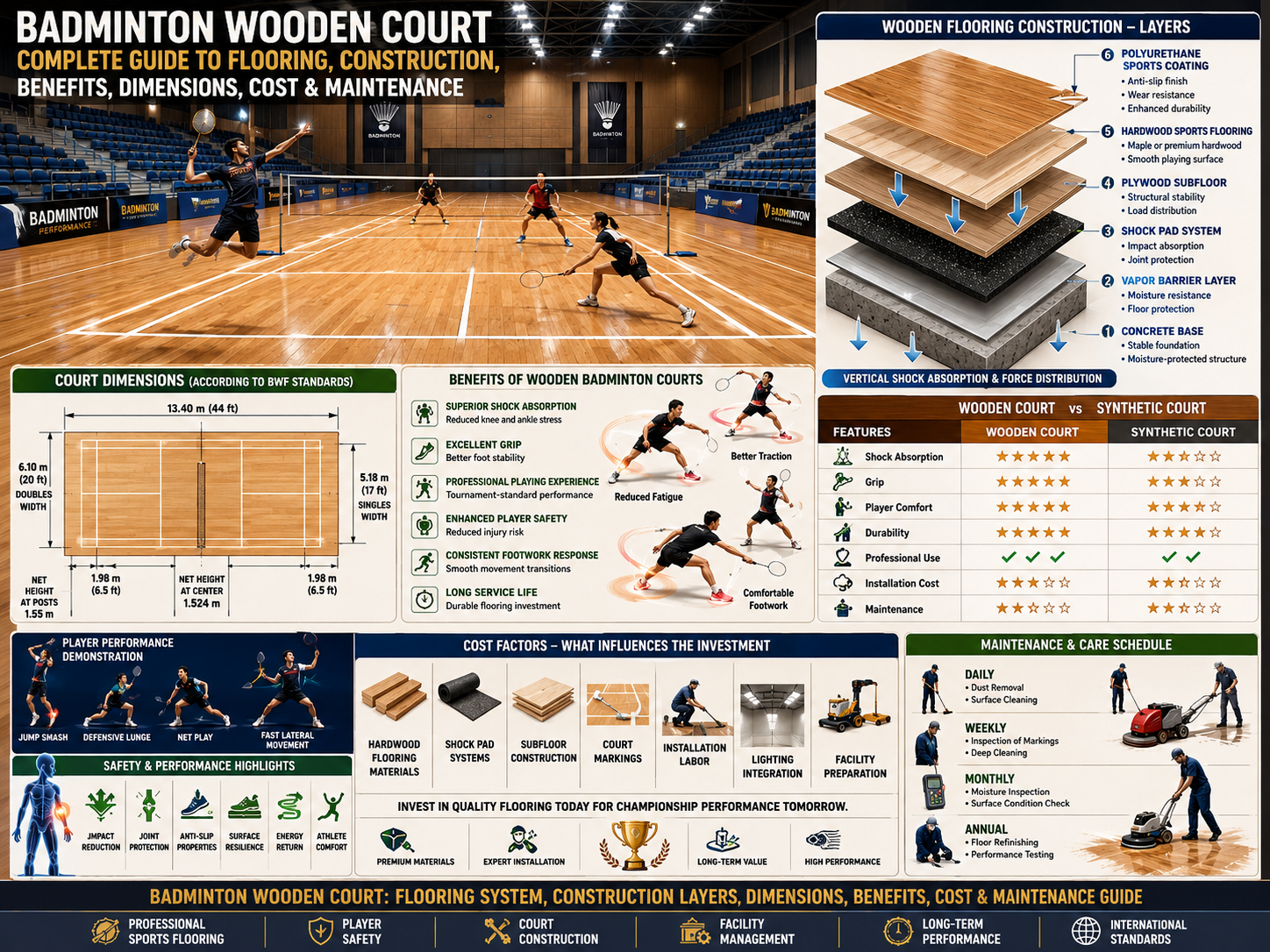
Wooden Badminton Court Flooring System
A professional badminton wooden court is normally constructed as a multi-layer system rather than a single flooring layer.
1. Structural Base
The concrete slab provides the foundation for the entire flooring system.
Before wooden flooring installation, the slab should be inspected for:
- Level variations
- Cracks
- Surface defects
- Moisture
- Weak areas
- Uneven patches
- Drainage or water-related problems
Installing expensive timber flooring over an unsuitable base can lead to movement, squeaking, moisture damage, unevenness, and premature deterioration.
The concrete surface should therefore be sufficiently cured, structurally stable, clean, and appropriately prepared before the flooring contractor proceeds.
2. Moisture Protection
Moisture is one of the biggest concerns in timber flooring construction.
Wood responds to changes in environmental humidity and moisture. If moisture migrates upward from the concrete slab, it can contribute to problems such as:
- Expansion
- Cupping
- Warping
- Joint movement
- Finish deterioration
- Fungal growth in unsuitable conditions
A suitable moisture-control strategy should therefore be incorporated into the floor design.
The exact membrane or moisture-management system should be selected according to the slab condition, building environment, flooring specification, and manufacturer’s recommendations.
3. Resilient Support Layer
The resilient support system is one of the most important components of a wooden sports floor.
Depending on the design, the system may use:
- Rubber pads
- Elastomeric cushions
- Resilient foam
- Timber battens
- Sleepers
- Specialized shock-absorbing components
The purpose is not simply to make the floor soft. The objective is to achieve a carefully controlled combination of resilience, stability, impact management, and load distribution.
An excessively soft floor can feel unstable, while an excessively rigid floor may provide inadequate cushioning. Professional sports flooring design aims for a controlled response appropriate to the intended use.
Hardwood Selection for Badminton Court Construction
Selecting the right timber is an important part of project planning.
Different wood species have different characteristics relating to hardness, dimensional stability, grain, availability, appearance, maintenance, and cost.
Maple Wood
Maple is widely associated with premium indoor sports flooring.
It is valued for:
- Consistent appearance
- Good wear resistance
- Strength
- Smooth finish
- Professional sports-flooring applications
Maple can be considered when the project requires a premium sports environment and the budget supports imported or high-grade hardwood systems.
Beech Wood
Beech is another hardwood used in sports flooring applications.
It offers a useful combination of:
- Strength
- Smooth appearance
- Wear resistance
- Stable performance
- Attractive finish
It can be suitable for academies, clubs, institutions, and indoor sports facilities depending on the flooring specification.
Teak Wood
Teak is commonly considered for premium timber applications in India because of its durability and attractive appearance.
However, choosing timber solely because it is a particular species is not enough. The flooring contractor should also evaluate timber quality, moisture content, grading, machining accuracy, installation method, and suitability for sports flooring.
Types of Wooden Badminton Court Flooring
Not every wooden badminton court needs the same construction system.
Sprung or Resilient Wooden Flooring
A sprung or resilient system uses engineered support components beneath the timber surface.
The support arrangement allows controlled movement under load and can improve impact management.
Suitable for
- Professional academies
- High-performance training facilities
- Sports clubs
- Tournament-oriented venues
- Premium indoor sports complexes
The design should be engineered carefully because the spacing, support components, timber construction, and overall floor response all influence performance.
Fixed Timber Sports Flooring
A fixed timber floor uses a more rigid construction arrangement than a fully resilient sprung system.
It can be appropriate for:
- Schools
- Colleges
- Community halls
- Clubs
- Multi-purpose indoor facilities
- Recreational sports centers
This option can provide a practical balance between durability, appearance, performance, and project cost.
Wooden Subfloor With Synthetic Badminton Mat
For many high-level badminton facilities, the wooden construction serves as the resilient foundation while a specialized badminton mat forms the actual playing surface.
This approach offers several advantages:
- Controlled traction
- Consistent playing response
- Professional competition appearance
- Replaceable playing surface
- Protection for the underlying timber system
The final specification should be selected according to the level of play and the requirements of the facility.
Badminton Wooden Court Construction Process
Successful court construction depends heavily on preparation. Rushing the installation can create problems that become expensive to correct later.
Site Inspection
The first stage is a detailed site assessment.
The contractor should evaluate:
- Available floor area
- Ceiling height
- Existing slab condition
- Floor levels
- Moisture conditions
- Ventilation
- HVAC requirements
- Lighting positions
- Access for material handling
- Drainage and water risks
For a new sports hall, these issues should ideally be considered during architectural planning.
Court Layout Planning
The court layout should be finalized before flooring installation.
The design should account for:
- Singles court
- Doubles court
- Run-off space
- Net position
- Service lines
- Center line
- Posts
- Player circulation
- Spectator or coaching areas where applicable
A common mistake is designing only around the painted court dimensions while ignoring the safety and circulation area surrounding it.
Concrete Base Preparation
The concrete base must be cleaned and prepared.
Any significant:
- Cracks
- High spots
- Low spots
- Surface contamination
- Loose material
- Moisture problems
should be addressed before the timber system is installed.
Precision at this stage has a major influence on the finished floor.
Moisture Testing and Protection
The concrete slab should be checked using an appropriate moisture-testing procedure.
If moisture conditions are unsuitable, installation should not simply continue because the timber has already arrived at the site.
A suitable moisture-control system should be installed according to the project’s technical specification.
Installing the Resilient Framework
The support system is positioned according to the flooring design.
The spacing and alignment of supports must be consistent.
Poor installation can result in:
- Uneven floor response
- Excessive movement
- Squeaking
- Localized deflection
- Premature wear
This is why sports flooring installation should be handled by technicians experienced in timber athletic flooring rather than general interior flooring installers.
Hardwood Installation
The selected timber is installed over the prepared support system.
Attention should be given to:
- Board alignment
- Joint arrangement
- Expansion requirements
- Moisture conditions
- Fastening
- Surface transitions
- Edge detailing
The installation must allow the timber system to respond appropriately to normal environmental changes.
Sanding and Surface Preparation
After installation, the timber surface is progressively sanded.
The purpose is to create a smooth, uniform surface suitable for finishing.
Professional sanding also helps remove minor installation irregularities and prepares the wood for the protective coating system.
Sports-Grade Finishing
A suitable sports flooring finish is applied to protect the hardwood.
The coating system should provide an appropriate balance between:
- Durability
- Traction
- Surface protection
- Appearance
- Ease of cleaning
The wrong finish can make a court excessively slippery or excessively sticky, both of which can negatively affect player movement.
Court Line Marking
Court markings should be accurately measured and professionally applied.
Lines need to be:
- Straight
- Consistent
- Clearly visible
- Correctly positioned
- Durable under regular cleaning
For multi-purpose sports halls, line colors and layouts should be planned carefully to avoid visual confusion.
Final Inspection
Before opening the court for use, the flooring system should be inspected.
The inspection should include:
- Surface flatness
- Visible defects
- Floor response
- Finish quality
- Court dimensions
- Line accuracy
- Net-post positioning
- General cleanliness
- Lighting and ventilation conditions
Only after the complete facility has been checked should the court be handed over for regular play.
Standard Badminton Court Dimensions
The playing dimensions of a badminton court are standardized internationally.
For a full doubles court, the playing area is:
13.40 metres long × 6.10 metres wide.
For singles play, the court remains 13.40 metres long, while the playing width is reduced to 5.18 metres.
Other important dimensions include:
- Net height at the posts: 1.55 metres
- Net height at the center: 1.524 metres
- Short service line: 1.98 metres from the net
- Doubles court width: 6.10 metres
- Singles court width: 5.18 metres
However, these dimensions represent the marked playing court. A building designer must also provide appropriate space around the court for player movement and safety.
For facilities intended for competitive or tournament use, the complete layout should be checked against the latest applicable badminton regulations and venue requirements rather than relying solely on the basic court rectangle.
How Much Does Wooden Badminton Court Construction Cost?
There is no single fixed price for a wooden badminton court because the total project cost depends on the complete flooring specification.
Major cost factors include:
- Timber species and grade
- Local or imported material
- Sprung or fixed construction
- Resilient support system
- Concrete preparation
- Moisture-control requirements
- Court size
- Number of courts
- PU or other finishing system
- Synthetic badminton mat, if required
- Court equipment
- Lighting
- HVAC
- Ceiling work
- Building construction
- Transportation
- Installation location
- Site accessibility
A basic timber sports floor and a professional competition-grade resilient flooring system can therefore have significantly different project costs.
Indicative Budget Considerations
In India, project quotations for wooden badminton flooring can vary substantially depending on material quality and system specification. Broad market estimates are often discussed in the range of several lakh rupees per court, but these figures should not be treated as a universal rate.
For an accurate quotation, the contractor should inspect the site and prepare a specification covering the complete flooring system.
Important: A low initial quote may not represent the lowest long-term cost. If the quotation excludes moisture protection, subfloor preparation, proper cushioning, finishing, or maintenance support, additional expenses may appear later.
Factors That Influence Badminton Court Construction Cost
Flooring Material
Premium imported hardwood generally costs more than locally sourced alternatives.
Subfloor Condition
A damaged or uneven concrete slab may require extensive preparation.
Cushioning System
Advanced resilient or sprung systems can increase the project cost but may provide improved sports performance.
Court Quantity
Constructing multiple courts within the same facility can affect installation and material economics.
Facility Location
Transportation, labor availability, accommodation, and logistics can influence project pricing.
Finish Quality
Sports-grade finishing systems, sanding, coatings, and specialized application methods affect both price and durability.
Additional Infrastructure
Lighting, HVAC, ceiling height, acoustic treatment, wall protection, spectator areas, and badminton equipment can significantly increase the total facility investment.
Advantages of Professional Wooden Badminton Court Construction
Better Player Comfort
A properly engineered resilient floor can provide a more comfortable playing environment than a rigid hard floor.
Improved Footwork Confidence
Controlled traction allows players to accelerate, stop, and change direction with greater confidence.
Reduced Surface-Related Stress
Appropriate impact management can reduce the harshness associated with repeatedly landing on very rigid surfaces.
Professional Facility Appearance
A high-quality wooden floor creates a premium environment for training, competition, and recreation.
Long-Term Durability
With appropriate construction and maintenance, quality timber flooring can remain functional for many years.
Multipurpose Use
Depending on its specification, wooden sports flooring can also support other indoor sports and activities.
Common Mistakes in Wooden Badminton Court Construction
Even expensive flooring can perform poorly when construction practices are inadequate.
Ignoring Moisture
Timber and uncontrolled moisture are a poor combination. Moisture testing and protection should be addressed before installation.
Installing Over an Uneven Base
Small defects in the concrete foundation can become larger flooring problems.
Choosing Wood Only by Appearance
Beautiful timber is not automatically suitable for sports flooring. Technical properties and system compatibility matter.
Using Ordinary Interior Flooring Finish
Residential wood finishes are not necessarily appropriate for high-intensity athletic movement.
Poor Support Spacing
Incorrect sleeper or resilient support placement can produce inconsistent floor response.
Incorrect Court Markings
A visually attractive floor is still unsuitable for competitive play if the lines are incorrectly positioned.
Insufficient Run-Off Space
Designing only the marked court and ignoring surrounding movement space can create safety problems.
Poor Environmental Control
Large fluctuations in humidity and temperature can affect timber flooring.
Choosing the Cheapest Contractor
Sports flooring requires specialized installation knowledge. A low-cost contractor without relevant experience can create problems that are expensive to repair.
Maintenance of a Wooden Badminton Court
Construction quality is only one part of the floor’s life cycle. Proper maintenance is equally important.
Daily Cleaning
Dust, grit, and debris should be removed regularly using suitable soft cleaning equipment.
Fine particles can act like abrasives and gradually wear the protective finish.
Control Moisture
Avoid excessive water during cleaning.
The floor should never be routinely flooded or left wet for extended periods.
Maintain Suitable Indoor Conditions
Stable indoor environmental conditions are important for timber flooring.
A controlled indoor environment helps reduce excessive expansion and contraction.
Use Appropriate Footwear
Players should use clean, non-marking indoor badminton shoes.
Outdoor footwear should not be permitted on the playing surface.
Prevent Heavy Point Loads
Unprotected heavy equipment, furniture, or sharp objects can damage the flooring.
When equipment needs to be moved, suitable protective measures should be used.
Inspect the Surface
Periodic inspections should look for:
- Scratches
- Worn finish
- Loose boards
- Gaps
- Squeaking
- Localized movement
- Moisture damage
Early detection is usually easier and less expensive to address.
Recoating and Refinishing
The protective finish may eventually require maintenance or renewal depending on traffic, usage, cleaning practices, and manufacturer recommendations.
The exact maintenance interval should be determined by the condition of the floor rather than following an arbitrary calendar alone.
Wooden Badminton Court vs Synthetic Badminton Flooring
Both wooden and synthetic systems can be suitable for badminton, but they serve different project requirements.
| Feature | Wooden Sports Flooring | Synthetic Badminton Flooring |
|---|---|---|
| Player comfort | Excellent with suitable resilient construction | Good to excellent depending on system |
| Appearance | Premium natural appearance | Modern and uniform |
| Shock absorption | Excellent in sprung systems | Depends on cushioning system |
| Maintenance | Requires controlled maintenance | Generally easier |
| Initial investment | Often higher | Can be more economical |
| Professional applications | Widely used | Widely used |
| Design flexibility | High | High |
| Multi-sport use | Possible | Depends on product |
The best choice depends on the facility’s budget, expected usage, performance objectives, maintenance capacity, and type of players.
Where Are Wooden Badminton Courts Used?
Wooden sports flooring is suitable for a wide range of indoor facilities.
Badminton Academies
Professional academies require durable floors capable of handling intensive daily training.
Schools and Colleges
Educational institutions can use wooden courts for badminton programs, physical education, and indoor activities.
Sports Clubs
Clubs often choose timber flooring because it combines performance with a premium appearance.
Stadiums and Tournament Venues
High-level facilities require carefully engineered sports flooring and accurate court layouts.
Corporate Sports Centers
Indoor courts can form part of employee recreation and wellness facilities.
Residential Sports Facilities
Premium residential developments may incorporate wooden badminton courts into clubhouse or recreation areas.
Multi-Purpose Sports Halls
With suitable design, a wooden floor can support multiple indoor sports and activities.
How to Choose a Wooden Badminton Court Contractor
Selecting the right contractor is as important as selecting the flooring material.
Before finalizing a company, evaluate:
Previous Sports Flooring Experience
Ask whether the contractor has completed actual badminton or indoor sports flooring projects.
Technical Specification
Request a written description of:
- Timber species
- Timber grade
- Moisture specification
- Support system
- Cushioning method
- Finish
- Installation process
- Warranty
Completed Project References
Where possible, review completed courts and speak with facility owners about long-term performance.
Installation Team
Sports flooring requires trained installers. Ask who will actually execute the installation rather than evaluating only the sales team.
Maintenance Support
A reliable contractor should be able to explain cleaning, recoating, repairs, and long-term maintenance.
Transparent Quotation
The quotation should clearly identify what is included and excluded.
A professional proposal should distinguish flooring cost from other facility components such as civil work, lighting, HVAC, ceiling systems, badminton equipment, and electrical work.
Planning a Badminton Wooden Court: Important Checklist
Before beginning construction, the project owner should confirm:
- Available building area
- Number of courts required
- Court orientation
- Ceiling height
- Concrete slab condition
- Moisture condition
- Flooring type
- Timber specification
- Cushioning system
- Court run-off space
- Lighting arrangement
- Ventilation and HVAC
- Wall protection
- Net-post system
- Court marking specification
- Cleaning requirements
- Maintenance plan
- Project budget
- Installation schedule
Planning these details early helps prevent expensive modifications later.
How to Make a Wooden Badminton Court Last Longer
The service life of a sports floor depends on more than the wood species.
A durable court requires:
Good design + correct installation + environmental control + proper cleaning + timely maintenance.
The facility should maintain appropriate indoor conditions, prevent water exposure, restrict unsuitable footwear, perform regular inspections, and address small defects before they develop into major structural problems.
Facility managers should also maintain records of cleaning, inspections, repairs, and refinishing work. This creates a useful maintenance history and helps identify recurring problems.
Future Trends in Badminton Wooden Court Construction
The sports flooring industry is moving toward systems that combine performance, durability, sustainability, and easier maintenance.
Future badminton facilities are likely to place greater emphasis on:
- Advanced resilient support systems
- Improved shock-management technology
- Moisture-resistant construction
- Low-emission finishing products
- Responsible timber sourcing
- Factory-engineered flooring components
- Improved installation accuracy
- Longer maintenance cycles
- Multi-purpose sports flooring systems
Sustainability is also becoming increasingly important. Responsible material sourcing, efficient manufacturing, durable finishes, and longer flooring life can reduce the environmental impact associated with repeated replacement.
Frequently Asked Questions About Badminton Wooden Court Construction
1. What is a wooden badminton court?
A wooden badminton court is a specialized indoor sports flooring system made from hardwood and engineered support components. It is designed to provide stability, controlled resilience, player comfort, and reliable movement during badminton.
2. Is wooden flooring good for badminton?
Yes. Properly engineered wooden sports flooring is widely used for badminton because it can provide excellent resilience, comfort, traction, and consistent playing characteristics.
3. Which wood is best for a badminton court?
Maple, beech, and teak can all be considered depending on the project. However, the overall flooring system is more important than wood species alone. Timber grade, moisture content, support structure, finishing, and installation quality all influence performance.
4. What is the standard size of a badminton court?
A doubles badminton court measures 13.40 metres long and 6.10 metres wide. A singles court has the same length but a width of 5.18 metres.
5. Does a badminton wooden court require a concrete base?
In most conventional indoor installations, a properly prepared structural base is required to support the complete flooring system. The exact base construction depends on the building and flooring design.
6. Is a sprung wooden floor better than a fixed wooden floor?
A properly designed sprung or resilient system generally provides greater controlled cushioning than a rigid fixed system. The best option depends on the intended use, player level, facility requirements, and budget.
7. Can a synthetic badminton mat be installed over a wooden floor?
Yes. Many professional badminton facilities use a synthetic playing mat over a specialized resilient wooden subfloor. This combination can provide a stable foundation with a dedicated badminton playing surface.
8. How long can a wooden badminton court last?
A well-designed and properly maintained sports floor can provide many years of service. Actual service life depends on timber quality, construction, traffic, environmental conditions, maintenance, and the quality of the original installation.
9. How much does wooden badminton court construction cost in India?
The cost varies considerably according to timber, flooring system, site condition, cushioning, finishing, location, and project scope. A reliable quotation should be based on a site inspection and detailed technical specification rather than a generic per-court price.
10. How should a wooden badminton court be cleaned?
Routine dust and debris should be removed using appropriate dry or minimally damp cleaning methods recommended for the specific finish. Excessive water should be avoided.
11. Can wooden badminton flooring be used for basketball or volleyball?
Yes, depending on the flooring system. Properly specified wooden sports floors can be designed for multiple indoor sports, but the performance requirements of each sport should be considered before selecting the system.
12. Why is moisture control important in wooden court construction?
Wood naturally responds to moisture changes. Uncontrolled moisture can contribute to expansion, warping, gaps, finish damage, and other flooring problems. Proper slab preparation and moisture management are therefore essential.
Conclusion
Badminton wooden court construction is a technical sports-infrastructure project, not simply a flooring installation. The final performance of the court depends on every stage, from building design and concrete preparation to moisture control, resilient support installation, hardwood selection, sanding, finishing, and accurate court marking.
A high-quality wooden badminton floor can provide a combination of player comfort, controlled shock absorption, dependable traction, durability, professional appearance, and long-term value. For academies, schools, colleges, clubs, sports complexes, and professional training facilities, it can become a major part of creating a high-quality badminton environment.
The most important decision is not simply choosing the most expensive wood. Instead, the flooring should be selected as a complete engineered system based on the facility’s intended use, player level, daily traffic, indoor environment, budget, and maintenance capabilities.
For a successful project, work with an experienced sports flooring contractor, insist on a detailed technical specification, verify the condition of the concrete base, address moisture before installation, and plan the complete court layout before construction begins.
When these elements are handled correctly, a professionally constructed wooden badminton court can provide a reliable, attractive, and high-performance playing environment for years to come.
Final Takeaway
If you are planning badminton wooden court construction in India, focus on five fundamentals:
- Prepare the structural base correctly.
- Control moisture before installing timber.
- Choose the appropriate resilient or sprung flooring system.
- Use sports-grade hardwood and finishing materials.
- Follow a disciplined cleaning and maintenance program.
The combination of good engineering, quality materials, skilled installation, and ongoing maintenance is what transforms a basic indoor floor into a professional badminton court.