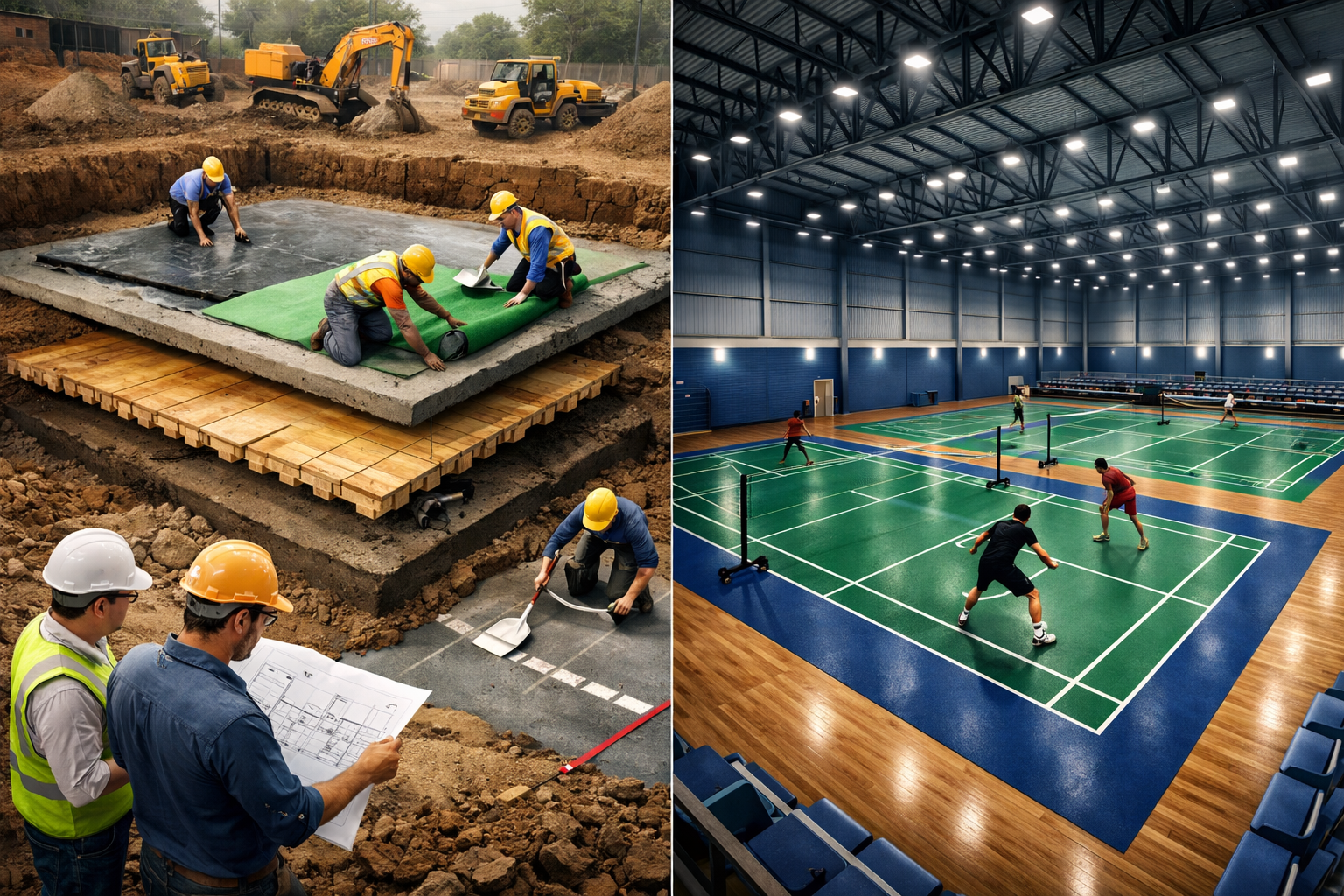
Badminton has rapidly evolved into one of the most popular indoor sports across India, played in schools, sports academies, residential communities, and professional arenas. As the demand for quality infrastructure grows, the importance of professional badminton court construction becomes increasingly significant. A well-constructed court is not just a playing surface—it is a carefully engineered system designed to enhance performance, ensure safety, and deliver long-term durability.
From selecting the right flooring materials to designing proper lighting and ventilation systems, every aspect of badminton court construction plays a vital role in creating an optimal playing environment. In this comprehensive guide, we explore the essential elements, construction process, benefits, and modern trends in building world-class badminton courts.
What is Badminton Court Construction?
Badminton court construction refers to the complete process of designing, developing, and installing a badminton playing facility that meets professional standards. It includes site preparation, structural design, flooring installation, court markings, lighting systems, and accessories.
A professionally built court ensures:
- Accurate dimensions and layout
- High-performance playing surface
- Player safety and comfort
- Long-lasting durability
Whether for recreational use or competitive tournaments, proper construction ensures consistent gameplay and minimal maintenance.
Importance of Professional Badminton Court Construction
A badminton court is more than just a marked surface. Poor construction can lead to uneven flooring, reduced grip, increased injury risks, and higher maintenance costs. Investing in professional construction ensures long-term value and superior performance.
Key Benefits
1. Enhanced Player Safety
High-quality flooring systems with shock absorption reduce stress on joints and minimize the risk of injuries during fast-paced movements.
2. Improved Gameplay Performance
A smooth, level surface with proper grip allows players to move quickly and maintain balance, resulting in better performance.
3. Structural Durability
Premium construction materials ensure resistance to wear, environmental conditions, and heavy usage over time.
4. Professional Appearance
Well-designed courts enhance the visual appeal of the facility, making it more attractive for players, spectators, and events.
5. Low Maintenance Costs
Durable materials and proper installation reduce the need for frequent repairs and resurfacing.
Types of Badminton Courts
Indoor Badminton Courts
Indoor courts are the preferred choice for professional and training facilities. They provide controlled environmental conditions and consistent gameplay.
Advantages:
- Protection from weather conditions
- Better lighting and ventilation control
- Longer lifespan
Outdoor Badminton Courts
Outdoor courts are suitable for recreational use and community spaces.
Advantages:
- Lower construction cost
- Quick installation
- Ideal for open areas
However, outdoor courts are more exposed to weather conditions, which can affect durability and gameplay.
Standard Badminton Court Dimensions
A professional badminton court must follow standard measurements:
- Length: 13.4 meters
- Width: 6.1 meters (doubles), 5.18 meters (singles)
- Net Height: 1.55 meters at edges, 1.524 meters at center
In addition to the playing area, extra space is required around the court for safety and movement.
Key Components of Badminton Court Construction
1. Site Preparation and Base Construction
The foundation is critical for the stability of the court. A concrete or asphalt base is typically used to ensure a level and durable surface.
2. Flooring Systems
Choosing the right flooring is essential for performance and safety.
Wooden Flooring
- Preferred for professional tournaments
- Provides natural feel and excellent shock absorption
PVC Vinyl Flooring
- Ideal for indoor courts
- Offers good grip and cushioning
- Low maintenance
PU (Polyurethane) Flooring
- Seamless and durable
- Suitable for high-traffic areas
Acrylic/Synthetic Flooring
- Used for outdoor courts
- Weather-resistant and cost-effective
3. Court Marking
Accurate line marking is essential for fair gameplay. Professional-grade paints ensure long-lasting visibility and adherence to official standards.
4. Lighting System
Lighting plays a crucial role in visibility and player performance.
Key Features:
- Uniform brightness across the court
- Glare-free illumination
- High-mounted LED fixtures
LED lighting is widely preferred due to energy efficiency and consistent output.
5. Ventilation and Airflow
Proper ventilation is essential for indoor courts to maintain a comfortable playing environment.
Solutions include:
- Natural ventilation through windows
- Exhaust fans and air circulation systems
- HVAC systems for temperature control
6. Net and Accessories
A complete badminton court includes:
- Professional net and posts
- Scoreboards
- Player seating
- Umpire chairs
- Safety padding
These elements enhance both functionality and user experience.
Step-by-Step Badminton Court Construction Process
1. Site Inspection
Evaluation of location, soil condition, space availability, and environmental factors.
2. Design and Planning
Preparation of layout, selection of materials, and customization based on client requirements.
3. Base Preparation
Construction of a strong and level foundation using concrete or other suitable materials.
4. Flooring Installation
Installation of selected flooring system with proper cushioning and finishing.
5. Line Marking and Equipment Setup
Precise marking of court lines followed by installation of net systems and accessories.
6. Lighting and Finishing
Installation of lighting systems, ventilation, and final touches.
7. Inspection and Handover
Quality checks to ensure compliance with standards before project completion.
Applications of Badminton Court Construction
Professional badminton courts are built for various facilities:
Educational Institutions
Schools and colleges use badminton courts to promote sports and physical fitness.
Sports Academies
Training centers require high-performance courts for professional coaching.
Residential Communities
Modern housing projects include badminton courts as recreational amenities.
Clubs and Fitness Centers
Sports clubs attract members by offering quality badminton facilities.
Indoor Stadiums
Large venues host tournaments and events, requiring multiple courts.
Cost Factors in Badminton Court Construction
The cost of constructing a badminton court depends on several factors:
- Type of court (indoor or outdoor)
- Flooring material
- Number of courts
- Lighting and ventilation systems
- Accessories and additional facilities
While costs vary, investing in high-quality construction ensures better durability and lower maintenance expenses over time.
Maintenance Tips for Long-Term Performance
To maintain the quality and performance of a badminton court:
- Clean the surface regularly
- Avoid dragging heavy objects
- Inspect flooring for damage
- Repaint lines when necessary
- Schedule periodic resurfacing
Proper maintenance extends the lifespan and ensures consistent gameplay.
Latest Trends in Badminton Court Construction
Eco-Friendly Materials
Use of sustainable flooring and energy-efficient lighting systems.
Smart Sports Facilities
Integration of digital scoreboards and performance tracking systems.
Modular Court Systems
Portable and easy-to-install courts for temporary setups and events.
Advanced Shock Absorption Technology
Modern flooring systems designed to reduce injury risks and improve comfort.
Why Choose Professional Badminton Court Construction Services?
Hiring experienced professionals ensures:
- Accurate court dimensions
- High-quality materials
- Efficient project execution
- Compliance with international standards
- Long-term reliability
Professional construction guarantees a court that performs consistently and meets user expectations.
Conclusion
Badminton court construction is a specialized process that requires expertise, precision, and high-quality materials. A well-built court enhances player performance, ensures safety, and provides long-term value for any facility.
Whether you are planning a court for a school, sports academy, residential complex, or professional venue, investing in expert construction is essential. From design and planning to installation and maintenance, every step plays a crucial role in delivering a world-class playing environment.
By focusing on quality, innovation, and proper planning, you can create a badminton court that meets international standards and stands the test of time. A professionally constructed badminton court is not just a sports facility—it is a foundation for excellence, fitness, and community engagement.
Frequently Asked Questions (FAQs) – Badminton Court Construction
1. What is badminton court construction?
Badminton court construction is the complete process of designing and building a badminton playing surface, including base preparation, flooring installation, court marking, lighting, and accessories to meet professional standards.
2. What is the standard size of a badminton court?
A standard badminton court measures:
- Length: 13.4 meters
- Width: 6.1 meters (doubles) and 5.18 meters (singles)
- Net Height: 1.55 meters at edges and 1.524 meters at the center
3. How much does it cost to construct a badminton court in India?
The cost depends on factors like flooring type, number of courts, and indoor or outdoor setup. On average, it can range from ₹5 lakh to ₹50 lakh or more based on quality and project scale.
4. Which flooring is best for badminton court construction?
The best flooring options include:
- Wooden flooring – Ideal for professional courts
- PVC vinyl flooring – Popular for indoor courts
- PU flooring – Durable and seamless
- Acrylic flooring – Suitable for outdoor courts
5. How long does it take to build a badminton court?
Construction typically takes 2 to 6 weeks depending on site conditions, type of court, and project complexity.
6. What base is required for a badminton court?
A strong, level base is essential. Common options include:
- Concrete base
- Asphalt base
- Wooden subfloor (for indoor courts)
7. Is indoor or outdoor badminton court better?
Indoor courts are preferred because they:
- Provide better playing conditions
- Protect against weather
- Offer longer durability
Outdoor courts are more economical but less suitable for professional play.
8. What lighting is required for badminton courts?
Badminton courts require uniform, glare-free LED lighting installed at sufficient height to ensure clear visibility of the shuttlecock.
9. How do you maintain a badminton court?
Maintenance includes:
- Regular cleaning
- Avoiding heavy impact or dragging objects
- Periodic inspection
- Repainting court lines
- Resurfacing when needed