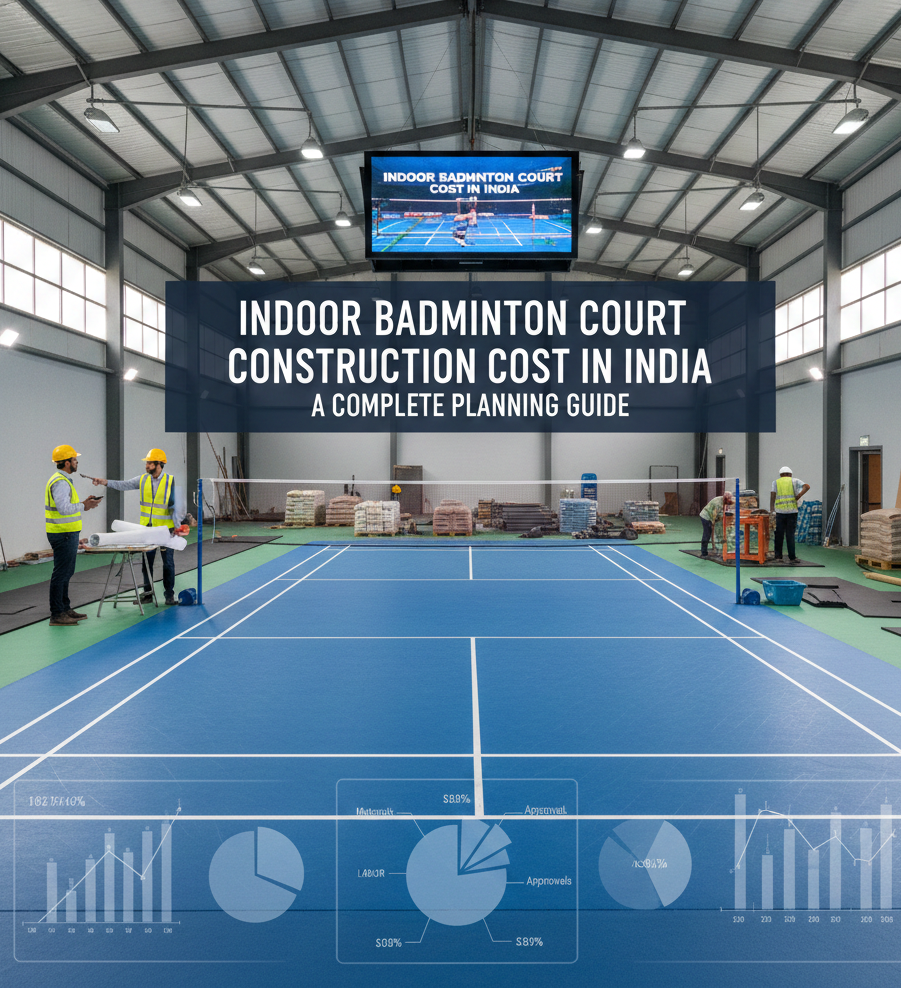
Badminton has become one of India’s most widely played indoor sports, enjoyed by people across age groups—from school students and fitness enthusiasts to competitive athletes. With the rise of professional coaching academies, corporate wellness programs, and residential sports facilities, the demand for well-designed indoor badminton courts has increased significantly.
An indoor badminton court offers controlled playing conditions, better safety, and year-round usability. However, before starting construction, one crucial question arises for most project planners and investors: What does it cost to build an indoor badminton court in India?
This comprehensive guide explains indoor badminton court construction costs, standard specifications, material options, design considerations, and long-term value—helping you plan your project efficiently and professionally.
1. Why Build an Indoor Badminton Court?
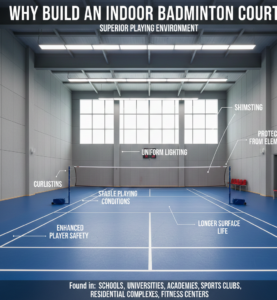
Indoor badminton courts provide a superior playing environment compared to outdoor courts. Since badminton is highly sensitive to wind, lighting, and surface quality, indoor facilities ensure consistent gameplay throughout the year.
Key Advantages of Indoor Courts
-
Stable playing conditions without wind or sunlight interference
-
Enhanced player safety through cushioned flooring systems
-
Uniform lighting that improves visibility
-
Protection from rain, humidity, and temperature fluctuations
-
Longer surface life due to controlled environment
Because of these benefits, indoor badminton courts are commonly found in schools, universities, training academies, sports clubs, residential complexes, and commercial fitness centers.
2. Standard Court Dimensions and Space Requirements
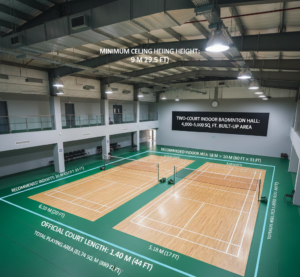
To ensure fair play and professional-level quality, indoor badminton courts must follow Badminton World Federation (BWF) specifications.
Official Court Dimensions
| Specification | Measurement (Meters) | Measurement (Feet) |
|---|---|---|
| Court Length | 13.40 m | 44 ft |
| Court Width (Singles) | 5.18 m | 17 ft |
| Court Width (Doubles) | 6.10 m | 20 ft |
| Total Playing Area (Doubles) | 81.74 sq. m | 880 sq. ft |
| Recommended Indoor Area | 18 m × 10 m | 60 ft × 33 ft |
| Minimum Ceiling Height | 9 m | 29.5 ft |
Additional space is required around the playing area for player movement, officials, lighting systems, and ventilation. For multiple courts, shared walkways and structural elements help optimize space usage.
A two-court indoor badminton hall generally requires 4,500–5,000 sq. ft. of built-up area.
3. Flooring Options and Their Cost Impact
The type of flooring selected plays the most significant role in determining construction costs. Each option offers different performance levels, durability, and price points.
Wooden Sports Flooring
Wooden flooring is the preferred surface for professional and tournament-level badminton courts.
Features:
-
Excellent shock absorption
-
Superior playing comfort
-
Natural bounce and grip
-
Long lifespan
Common Materials: Maple or teak top layer with pine or rubber shock pads underneath.
Cost Range: ₹4.5 lakh – ₹5.5 lakh per court
Synthetic Vinyl (PVC) Flooring
PVC or vinyl flooring is a popular choice for academies and recreational facilities due to its affordability and ease of maintenance.
Features:
-
Good cushioning and traction
-
Anti-slip surface
-
Moisture-resistant
-
Faster installation
Cost Range: ₹2.5 lakh – ₹3.5 lakh per court
PU or Hybrid Flooring Systems
Polyurethane and hybrid flooring systems are increasingly used in premium indoor sports facilities.
Features:
-
Seamless finish
-
High durability
-
Excellent impact absorption
-
Professional appearance
Cost Range: ₹4 lakh – ₹6 lakh per court
4. Detailed Cost Breakdown for Indoor Badminton Court Construction (2025)
Below is an approximate cost estimate for constructing a single indoor badminton court in India:
| Component | Description | Estimated Cost (₹) |
|---|---|---|
| Civil Work & Base Preparation | RCC/PCC flooring, leveling, curing | ₹80,000 – ₹1,20,000 |
| Sports Flooring System | Wooden / PVC / PU | ₹2,50,000 – ₹5,50,000 |
| LED Lighting System | 8–12 glare-free fixtures | ₹80,000 – ₹1,20,000 |
| Electrical Wiring & Panels | Switches, cabling, safety systems | ₹40,000 – ₹60,000 |
| Wall Treatment & Paint | Anti-glare matte finish | ₹40,000 – ₹60,000 |
| Net Poles & Accessories | BWF-standard posts and nets | ₹20,000 – ₹30,000 |
| Ventilation & Airflow System | Fans or exhaust units | ₹50,000 – ₹80,000 |
| Miscellaneous Works | Markings, drainage, finishing | ₹30,000 – ₹50,000 |
Total Estimated Cost per Court
-
Budget Setup (PVC Flooring): ₹4.5 lakh – ₹6 lakh
-
Professional Wooden Court: ₹6.5 lakh – ₹8.5 lakh
-
Premium Indoor Facility: ₹8 lakh – ₹10 lakh
Costs may vary based on city, labor rates, material brands, and building structure.
5. Factors That Influence Construction Cost
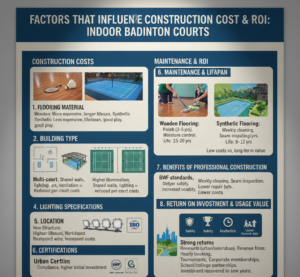
Several variables affect the final cost of an indoor badminton court:
1. Flooring Material
Wooden courts are more expensive than synthetic options but offer longer lifespan and better play quality.
2. Building Type
Constructing a new indoor structure costs more than upgrading an existing hall.
3. Number of Courts
Multi-court facilities benefit from shared walls, lighting, and ventilation, reducing per-court costs.
4. Lighting Specifications
Higher illumination levels and professional-grade fixtures increase installation costs.
5. Location
Urban locations generally have higher labor and logistics expenses.
6. Certifications
BWF-approved or ISO-certified materials ensure compliance but slightly raise initial investment.
6. Maintenance Costs and Lifespan
Regular upkeep ensures consistent performance and extends the court’s life.
Wooden Flooring Maintenance
-
Polishing every 3–5 years
-
Regular dust removal
-
Moisture control
Expected Life: 15–20 years
Synthetic Flooring Maintenance
-
Weekly cleaning with mild detergent
-
Periodic inspection of seams
-
Repainting court markings every few years
Expected Life: 8–12 years
Maintenance costs are relatively low compared to the long-term value these courts deliver.
7. Benefits of Professional Construction
Opting for professional indoor badminton court construction offers several advantages:
-
Compliance with BWF standards
-
Improved player safety and reduced injuries
-
Better aesthetics and facility branding
-
Increased usability and booking potential
-
Lower long-term repair costs
Well-constructed indoor courts attract players, tournaments, and coaching programs, making them a valuable asset.
8. Return on Investment and Usage Value
Indoor badminton courts offer strong returns, especially in urban and semi-urban areas. Revenue can be generated through:
-
Hourly court bookings
-
Coaching academies
-
Tournaments and leagues
-
Corporate memberships
-
School or college partnerships
With consistent demand, many facilities recover their investment within a few years.
9. Conclusion
Constructing an indoor badminton court in India is a strategic investment in sports infrastructure and community wellness. While the average construction cost ranges from ₹6 lakh to ₹10 lakh per court, the benefits include year-round playability, professional performance standards, and long-term durability.
Choosing the right flooring system, ensuring proper lighting and ventilation, and working with experienced contractors are key to building a high-quality indoor badminton court.
Whether you plan to develop a single-court facility or a full-fledged badminton academy, a professionally constructed indoor court ensures safety, performance, and lasting value for players and operators alike.