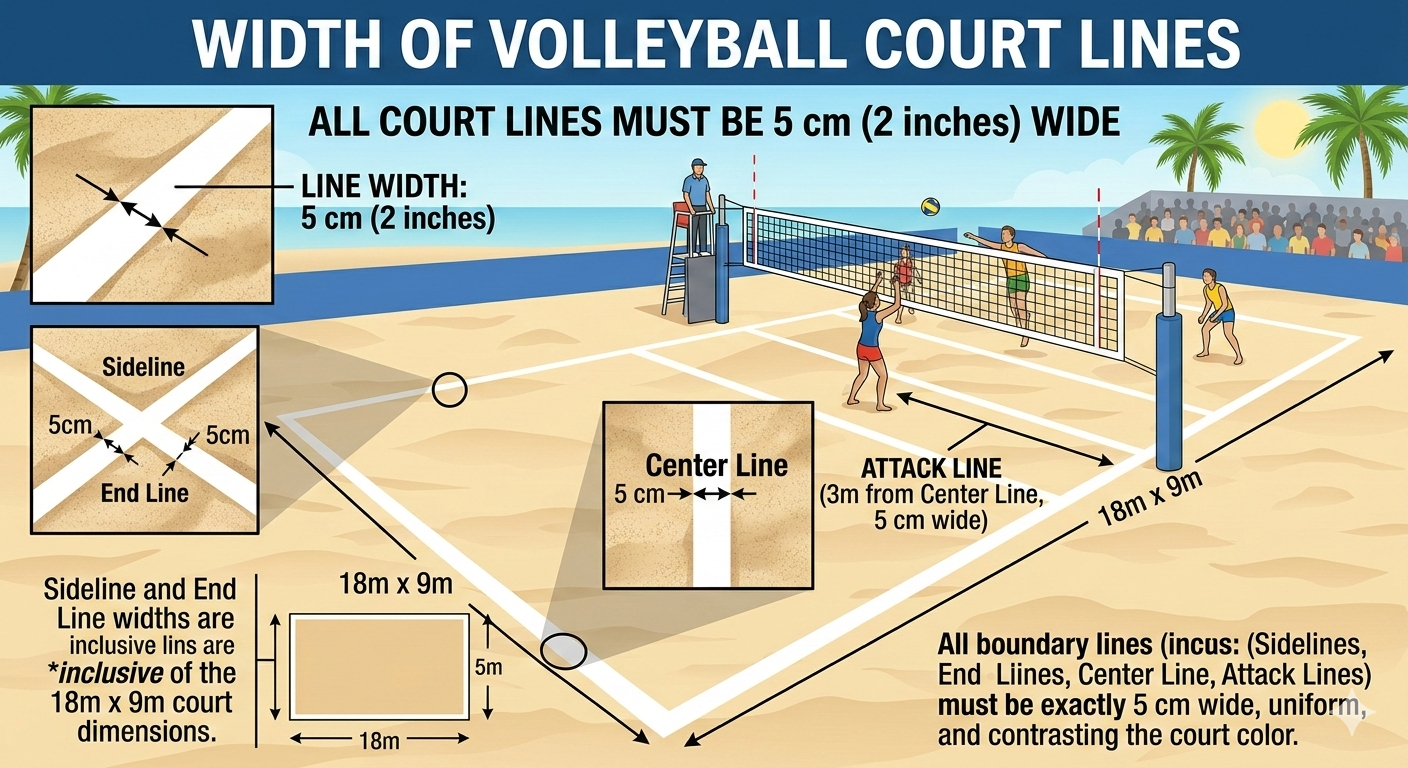
Volleyball is a dynamic and fast-paced sport that requires precise court markings for fair play and consistency. The dimensions and markings of a volleyball court play a crucial role in determining the accuracy of the game. One of the most important yet often overlooked elements of a volleyball court is the width of the court lines. Understanding their correct measurements and placement helps ensure the game adheres to official international standards set by the Fédération Internationale de Volleyball (FIVB) and other governing bodies.
In this comprehensive guide, we will discuss the standard width of volleyball court lines, their purpose, how they are marked, and why accuracy in line marking is critical for competitive play.
1. Standard Volleyball Court Dimensions
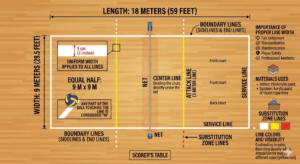
Before discussing the line width, it’s important to understand the basic court dimensions.
According to FIVB standards, a standard volleyball court measures:
-
Length: 18 meters (59 feet)
-
Width: 9 meters (29.5 feet)
This rectangular area is divided into two equal halves by a net, each half measuring 9 meters by 9 meters. All lines on the court are considered part of the playing area.
2. Standard Width of Volleyball Court Lines
The width of all volleyball court lines is 5 centimeters (2 inches).
This uniform measurement applies to all lines, including:
-
Boundary lines (end lines and sidelines)
-
Center line
-
Attack line (3-meter line)
-
Service line
-
Substitution zone lines
These 5 cm-wide lines are drawn inside the court dimensions, meaning the actual playing area includes the lines themselves. Therefore, any part of the ball touching the line is considered “in.”
3. Types of Volleyball Court Lines
Each line on the volleyball court serves a specific function. Let’s break down the purpose of each one:
a) Boundary Lines
-
The sidelines mark the length of the court (18 m), and the end lines mark the width (9 m).
-
The 5 cm wide boundary lines define the playable area.
-
Any ball landing on these lines is considered in bounds.
b) Center Line
-
The center line divides the court into two equal halves (9 m x 9 m).
-
It runs directly under the net and extends fully from one sideline to the other.
-
Each team must remain on its own side, though players can step on (but not over) the center line during play.
c) Attack Line (3-Meter Line)
-
Also known as the front zone line or 3-meter line, this line is drawn 3 meters from the center line on each side of the court.
-
It separates the front court (where front-row players can attack the ball) from the back court (where back-row players must attack from behind this line).
d) Service Line
-
The service line, also called the end line, is where the player stands while serving the ball.
-
The player must not step on or across this line during service.
e) Substitution Zone Lines
-
Marked outside the court near the scorer’s table, these lines help manage player substitutions during the game.
4. Importance of Proper Line Width
The accuracy of the 5 cm line width is vital for maintaining fairness and consistency in matches. Here’s why:
-
Fair Judgement of “In” or “Out” Calls:
Since the lines are considered part of the court, having uniform width ensures that the ball’s contact with the line is easily visible and judged accurately. -
Standardization Across Venues:
Consistent line width ensures that all courts—whether for local, national, or international tournaments—maintain the same standard of play. -
Player Safety:
Properly marked lines with standard width ensure that players can clearly see court boundaries, reducing the risk of injury during fast-paced rallies. -
Professional Aesthetic:
Courts with correctly measured and painted lines appear professional and meet the expectations of governing bodies for competitions.
5. Materials Used for Court Line Marking
Depending on the type of surface (indoor or outdoor), different materials are used to mark the volleyball court lines:
-
Indoor Volleyball Courts:
Lines are usually painted using PU (polyurethane) or acrylic paints on wooden, synthetic, or vinyl floors. The paint must be non-slip, durable, and resistant to wear. -
Outdoor Volleyball Courts:
On concrete or asphalt surfaces, acrylic-based paints are preferred for weather resistance.
For sand volleyball courts, taped or rope lines (usually 5 cm wide) are laid on the surface. -
Synthetic Courts (PU, PVC, or Rubber):
The lines are either painted or pre-marked as part of the flooring system.
6. Line Colors and Visibility
According to FIVB regulations:
-
All lines should be 5 cm wide and contrasting in color with the playing surface.
-
The boundary lines are typically white to enhance visibility against colored court flooring.
-
The attack line and center line may be painted in a different color (often yellow or red) to help distinguish zones clearly.
High-contrast colors not only improve gameplay accuracy but also enhance visibility for referees and players.
7. Maintenance of Court Lines
Proper maintenance ensures longevity and consistent performance of court markings.
Key maintenance tips include:
-
Regularly cleaning the surface to prevent dust and fading.
-
Repainting worn-out lines to maintain visibility.
-
Ensuring the lines remain exactly 5 cm wide during touch-ups.
-
For outdoor courts, reapplying paint after rainy seasons or heavy use.
8. Common Mistakes in Court Line Marking
Some common errors to avoid include:
-
Incorrect line width (less than or more than 5 cm).
-
Lines placed outside the official dimensions, which can affect gameplay.
-
Low-contrast colors, making boundaries difficult to see.
-
Uneven line edges caused by poor-quality tape or paint application.
Using professional marking tools and following FIVB guidelines ensures precise and durable markings.
9. Conclusion
The width of volleyball court lines may seem like a small detail, but it holds great significance in maintaining the integrity and accuracy of the sport. The official 5 cm (2 inches) line width ensures fairness, visibility, and consistency across all levels of play. From international tournaments to local games, adhering to these standards is essential for quality gameplay.
Whether it’s an indoor wooden court or an outdoor synthetic or sand surface, maintaining proper line width, color contrast, and placement guarantees a professional and safe playing environment.
In conclusion, the width of volleyball court lines is not just a technical specification—it represents the precision and discipline that make volleyball a globally respected and enjoyable sport.