Badminton is a sport that blends agility, strategy, and precision, played across the world in homes, schools, and professional arenas. But while most people enjoy the thrill of fast rallies and sharp smashes, few pay attention to one of the most fundamental aspects of the game — the court dimensions.
Among all dimensions, the width of a badminton court plays a vital role in determining the game’s fairness, shot accuracy, and player movement. Whether you are constructing a badminton court, learning the game, or designing one for an academy, understanding the correct width and its importance is essential.
In this article, we’ll explore the official width of a badminton court, how it differs between singles and doubles play, its role in game strategy, and why maintaining the correct dimensions matters.
1. Standard Dimensions of a Badminton Court
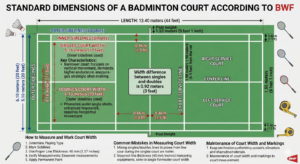
According to the Badminton World Federation (BWF), the governing body for international badminton, a standard court has the following official dimensions:
-
Length: 13.40 meters (44 feet)
-
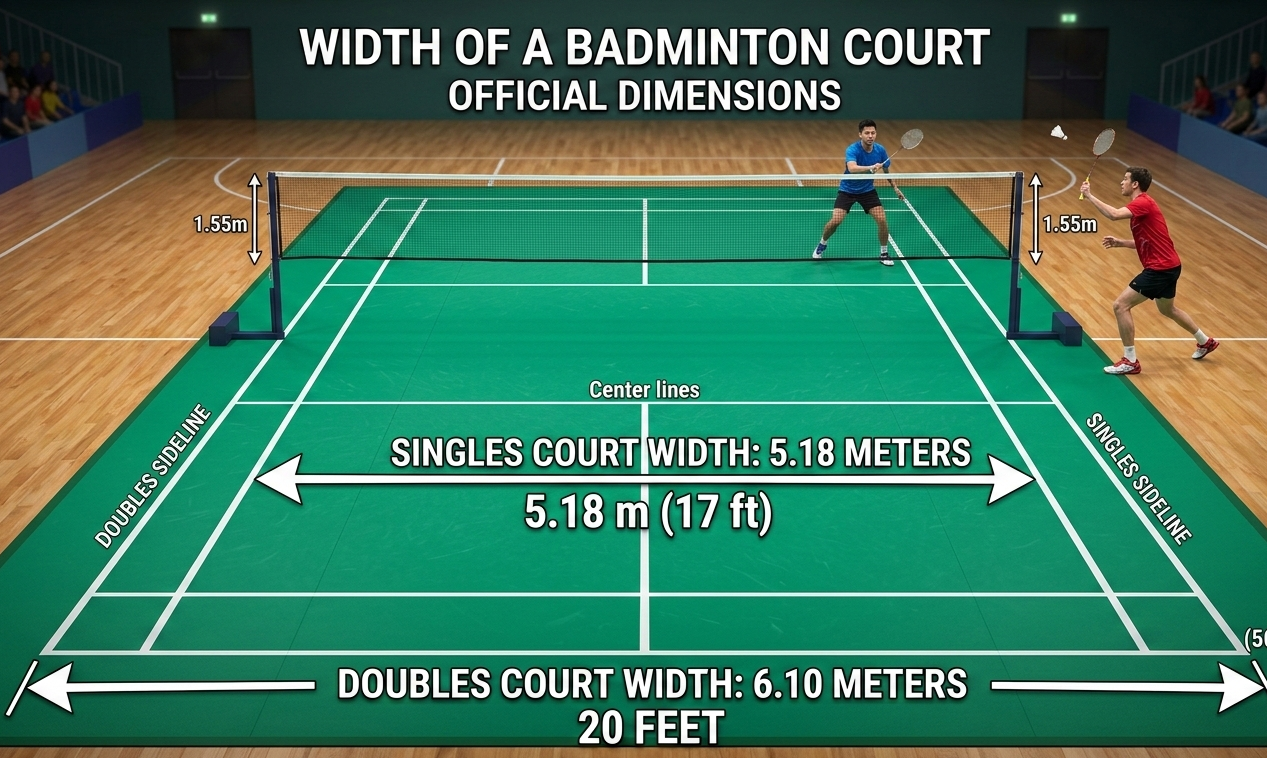
Width (for doubles): 6.10 meters (20 feet)
-
Width (for singles): 5.18 meters (17 feet)
These measurements are consistent worldwide, ensuring that every match — whether played in India, Indonesia, Denmark, or Japan — takes place on an identical playing field.
The slight variation in width between singles and doubles play reflects the difference in gameplay styles. Doubles players have a broader area to cover and use the outer sidelines, whereas singles players focus on agility and precision within a narrower court.
2. Width of the Court for Singles and Doubles
The difference in the width of the badminton court changes how the game is played. Let’s break down both variations in detail:
a) Singles Court Width – 5.18 meters (17 feet)
In singles matches, only the inner sidelines are used as boundaries. This narrower space creates a more controlled and tactical game, where players must rely on precision, placement, and stamina.
-
Key Characteristics:
-
Narrower court focuses on vertical movement (front-to-back).
-
Demands higher endurance since one player covers the entire area.
-
Encourages strategic shot-making rather than brute strength.
-
b) Doubles Court Width – 6.10 meters (20 feet)
In doubles play, the outer sidelines become active, widening the court by nearly one meter. The broader width adds a dynamic team-based element to the sport.
-
Key Characteristics:
-
Promotes wider angle shots and faster rallies.
-
Enhances teamwork and coordination between partners.
-
Requires more horizontal movement and quick reflexes.
-
In simple terms, the width difference between singles and doubles is 0.92 meters (3 feet) — and this small variation dramatically changes the rhythm and strategy of the game.
3. Why the Court Width Is Important
The width of a badminton court may seem like a minor detail, but it has a deep impact on the sport’s design and gameplay.
a) Ensures Fair Play
Standardized width allows players around the world to compete under identical conditions. Whether in a school tournament or an international championship, every match is played on a uniform court.
b) Affects Game Strategy
Players base their shot selection, footwork, and positioning on the court’s width. For instance:
-
In singles, narrow width promotes deep clears and drop shots.
-
In doubles, players use cross-court smashes and wide drives.
c) Influences Player Training
Coaches plan drills and movement exercises based on court width. Practicing on non-standard dimensions can negatively affect timing and positioning.
d) Helps Maintain Consistency
Correct width ensures that every serve, rally, and return is judged fairly, preventing confusion about whether the shuttlecock is “in” or “out.”
e) Enhances Safety
When the correct width is marked, players get enough space for safe movement and avoid collisions or overreaching injuries.
4. How to Measure and Mark the Width of a Badminton Court
Constructing a badminton court with accurate width is crucial for proper gameplay. Below is a simplified process to measure and mark the court width according to BWF standards.
Step 1: Determine the Playing Type
-
Singles: Use a width of 5.18 meters (17 feet).
-
Doubles: Use a width of 6.10 meters (20 feet).
Step 2: Mark the Sidelines
The court width is defined by two parallel sidelines that run the entire length of the court. For doubles, use the outer lines; for singles, use the inner ones.
Step 3: Use Proper Line Thickness
Each line should be 40 mm (1.57 inches) wide. The width of the lines is included within the measurement of the court.
Step 4: Verify Measurements
Use a measuring tape to confirm that the distance between the two sidelines matches the official width. Recheck after marking to ensure precision.
Step 5: Apply Permanent Paint
Once confirmed, use durable, non-slip paint (typically white or yellow) for permanent line marking.
5. Layout Details of Court Width
The court’s width interacts with other markings to define play zones:
-
Singles Sideline: The inner line marking the narrower width.
-
Doubles Sideline: The outer line marking the full 6.10 m width.
-
Center Line: Divides the court into left and right service courts.
-
Service Boxes: Each half has two service areas formed by the center and short service lines.
The space between the singles and doubles sidelines on each side is 0.46 meters (1.5 feet). This margin makes a visible difference during gameplay and is often a key visual reference for both players and referees.
6. Surface and Court Width Considerations
The accuracy of width also depends on the type of flooring used:
-
Wooden Flooring: Most common in professional indoor courts. Offers stable width marking and excellent grip.
-
PVC / Synthetic Flooring: Allows pre-printed lines with standard widths. Durable and easy to maintain.
-
Concrete or Asphalt: Common for outdoor recreational courts, though markings may fade faster.
Professional sports facility installers use laser-level alignment tools to ensure precise marking and correct width alignment.
7. Common Mistakes in Measuring Court Width
Even small errors can affect gameplay quality. Common mistakes include:
-
Misalignment of sidelines or uneven spacing.
-
Mixing up singles and doubles markings.
-
Not including the line thickness within total width.
-
Using incorrect conversion between meters and feet.
To avoid these issues, always refer to official BWF court diagrams or consult certified sports flooring experts during installation.
8. Maintenance of Court Width and Markings
Over time, markings can fade due to wear and tear. To maintain correct width and visibility:
-
Repaint court lines every 6–12 months.
-
Use anti-skid paint for synthetic and wooden surfaces.
-
Avoid harsh cleaning chemicals that remove paint.
-
Routinely inspect to ensure markings haven’t widened or narrowed.
Well-maintained lines not only enhance gameplay experience but also ensure compliance with tournament standards.
9. How Court Width Influences Gameplay
The width of the badminton court affects both offensive and defensive styles.
-
Wider court (doubles): Encourages attacking play, smashes, and wider placement.
-
Narrower court (singles): Emphasizes endurance, anticipation, and shot accuracy.
Professional players adjust their body positioning, footwork patterns, and shot trajectory based on the width they are playing in.
10. Conclusion
The width of a badminton court is more than just a measurement — it’s a fundamental part of the sport’s identity. The official widths of 5.18 meters for singles and 6.10 meters for doubles ensure consistency, fairness, and global standardization in every match played.
From professional tournaments to local community games, adhering to the right court width guarantees that players experience badminton as it was meant to be — fast, balanced, and fair.
Whether you’re a player, coach, or facility designer, always remember that accuracy in court dimensions defines the quality of the game. A well-marked court width creates not only fairness but also enhances the overall spirit and precision of badminton.
FAQ – Width of a Badminton Court 🏸
1. What is the standard width of a badminton court?
The standard width of a badminton court is:
-
6.1 meters (20 feet) for doubles matches
-
5.18 meters (17 feet) for singles matches
2. Does the width of the court change for singles and doubles?
Yes. Doubles courts are wider at 6.1 meters, while singles courts are narrower at 5.18 meters. The extra width accommodates additional players on the court.
3. What is the total size of a standard badminton court?
-
Length: 13.4 meters (44 feet)
-
Width: 6.1 meters for doubles, 5.18 meters for singles
4. How wide is the service court in badminton?
The service courts are half the width of the full court:
-
Doubles service court width: 3.05 meters
-
Singles service court width: 2.59 meters
5. What is the width of a badminton net?
The badminton net spans the full width of the court:
-
Width: 6.1 meters (doubles court width)
-
Height at the center: 1.524 meters (5 feet)
6. Can badminton courts be customized in width?
For recreational or small-scale courts, slight modifications are possible. However, for official tournaments, the width must comply with BWF standards.
7. Why is the width of a badminton court important?
The width ensures proper spacing for singles and doubles gameplay, allows fair competition, and meets international standards for tournaments.
8. What markings define the width of a badminton court?
The court width is marked by:
-
Side lines for singles (inner lines)
-
Side lines for doubles (outer lines)
-
Net line across the width at the midpoint of the court
9. Is the width of an outdoor badminton court the same as indoor?
Yes. Official outdoor courts follow the same width standards: 6.1 meters for doubles, 5.18 meters for singles.
10. Who sets the official width of a badminton court?
The Badminton World Federation (BWF) sets the official court dimensions, including width, length, and markings.