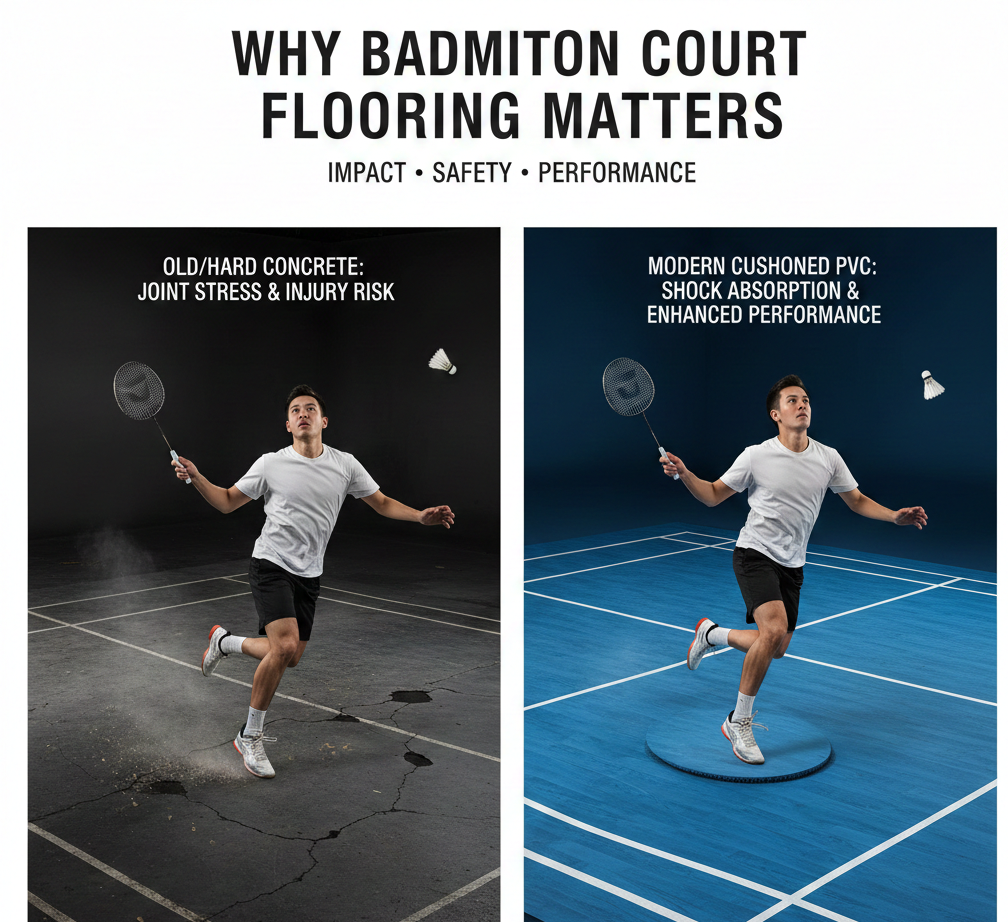
Badminton is a high-speed, high-mobility sport. Players quickly change direction, jump, land, lunge — so the floor must provide:
-
Good grip (to prevent slipping during fast movement).
-
Proper shock absorption / cushioning (to reduce stress on knees/ankles and avoid injuries).
-
Consistent bounce/response, so shuttle movement and player movement feel right.
-
Durability and weather or humidity resistance (depending on indoor/outdoor).
-
Low maintenance and good longevity, especially for academies or clubs.
Thus, choosing the right flooring material is critical — wrong choice can lead to poor game experience or even injuries.
✅Common Flooring Materials for Badminton Courts
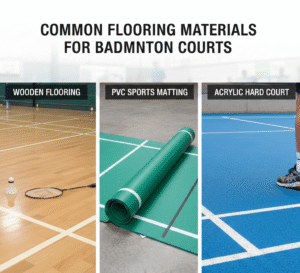
Here are commonly used materials for badminton courts (indoor or outdoor), with their strengths and limitations:
1. Wooden Flooring (Maple / Teak / Oak / Hardwood)
-
Common for high-quality indoor badminton courts, pro sports halls, clubs.
-
Provides natural feel: excellent shock absorption, balanced grip & slide, consistent bounce, and player comfort — very good for long matches/training.
-
Aesthetically premium and gives professional-level performance interface.
Drawbacks:
-
Expensive compared to synthetic options.
-
Requires regular maintenance, polishing, and controlled indoor environment — wood can respond to humidity / moisture (expansion/ contraction).
Best for: Indoor courts, professional use (clubs, academies, training centers, tournament venues).
2. PVC / Vinyl Flooring (Roll-out Synthetic Mats)
-
Popular for indoor badminton courts, gyms, multipurpose halls.
-
Typically comes as sheets/rolls, with a foam backing for cushioning — offers good shock absorption, consistent shuttle bounce, and quieter play.
-
Easy & cheaper to install compared to wood or PU; low maintenance and available in various colors/thicknesses.
Drawbacks:
-
Less “premium feel” compared to wood.
-
Not recommended for outdoor use — not weatherproof.
-
Bounce and shock absorption are okay but sometimes not enough for heavy/training-intense courts.
Best for: Indoor courts for recreational use, schools, multipurpose halls, budget-constrained setups.
3. PU (Polyurethane) Synthetic Flooring
-
PU flooring is a seamless synthetic surface — often considered a “premium synthetic” choice.
-
Offers good elasticity, shock absorption, durability, slip resistance, and consistent bounce.
-
Suitable for indoor courts, especially those with heavy usage or professional-level play; ideal for clubs, academies, or multi-sport halls.
Drawbacks:
-
Higher cost than PVC.
-
Requires skilled installation and a good subfloor (flat, dry)
-
Less common for outdoor without extra weatherproofing (though some synthetic systems attempt it).
Best for: Indoor courts where performance, durability, and low maintenance are priorities — e.g. sports academies, clubs, long-term investment courts.
4. Synthetic Acrylic Surface (Outdoor / Semi-Outdoor)
-
Often used for outdoor badminton courts thanks to weather-resistant properties.
-
Acrylic coatings over concrete/asphalt base — textured surface provides good grip, even after rains; UV-stable; dries quickly.
-
Low maintenance, comparatively inexpensive, and adequate for recreational / club-level outdoor courts.
Drawbacks:
-
Shock absorption is limited compared to wood or cushioned synthetic floors (not ideal for heavy/training-intensive play).
-
Ineffective if base concrete has cracks, because those reflect through the acrylic layer.
Best for: Outdoor courts, residential societies, clubs or community courts where budget and weather resistance matter; recreational play.
5. Modular / Interlocking Tiles (PP Tiles, Rubber Tiles, etc.)
-
Some courts use PP modular interlocking tiles, or rubber tiles — handy for rooftops, temporary courts, or spaces where portability or easy installation is needed.
-
Installation is often easier, sometimes no glue required; damaged tiles can be replaced individually.
Drawbacks / Considerations:
-
Bounce or “feel” might differ compared to seamless floors; may be less uniform.
-
Depending on tile quality, may expand in extreme heat if not properly installed.
Best for: Temporary or semi-permanent courts, rooftop courts, budget-conscious setups, or spaces where you may want to disassemble/move the court later.
📊 Quick Comparison
| Material | Best For | Pros | Cons |
|---|---|---|---|
| Wood (Maple/Teak) | Indoor, professional courts | Great shock absorption, bounce, grip, aesthetics | Expensive; needs maintenance & climate control |
| PVC / Vinyl | Indoor halls, gymnasia | Affordable, easy install, cushioned, easy maintenance | Less premium feel; not for outdoor; moderate shock absorption |
| PU Synthetic | Indoor professional / heavy-use | Elastic, durable, good shock absorption, seamless | Higher cost; needs skilled installation & good subfloor |
| Acrylic Surface | Outdoor / semi-outdoor courts | Weatherproof, UV-resistant, low cost, easy maintenance | Limited cushioning; dependent on good base slab |
| Modular Tiles (PP / Rubber) | Temporary / portable courts, rooftop | Easy install, replaceable tiles, lower cost | Different “feel”, bounce may vary, less uniform |
🎯 Which Material Should You Choose?
Your decision should depend on:
-
Purpose & Level of Play: Professional competition / academy vs recreational / community usage.
-
Indoor or Outdoor: Indoor courts — wood, PVC or PU are ideal. Outdoor — acrylic or modular tiles.
-
Budget & Maintenance Capacity: If you have budget + maintenance capabilities → wood or PU. If budget matters more → PVC / acrylic / tiles.
-
Frequency & Footfall: For heavy training / frequent use → durable and cushioned materials (wood, PU). For occasional use → PVC or acrylic suffice.
-
Portability or Permanence: Permanent courts: wood/PU. Temporary/rooftop or movable: tiles or vinyl mats.
Common Mistakes to Avoid
-
Putting outdoor PVC / vinyl flooring — not weatherproof → leads to damage.
-
Using hard concrete without cushioning — leads to poor play feel and higher risk of injuries.
-
Skipping proper subfloor/preparation when applying acrylic or PU — leads to cracks or uneven bounce.
-
Choosing wrong thickness or cheap tiles — results in poor shock absorption, inconsistent bounce, and shorter lifespan.
Performance Benefits of the Right Flooring Material
The right flooring enhances gameplay through:
-
Superior footwork control
-
Safer impact absorption
-
Improved response and stability
-
Reduced injury risk
-
A more enjoyable playing experience
-
A longer-lasting court with fewer repairs
By choosing the correct material, you ensure your badminton court performs at its highest potential for years.
Conclusion
Badminton court flooring is a long-term investment—one that influences safety, performance, and overall game experience. Whether you choose wood, PVC, PU, acrylic, or modular tiles, understanding each material’s qualities ensures you make the best decision for your facility.
High-quality flooring material isn’t just about building a court—it’s about building confidence, improving player skill, and creating a professional environment where athletes can thrive.
Choose the right flooring material. Choose long-lasting performance.