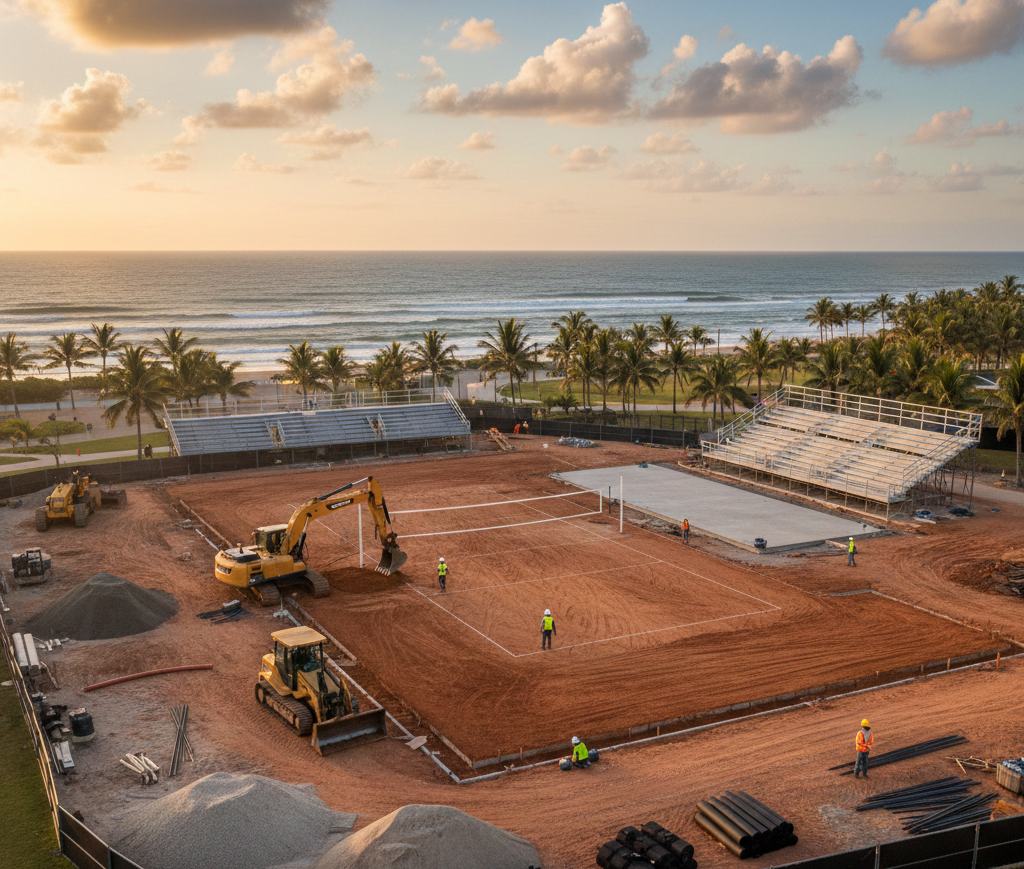
Volleyball is a dynamic sport that has gained immense popularity across schools, colleges, residential communities, and professional sports arenas. A well-constructed volleyball court is essential for safe and enjoyable gameplay. Whether for indoor or outdoor use, a volleyball court requires precise planning, quality materials, and adherence to international standards.
This guide provides a detailed look at the volleyball court construction process, from planning and site selection to finishing touches.
1. Planning and Site Selection
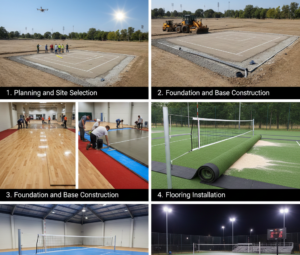
The first and most crucial step in constructing a volleyball court is planning and selecting the appropriate site. Key considerations include:
-
Location: Ensure the site is level, spacious, and free of obstructions like trees or poles.
-
Court Orientation: For outdoor courts, align the court north-south to minimize sun glare for players.
-
Accessibility: Ensure easy access for players, officials, and spectators.
-
Drainage Consideration: Proper drainage is essential for outdoor courts to prevent waterlogging.
During this stage, the intended use of the court—professional tournaments, recreational play, or training—must also be considered, as it affects the choice of materials and dimensions.
2. Site Preparation
After selecting the site, the ground must be properly prepared. This ensures a stable and level surface:
-
Clearing: Remove vegetation, stones, and debris from the site.
-
Levelling: Use machinery or manual labor to level the area, ensuring even surfaces for safe play.
-
Marking the Court: Outline the court dimensions based on standard regulations: 18 × 9 meters for the playing area, with a minimum 3-meter free zone around the court.
For indoor courts, additional preparation includes checking the foundation’s ability to support flooring layers and ensuring proper insulation and moisture control.
3. Foundation and Base Construction
A solid foundation is critical for durability and safety:
-
Indoor Courts:
-
Install a reinforced concrete base to provide stability.
-
Add a moisture-proof layer to protect wooden flooring from dampness.
-
Ensure the base is perfectly level, as uneven surfaces can affect gameplay and safety.
-
-
Outdoor Courts:
-
For sand or grass courts, compact the soil and install proper drainage systems.
-
For synthetic turf courts, create a sub-base layer of crushed stone or gravel to ensure stability and prevent settling over time.
-
The foundation stage directly affects the longevity of the court and the quality of the playing experience.
4. Flooring Installation
The choice of flooring depends on whether the court is indoor or outdoor:
-
Indoor Hardwood Courts:
-
Use high-quality maple or other durable hardwood.
-
Install shock-absorbing underlayers to reduce joint injuries.
-
Ensure panels are fitted tightly to prevent gaps.
-
-
Indoor Synthetic Courts:
-
Lay polyurethane or other synthetic surfaces.
-
Ensure anti-slip properties for player safety.
-
Install padding or cushioning underneath for shock absorption.
-
-
Outdoor Courts:
-
Sand Courts: Spread sand evenly to a depth of 40–50 cm. Level and compact lightly to maintain softness without creating uneven patches.
-
Grass Courts: Lay high-quality turf, install irrigation systems, and ensure proper leveling.
-
Synthetic Turf: Roll out artificial turf, secure it firmly, and add a shock-absorbing layer beneath.
-
5. Net and Post Installation
A correctly installed net system is vital for both indoor and outdoor courts:
-
Net Posts:
-
Made from durable, corrosion-resistant metal.
-
Installed at 0.5 meters outside the sidelines for stability.
-
Adjustable height mechanism for men’s and women’s games.
-
-
Net Specifications:
-
Width: 1 meter
-
Height: 2.43 meters (men) / 2.24 meters (women)
-
Mesh: 10 cm × 10 cm openings for optimal performance
-
Material: High-quality synthetic fiber for durability
-
-
Antennae:
-
Height: 1.80 meters
-
Positioned at the edges of the net to mark in-bounds areas
-
Striped for visibility
-
6. Boundary Lines and Markings
Accurate court markings are crucial for fair play:
-
Line Width: 5 cm
-
Color: Contrasts with the flooring for visibility
-
Material: Non-slip paint for indoor courts; durable tapes for outdoor courts
-
Placement: Ensure alignment with FIVB regulations for attack lines, center lines, and sidelines
Properly marked boundaries help referees make precise calls and enhance player experience.
7. Safety and Free Zone Implementation
Safety is a priority in volleyball court construction:
-
Maintain at least 3 meters of free zone around the court.
-
Ensure all equipment, such as net posts and lighting, is securely installed.
-
For indoor courts, provide adequate ceiling clearance of at least 7 meters.
-
For outdoor courts, check for potential hazards such as stones or uneven surfaces.
These measures minimize the risk of injuries and allow smooth movement during gameplay.
8. Lighting and Additional Accessories
-
Indoor Courts: Install uniform lighting with minimum 500 lux to avoid shadows or glare.
-
Outdoor Courts: Ensure adequate sunlight or add floodlights for evening games.
-
Seating and Spectator Areas: Properly designed seating outside the free zone improves viewing and ensures safety.
-
Scoreboards and Equipment Storage: Plan locations for scoreboards, benches, and other accessories.
9. Maintenance Considerations
A well-constructed court requires regular maintenance for longevity:
-
Indoor courts: Clean daily, polish wooden surfaces periodically, and check net tension.
-
Outdoor sand courts: Rake sand, remove debris, and inspect for uneven patches.
-
Grass courts: Regular mowing, irrigation, and pest control.
-
Synthetic turf: Brush regularly, clean debris, and check for damage.
Proper maintenance ensures consistent play quality and prolongs the life of the court.
10. Conclusion
The construction of a volleyball court is a multi-step process that combines planning, precise execution, and adherence to international standards. From site selection and foundation laying to flooring, net installation, and safety measures, every step impacts player performance and safety.
By investing in proper construction and maintenance, sports facilities can promote volleyball as a safe, competitive, and enjoyable sport for all age groups.
FAQ: Volleyball Court Construction Process
1. What are the main steps in constructing a volleyball court?
The volleyball court construction process typically involves:
-
Site survey and planning – Assessing land, soil, drainage, and space requirements.
-
Design & layout – Marking court dimensions, free zones, and orientation for optimal play.
-
Ground preparation – Excavation, leveling, and compacting the base.
-
Sub-base and flooring installation – For indoor courts: wooden, epoxy, or synthetic flooring; for outdoor courts: sand, turf, or cement-based surfaces.
3. What materials are used in volleyball court construction?
-
Indoor: Hardwood, synthetic sports tiles, or epoxy-coated flooring
-
Outdoor: Sand (for beach volleyball), artificial turf, grass, or cement with waterproof coating
-
Accessories: Nets, poles, boundary lines, and lighting systems
5. How is site preparation done for an outdoor volleyball court?
Site preparation includes:
-
Clearing vegetation and debris
-
Leveling and compacting soil
-
Installing proper drainage to prevent waterlogging
-
Laying sub-base layers (sand, gravel, or soil stabilization)
6. What is the difference between indoor and outdoor volleyball court construction?
-
Indoor: Requires high-quality flooring, controlled lighting, and anti-slip surfaces
-
Outdoor: Focuses on drainage, weather-resistant surfaces, and materials like sand, turf, or grass
7. How much does it cost to construct a volleyball court?
Costs vary based on type and specifications:
-
Outdoor court: ₹4–8 lakhs
-
Indoor court: ₹10–25 lakhs
The price includes materials, labor, site preparation, and installation.
8. Is maintenance required after construction?
Yes. Regular maintenance ensures longevity:
-
Indoor courts: Cleaning, polishing, and net inspection
-
Outdoor courts: Sand leveling, turf mowing, and drainage checks
10. Who should I hire for constructing a volleyball court?
Hire professional contractors with experience in sports facilities. Look for:
-
Verified project portfolios
-
Compliance with FIVB standards
-
End-to-end services (design, construction, finishing, and maintenance)