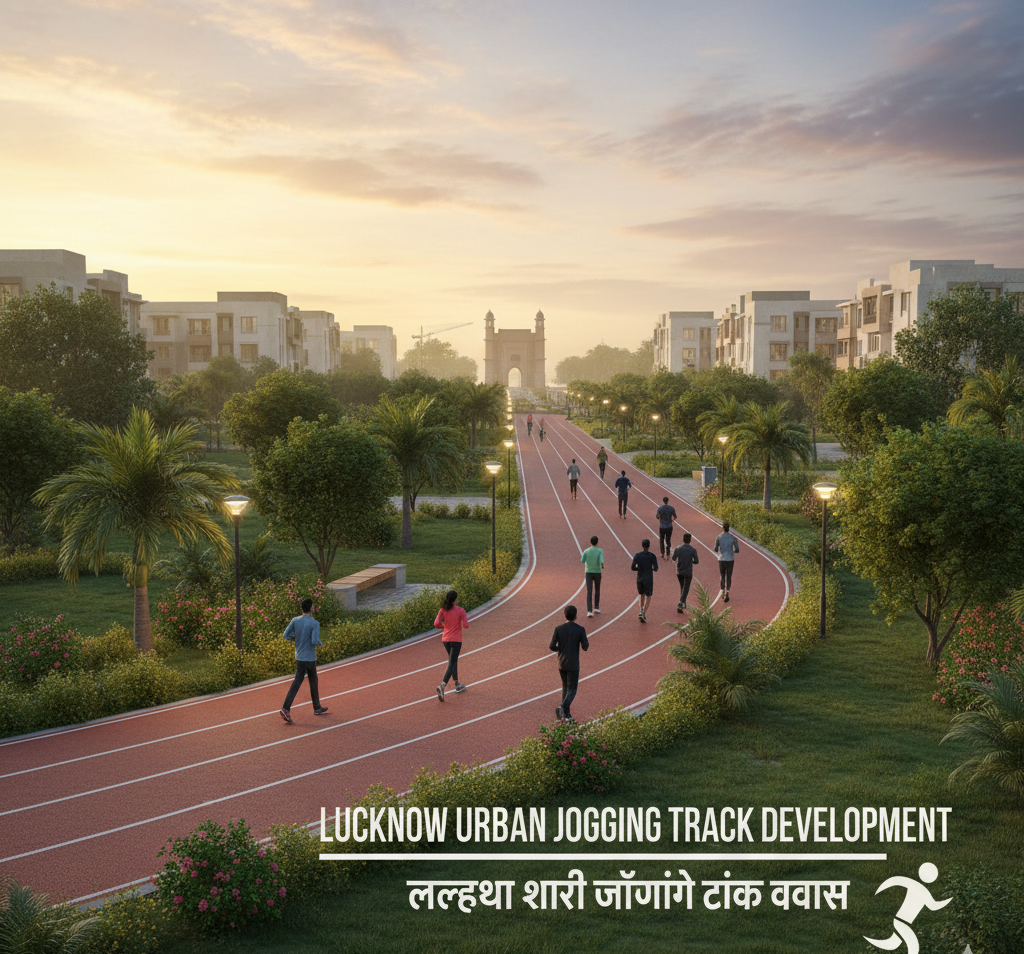
1. Why an Urban Jogging Track Matters in Lucknow
As Lucknow continues to expand rapidly, the need for quality urban fitness infrastructure becomes increasingly important. An urban jogging track offers many benefits:
-
It promotes daily physical activity and wellness for residents, reducing reliance on gyms.
-
It enhances public green space and connectivity — the track becomes part of a larger recreational ecosystem in the city.
-
It supports early morning and evening use, helping city dwellers integrate jogging/walking into their routines.
-
For Lucknow specifically, several projects are underway, reflecting municipal commitment. For example, a new jogging-track segment is planned along the Gomti Riverfront.
-
It can also become a community amenity that improves urban livability and property values in surrounding areas.
2. Key Projects & Developments in Lucknow
Here are some notable developments in Lucknow around jogging/running tracks:
a) Janeshwar Mishra Park (Gomti Nagar)
-
The park already has a jogging track, but officials have determined it is in poor condition, and a new running track is being planned with an estimated budget of around ₹ 55 lakh.
-
The new track is to be built along the artificial lake in the park, which is very centrally located and high-footfall (2,500–3,000 users in morning hours).
-
Also noted: in 2025, the park will have a dedicated “sports zone” including synthetic tracks, skating, tennis, etc.
-
This project provides a strong template for urban jogging track
-
Gomti Riverfront (Marine Drive / Morpankhi Lawn)
-
The LDA (Lucknow Development Authority) has approved beautification and walkway/upgrading along the riverbank with a dedicated ≈ 500-metre jogging-track section. It’s part of an ~₹ 11 crore budget for site development.
-
The focus: open-air, scenic route along water, increased access points (5 entry/exit), and pedestrian-friendly amenities. This demonstrates how jogging track infrastructure can tie into urban waterfront redevelopment.
-
-
c) Quality & Maintenance Challenge – Example of Dr. Ram Manohar Lohia Park (Gomti Nagar)
-
A 450-metre jogging track built recently started showing signs of breaking down within only three months of construction.
-
This underlines the importance of not only constructing but maintaining high quality foundations, surface finish, drainage, user safety, and monitoring over time.
-
-
3. Design Considerations & Infrastructure Components
For successful urban jogging tracks in Lucknow, several infrastructure and design themes must be addressed:
a) Track dimensions & surface
-
Even in non-competitive settings, track width of 1.2m to 3.6m is suggested for single/multiple user lanes.
-
Material: For durability in outdoor Indian context, surfaces like PU synthetic, EPDM rubber, or acrylic are recommended for better shock absorption and weather resistance. sports-facility.in+1
b) Foundation & drainage
-
Especially in Lucknow where monsoon can bring heavy rainfall, proper slope (1-2%), drainage channels, periphery water management must be built in.
-
Many failures (see Lohia Park case) stem from inadequate drainage, poor base preparation.
-
Use of synthetic surfacing over a well-compacted base is critical.
c) Accessibility & usage
-
Morning/evening use requires lighting, signage, safe access.
-
Entry/exit points, connectivity from residential areas, water points, benches, shade.
-
Integrate with urban green corridors (e.g., riverfront, parks) to maximize usage.
d) Maintenance & lifecycle planning
-
Budget for resurfacing, wear and tear, cleaning.
-
Use quality certified materials; ensure contractor post-installation service.
-
Monitoring for cracks, unevenness, user feedback.
e) Urban integration
-
Connect to walking paths, cycle lanes, fitness stations to create holistic urban wellness zone.
4. Challenges Specific to Lucknow
-
Rapid urban growth: Land pressure means that park spaces are often multi-use and require careful layout.
-
Climate & surface durability: High summer heat and monsoon precipitation test materials and construction quality.
-
Budget & governance: Ensuring timely funds, procurement transparency, quality oversight (as the Lohia Park example shows).
-
Usage demand: High morning footfall (2,500–3,000 at Janeshwar Park) means track design must manage peak loads.
-
Maintenance culture: Long-term maintenance budgets often overlooked; surface failures reduce community trust.
5. Recommendations for Successful Urban Jogging Track in Lucknow
-
Perform detailed site survey, soil testing, drainage planning before committing to surface.
-
Choose high-quality contractor and certified materials (PU/EPDM) suited to Indian climatic and usage conditions.
-
Design for sufficient width, user volumes, and multi-purpose use (walking + jogging + fitness).
-
Build comprehensive maintenance plan: resurfacing every X years, cleaning, user feedback loop.
-
Integrate track into broader park/riverfront ecosystem: benches, shade, landscape, lighting.
-
Provide community engagement: signage, distance markers, user groups to foster culture of usage and care.
-
Monitor for quality and longevity: The case in Lucknow where track broke in 3 months means oversight is essential.
-
Because of existing initiatives (riverfront, large parks like Janeshwar, Lohia), there is already momentum.
-
Urban planning agencies such as the Lucknow Development Authority (LDA) are allocating funds for jogging/walking tracks.
-
Growing health and wellness awareness among residents increases demand and thus justifies investment.
7. Conclusion
Creating high-quality urban jogging tracks in Lucknow is not just about laying rubber or synthetic surface — it’s about crafting well-integrated public wellness infrastructure. When done right, these tracks become community assets that improve health, value, green space, and livability in the city.
-