The foundation of any professional or community running track begins with careful track layout planning.
A properly planned track ensures long-lasting performance, low maintenance, and the ability to host competitive events at any level.
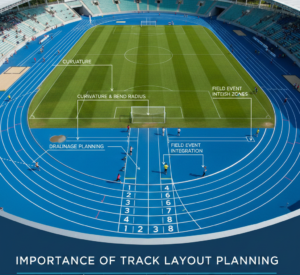
1. Importance of Track Layout Planning
-
Athlete Safety
-
Prevents collisions, missteps, and injuries by providing clear lanes, proper curves, and safe start/finish areas.
-
-
Performance Optimization
-
Correct geometry and lane spacing maximize running efficiency and energy return.
-
-
Regulatory Compliance
-
Aligns with IAAF/World Athletics specifications for international or national competitions.
-
-
Efficient Use of Space
-
Integrates track, field events, and spectator areas without compromising safety or aesthetics.
-
-
Maintenance and Longevity
-
Proper layout reduces stress on the track surface, minimizes water pooling, and facilitates easier maintenance.
-
2. Key Elements of Track Layout Planning
A functional track layout incorporates several critical components:
a. Track Shape and Size
-
Most standard tracks are 400 meters per lap with two straight sections and two curves.
-
Smaller or indoor tracks may range from 200 to 300 meters per lap.
-
The shape may include ovals, ovals with extended straights, or multi-purpose layouts for schools and community centers.
b. Lane Configuration
-
Standard lane width: 1.22 meters per lane.
-
Professional tracks: 6–10 lanes for competitive events.
-
Lane markings and staggered starts must account for curvature and race distance.
c. Curvature and Bend Radius
-
Curve radius affects speed, safety, and energy return.
-
Standard curve radius for a 400-meter track: approximately 36.5 meters.
-
Smooth, properly banked curves reduce athlete strain.
d. Start and Finish Zones
-
Sprint start lines (100m, 200m, 400m) are precisely placed.
-
Staggered starts on curves ensure each lane covers the same distance.
-
Finish lines must accommodate timing systems, photo-finish cameras, and measurement equipment.
e. Field Event Integration
-
Zones for long jump, high jump, javelin, discus, and shot put must be included without obstructing running lanes.
-
Safe distances between track and field events are mandatory.
f. Drainage Planning
-
Proper track slope and base grading prevent water pooling.
-
Integrated drainage channels ensure year-round usability.
3. Steps in Track Layout Planning
Step 1: Site Assessment
-
Evaluate terrain, soil type, and space availability.
Step 2: Design Requirements
-
Determine track type: synthetic, polyurethane, or asphalt.
-
Decide the number of lanes, lap length, and surface material.
-
Calculate curves, straights, and lane staggering.
-
Use survey equipment for precise measurements.
-
Identify safe zones for field events.
-
Ensure minimum distances between track lanes and jumping or throwing areas.
-
Plan entry/exit points, pathways, seating, and safety barriers.
-
Provide adequate space for officials, equipment storage, and emergency access.
-
Integrate cross slopes (0.5–1%) for water runoff.
-
Include perimeter and subsurface drainage to maintain track surface integrity.
-
Verify that the layout complies with national and international athletic regulations.
4. Materials and Surface Considerations
-
Synthetic Surfaces
-
Polyurethane, Tartan, and EPDM surfaces provide uniform traction, energy return, and durability.
-
-
Asphalt or Concrete Base
-
Supports synthetic surfaces and ensures level, stable foundation.
-
-
Shock-Absorbing Layers
-
Cushions impact, reduces injuries, and improves athlete performance.
-
-
Line Marking Materials
-
Acrylic, thermoplastic, or polyurethane paints ensure clear lane markings and event zones.
-
5. Factors Affecting Track Layout
-
Available Land Space – Influences track shape, number of lanes, and field event zones.
-
Intended Use – Professional, school, or recreational use determines surface and lane design.
-
Climate Conditions – Heavy rainfall areas require enhanced drainage and water-resistant surfaces.
-
-
Maintenance Considerations – Proper layout simplifies cleaning, resurfacing, and repairs.
6. Advantages of Proper Track Layout Planning
-
Athlete Safety and Performance – Reduces injury risk and improves running efficiency.
-
Compliance – Meets IAAF, national, and local athletic standards.
-
Durability – Well-planned layouts prevent surface stress and prolong track lifespan.
-
Aesthetic Appeal – Smooth curves, clear lines, and balanced zones enhance facility appearance.
-
Efficient Event Management – Simplifies race setup, relay zones, and field event coordination.
7. Challenges in Track Layout Planning
-
Limited Space
-
Requires creative design for curves, straights, and field events.
-
-
Uneven Terrain
-
Demands careful grading and slope adjustments.
-
-
Integration of Multi-Sport Facilities
-
Balancing running lanes with football, soccer, or multi-sport areas.
-
-
Compliance with Standards
-
Must maintain precise lane widths, curve radii, and staggered start calculations.
-
Professional planners overcome these challenges using surveying technology, CAD designs, and 3D modeling.
8. Applications
Track layout planning is essential for:
-
Olympic and Professional Stadiums
-
University and School Athletic Tracks
-
Community Sports Grounds
-
Indoor Synthetic Tracks
-
Multi-Purpose Training Facilities
Accurate planning ensures that tracks are safe, functional, and competition-ready.
9. Conclusion
Track layout planning is the cornerstone of building a successful athletic facility.
From precise measurement and slope design to surface selection and field integration, professional track layout planning maximizes athlete performance, safety, and longevity of the track. Investing in a well-planned layout ensures a world-class running track capable of hosting training sessions, competitions, an
(FAQ – Track Layout Planning)
1. What is track layout planning?
Track layout planning is the process of designing and marking the lanes, curves, and dimensions of an athletic track. It ensures the track meets official standards, is safe for athletes, and optimizes space usage.
2. Why is track layout planning important?
-
Ensures compliance with official regulations (IAAF/World Athletics standards)
-
Provides accurate lane dimensions and curve radii for fair competition
-
Prevents construction errors and unnecessary costs
-
Enhances athlete performance and safety
3. What factors are considered in track layout planning?
-
Track length and number of lanes (usually 400m with 6–8 lanes)
-
Lane width (typically 1.22m per lane)
-
Straight section length and curve radius
-
Drainage slope for water runoff
-
Start and finish line placement
4. What materials are used for track layout marking?
-
Chalk or lime for temporary markings
-
Paint or thermoplastic for permanent lane lines
-
Measuring tapes, laser levels, and string lines for precision
5. How long does track layout planning take?
-
Small or school tracks: 1–2 days
-
Standard 400m stadium tracks: 3–5 days
Time depends on track size, accuracy requirements, and number of lanes.
6. Can existing tracks be re-planned?
Yes. Existing tracks can be re-measured and re-marked to meet updated standards or for new competitions.
7. Who performs track layout planning?
-
Professional track and field designers
-
Certified athletic facility engineers
-
Experienced sports contractors who ensure proper dimensions, safety, and compliance
8. What is included in a track layout plan?
-
Overall track dimensions and lane markings
-
Curve radii and straight section lengths
-
Hurdle placements (if needed)
-
Start and finish lines
-
Drainage slopes and gradients
9. How does accurate track layout planning affect costs?
-
Reduces material wastage
-
Minimizes labor errors
-
Avoids rework and project delays
Poor planning can lead to higher costs due to corrections and adjustments.
10. Is technology used in track layout planning?
Yes. Modern planning uses:
-
Laser measurement tools
-
GPS and surveying equipment
-
CAD software for precise design and alignment