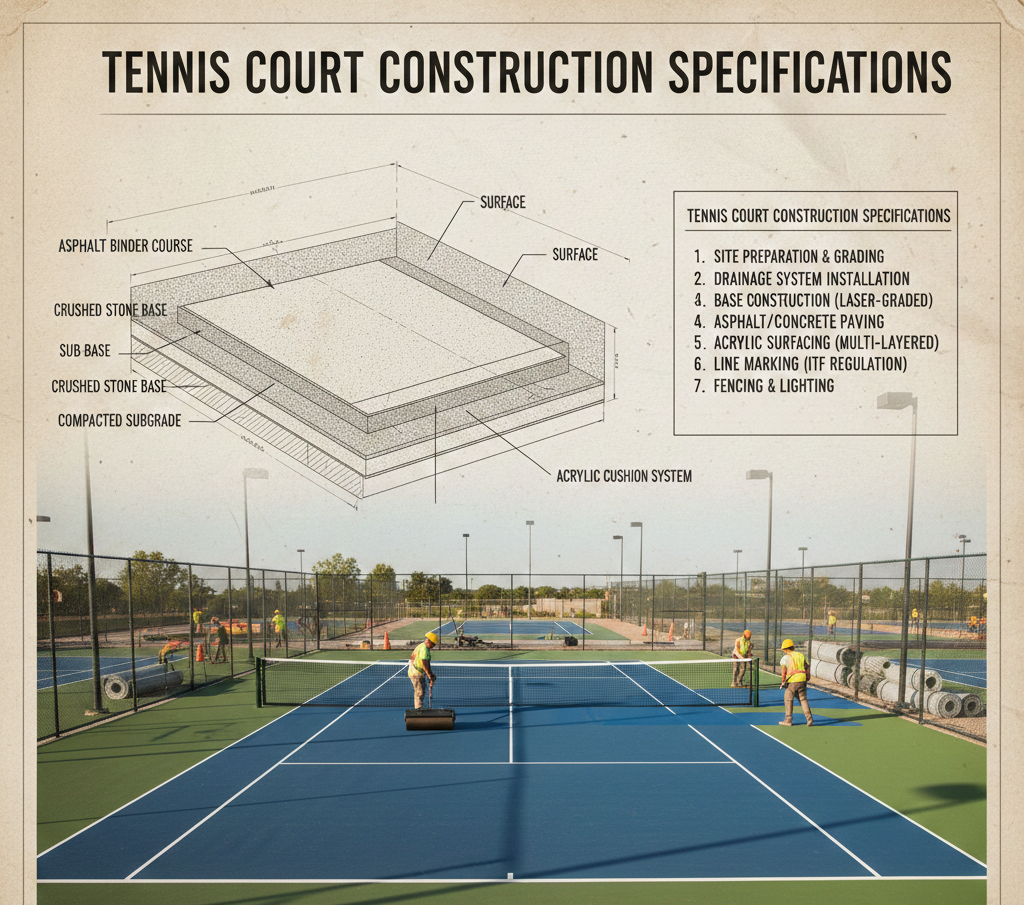
Tennis is a globally renowned sport that demands precision, skill, and the right infrastructure. Building a tennis court is not merely about marking an area and installing a net; it requires meticulous planning, adherence to international standards, and high-quality materials to ensure durability, safety, and a professional playing experience.
Whether you are constructing a tennis court for a school, sports academy, residential complex, or professional training facility, understanding the construction specifications is crucial. This comprehensive guide covers all aspects of tennis court construction, including dimensions, surface types, materials, equipment, and maintenance.
1. Standard Tennis Court Dimensions
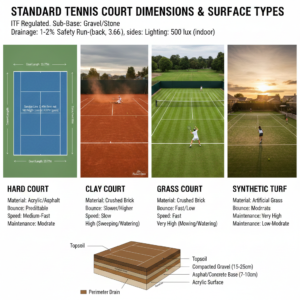
The International Tennis Federation (ITF) defines precise dimensions for a standard tennis court to ensure fair play and consistency:
-
Court Length: 23.77 meters (78 feet)
-
Court Width: 8.23 meters (27 feet) for singles; 10.97 meters (36 feet) for doubles
-
Baseline: The line at the end of each court side
-
Service Line: 6.40 meters (21 feet) from the net on each side
-
Net Height: 0.91 meters (3 feet) at the center, 1.07 meters (3.5 feet) at the posts
-
Service Boxes: Divided by the center service line into two equal areas on each side of the net
-
Clearance/Run-Off: Minimum 6.40 meters behind the baseline and 3.66 meters on the sides for safety
-
Ceiling Height (Indoor Courts): Minimum 9 meters (30 feet) to allow unobstructed play
Adhering to these dimensions ensures that the court can host both recreational and professional matches.
2. Tennis Court Surface Types
The choice of surface impacts gameplay, player performance, and maintenance requirements. Tennis courts can be categorized into four main types:
a) Hard Courts
-
Material: Acrylic or synthetic coating over asphalt or concrete base
-
Bounce: Predictable and consistent
-
Speed: Medium to fast
-
Maintenance: Moderate; requires regular cleaning and resurfacing every 5–7 years
-
Advantages: Durable, weather-resistant, suitable for all levels of play
b) Clay Courts
-
Material: Crushed brick, shale, or stone
-
Bounce: Slower and higher, promoting longer rallies
-
Maintenance: High; requires daily sweeping, watering, and rolling to maintain surface consistency
-
Advantages: Reduces joint impact, preferred for professional tournaments like the French Open
c) Grass Courts
-
Material: Natural grass grown over soil
-
Bounce: Fast and low, making it ideal for serve-and-volley players
-
Maintenance: Very high; requires mowing, watering, fertilizing, and regular rolling
-
Advantages: Traditional surface used in prestigious tournaments like Wimbledon
d) Synthetic/Artificial Turf
-
Material: Artificial grass with shock-absorbing layers
-
Bounce: Moderate and consistent
-
Maintenance: Low to moderate; minimal watering required
-
Advantages: Suitable for outdoor recreational facilities and residential areas
3. Sub-Base and Foundation Specifications
A stable foundation is essential for a durable tennis court:
-
Excavation: Remove topsoil and level the area
-
Sub-Base: A compacted layer of gravel or crushed stone, 15–25 cm thick, ensures proper drainage and stability
-
Base Layer: Asphalt or concrete layer, 7–10 cm thick for hard courts
-
Slope: Slight slope of 1–2% away from the center for water drainage
-
Drainage System: Install perimeter drains to prevent waterlogging and surface damage
For clay and grass courts, proper soil compaction, grading, and irrigation systems are critical to maintain an even and playable surface.
4. Net and Equipment Specifications
High-quality equipment is vital for professional play:
-
Net: 0.91 meters high at the center, 1.07 meters at posts; 10–12.5 meters wide
-
Posts: Strong metal posts installed outside the court; adjustable net tension mechanism
-
Line Markings: White lines, 5–7.5 cm wide, accurately painted or embedded in the surface
-
Lighting (for indoor or night play): Uniform illumination, minimum 500 lux; avoid glare and shadows
Proper net and equipment installation ensures fair play and enhances the player experience.
5. Safety and Accessibility Considerations
Safety measures are essential for all tennis courts:
-
Maintain a run-off area of at least 6.40 meters behind baselines and 3.66 meters at sides
-
Ensure non-slip surfaces for indoor and outdoor courts
-
Provide emergency access points for medical situations
-
Install spectator areas at a safe distance from the court
-
Ensure indoor courts have sufficient ceiling clearance to prevent obstruction
These considerations protect players and maintain the court’s professional standards.
6. Construction Process Overview
Constructing a tennis court involves several key steps:
-
Site Preparation: Clear, level, and grade the area; plan drainage and orientation
-
Foundation and Sub-Base: Lay compacted gravel or crushed stone; install base layer for hard courts
-
Surface Installation: Lay asphalt/concrete and apply acrylic coatings for hard courts; prepare clay or grass surfaces for outdoor courts
-
Net Installation: Set posts, attach net, and adjust tension
-
Line Marking: Paint accurate lines and service boxes
-
Finishing Touches: Install lighting, seating, fences, and accessories
7. Maintenance Guidelines
Proper maintenance prolongs the life of the tennis court and ensures safety:
-
Hard Courts: Clean debris, inspect cracks, repaint lines, and resurface every 5–7 years
-
Clay Courts: Daily sweeping, watering, rolling, and re-leveling
-
Grass Courts: Regular mowing, watering, soil treatment, and pest control
-
Synthetic Turf: Brush surface, check shock-absorbing layer, remove debris
Regular maintenance prevents injuries and maintains consistent ball bounce and play quality.
8. Choosing the Right Tennis Court
The type of court depends on usage, budget, climate, and player preference:
| Factor | Hard Court | Clay Court | Grass Court | Synthetic Turf |
|---|---|---|---|---|
| Speed of Play | Medium-Fast | Slow | Fast | Medium |
| Maintenance | Moderate | High | Very High | Low-Moderate |
| Player Safety | High | High | Medium | High |
| Durability | Very High | Medium | Low | High |
| Cost | Medium-High | High | High | Medium |
9. Conclusion
Tennis court construction is a complex process that requires careful planning, adherence to international specifications, and use of high-quality materials. Whether building a hard court for professional matches, a clay court for competitive play, a grass court for tradition, or synthetic turf for residential use, following precise construction standards ensures a safe, durable, and enjoyable playing experience.
Investing in a well-constructed tennis court is not only building a sports facility—it is creating a space for skill development, professional training, and community engagement. With proper planning, construction, and maintenance, a tennis court can provide decades of high-quality play for athletes and enthusiasts alike. https://www.sports-facility.in/index.php