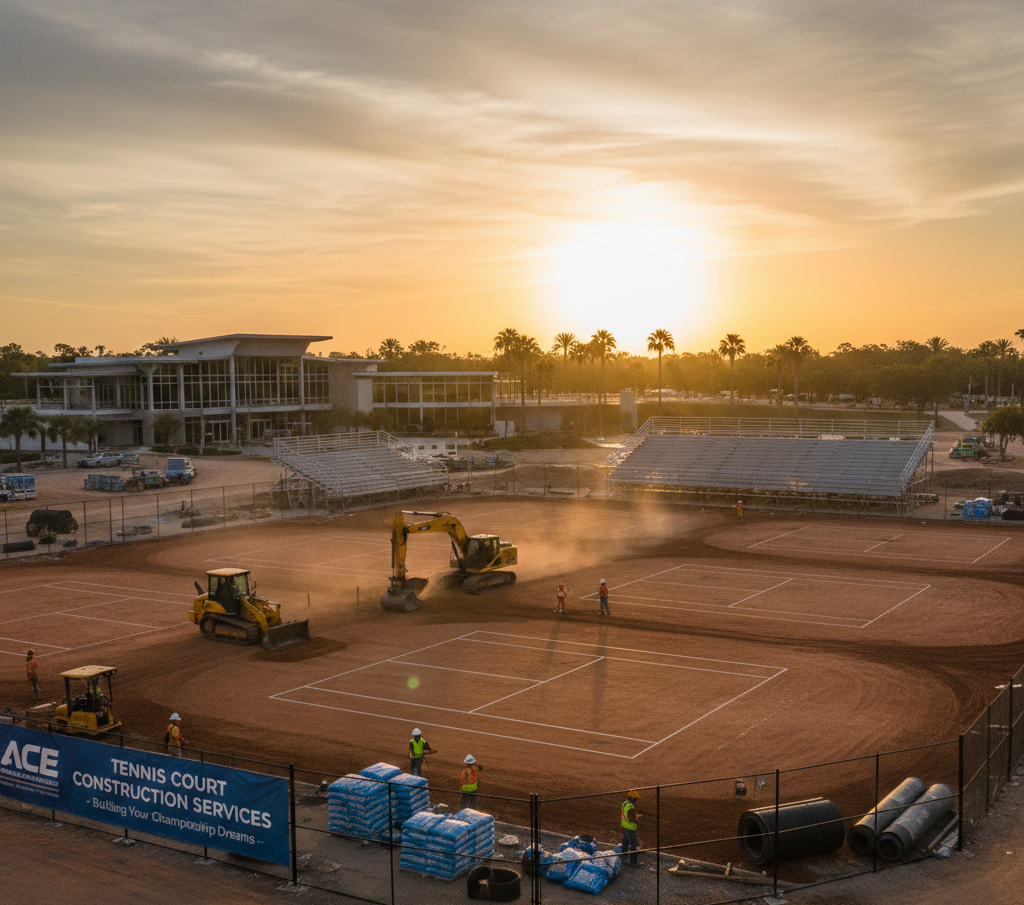
If you’re planning to build a tennis court, whether for personal use, sports clubs, schools, or commercial complexes, you need professional expertise, quality materials, and precise planning. Tennis court construction is not just about laying a surface — it’s about ensuring perfect dimensions, durability, performance, and player comfort.
This complete guide explains everything you need to know about tennis court construction services, from planning and surface selection to maintenance and costs — optimized for SEO and written in simple, human-friendly language.
1. Understanding Tennis Court Construction
Tennis court construction involves engineering, design, and high-quality materials to create a professional and safe playing area. A standard tennis court measures 78 feet (23.77 m) long and 36 feet (10.97 m) wide for doubles and 27 feet (8.23 m) wide for singles.
Key elements of court construction include:
-
Site preparation and leveling
-
Base construction
-
Surface installation
-
Fencing and lighting
-
Line marking and accessories
A professional construction service ensures that every layer, from the sub-base to the topcoat, meets international standards (like ITF and ASTM).
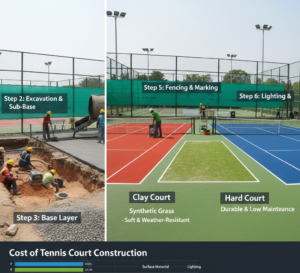
2. Step-by-Step Tennis Court Construction Process
Step 1: Site Inspection and Planning
The first step is assessing the location, soil type, and drainage system. A flat, well-drained site reduces future maintenance costs. Engineers also consider sunlight direction — ideally, the court should run north-south to minimize glare during play.
Step 2: Excavation and Sub-Base Preparation
The ground is excavated to the required depth and compacted properly. A solid sub-base layer (often made of crushed stone or gravel) ensures stability and prevents surface cracks. Drainage pipes are installed to prevent water accumulation.
Step 3: Base Layer Construction
Depending on the chosen surface type, different base materials are used:
-
For hard courts, asphalt or concrete is common.
-
For clay courts, compacted red or green clay is used.
-
For grass courts, natural turf or synthetic grass is laid on a stable soil bed.
Step 4: Surface Coating or Installation
The surface material defines the playing experience. Layers of acrylic, clay, or turf are applied according to the surface type. Each surface provides a different ball bounce, speed, and maintenance requirement.
Step 5: Marking, Nets, and Fencing
Once the surface is ready, white line markings are painted precisely to match ITF standards. Heavy-duty fencing around the court keeps the ball in play and ensures player safety. The net posts and center strap are then installed.
Step 6: Lighting and Accessories
For night play, LED floodlights are installed strategically to provide even illumination without glare. Optional accessories include benches, umpire chairs, and windbreaks.
3. Types of Tennis Court Surfaces
Choosing the right surface depends on your budget, climate, and maintenance capacity. Here are the most popular types:
1. Hard Court
-
Material: Asphalt or concrete with acrylic coating.
-
Pros: Durable, low maintenance, and suitable for all weather.
-
Cons: Slightly harder on joints.
-
Best for: Schools, clubs, and residential areas.
2. Clay Court
-
Material: Natural red clay or synthetic clay.
-
Pros: Excellent traction and slower ball bounce, ideal for long rallies.
-
Cons: Requires frequent maintenance.
-
Best for: Professional training and classic court aesthetics.
3. Synthetic Grass Court
-
Material: Artificial turf with sand infill.
-
Pros: Soft, comfortable, and weather-resistant.
-
Cons: Slightly faster ball bounce.
-
Best for: Resorts, clubs, and private courts.
4. Acrylic Court
-
Material: Multiple layers of acrylic resins.
-
Pros: Long lifespan, customizable color options, and UV resistance.
-
Cons: Can heat up under strong sun.
-
Best for: Professional and commercial use.
5. Carpet or Indoor Courts
-
Material: Textile or polymer surfaces.
-
Pros: Easy to install indoors, smooth and fast play.
-
Cons: Not ideal for outdoor use.
-
Best for: Indoor sports complexes.
4. Cost of Tennis Court Construction
The cost of building a tennis court in India typically ranges between ₹8 lakhs to ₹25 lakhs, depending on:
-
Surface type (hard, clay, or synthetic)
-
Location and land conditions
-
Lighting and fencing requirements
-
Additional amenities
Approximate Cost Breakdown:
| Component | Estimated Cost (INR) |
|---|---|
| Site Preparation & Base | ₹1,50,000 – ₹3,00,000 |
| Surface Material | ₹3,00,000 – ₹10,00,000 |
| Fencing & Net Posts | ₹1,00,000 – ₹2,00,000 |
| Lighting Setup | ₹1,00,000 – ₹5,00,000 |
| Miscellaneous (Accessories, Paint, etc.) | ₹50,000 – ₹1,50,000 |
💡 Tip: Always hire certified tennis court contractors who provide warranty and post-installation maintenance.
5. Maintenance of Tennis Courts
Proper maintenance extends your court’s life and keeps it safe for players.
Hard Court Maintenance
-
Clean debris and dust regularly.
-
Recoat acrylic surface every 5–7 years.
-
Repair cracks immediately.
Clay Court Maintenance
-
Water the surface daily.
-
Roll the clay regularly for firmness.
-
Refill worn areas with new clay.
Synthetic Grass Maintenance
-
Brush fibers weekly.
-
Check sand infill levels.
-
Rinse the turf periodically to remove dirt.
6. Benefits of Professional Tennis Court Construction
Hiring experts for your tennis court ensures:
-
Precision: Accurate leveling and dimensions.
-
Quality materials: Long-lasting and weather-resistant.
-
Safety: Proper grip and drainage for player comfort.
-
Warranty: Coverage for surface damage or fading.
-
Customization: Color, surface, and accessories tailored to your needs.
7. Why Choose Our Tennis Court Construction Services
At Sports-Facility.in, we specialize in premium tennis court construction using ITF-approved materials and expert engineering. Our services include:
-
Complete design and layout planning
-
Customized surface options (clay, acrylic, synthetic grass, or hard)
-
Drainage and base system engineering
-
Lighting, fencing, and accessories
-
Maintenance support and resurfacing
Whether it’s a private villa, sports academy, or government project, we deliver durable, professional-grade courts that ensure performance, safety, and aesthetic appeal
8. Conclusion
A well-constructed tennis court is a long-term investment in sports, health, and community development. By partnering with a professional tennis court construction company, you get quality craftsmanship, durable materials, and an excellent playing experience.
From planning and surface selection to finishing and maintenance, every step matters. Choose experts who understand your needs and follow international standards to make your dream tennis court a reality.