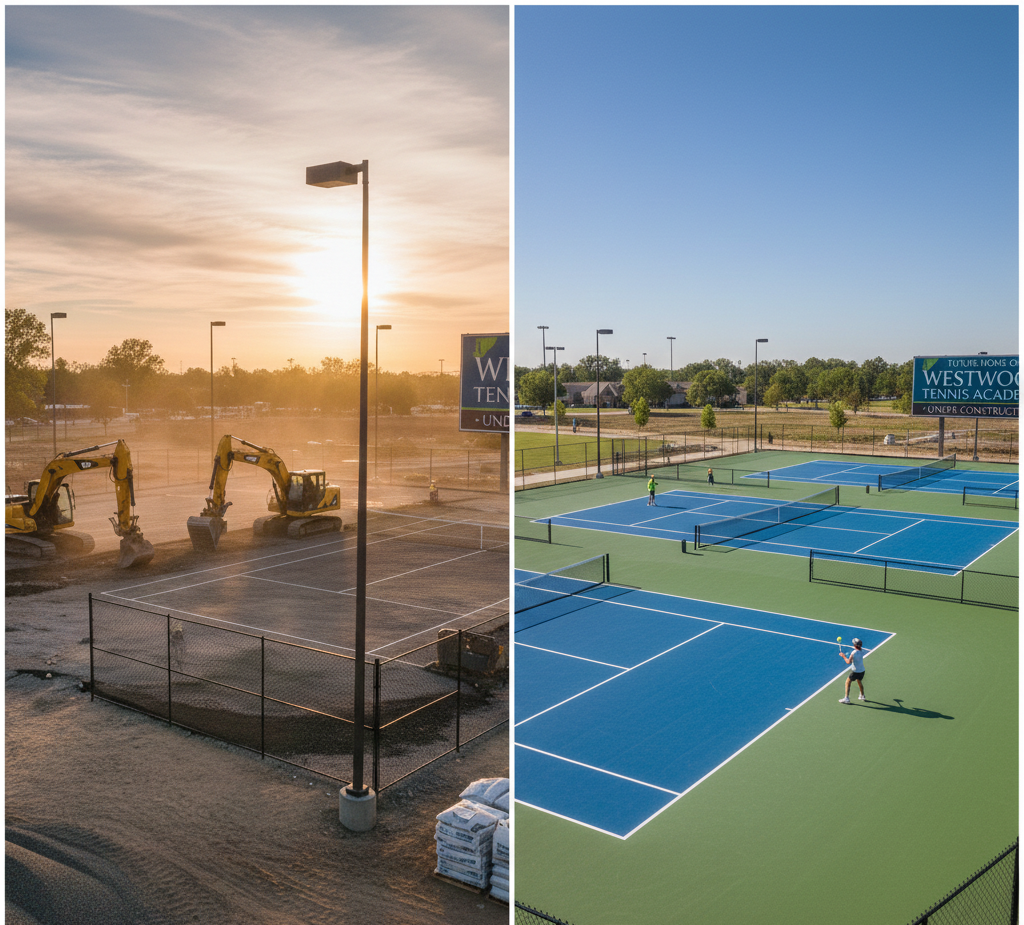
Tennis is one of the most popular sports worldwide, known for its precision, speed, and endurance. Whether played recreationally or professionally, a well-built tennis court is essential for ensuring fair play, player safety, and long-term performance. Constructing a tennis court is not just about laying a surface and installing a net—it involves careful planning, adherence to international standards, and use of high-quality materials.
In this detailed guide, we will explore everything about tennis court construction, including specifications, surface types, design considerations, materials, and the step-by-step building process.
1. Understanding Tennis Court Dimensions and Layout
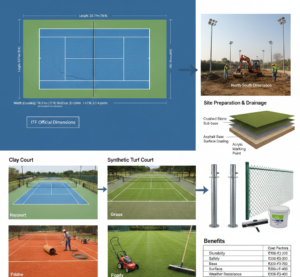
Before construction begins, understanding the standard layout and measurements is crucial. The International Tennis Federation (ITF) defines the following official dimensions:
-
Length: 23.77 meters (78 feet)
-
Width: 8.23 meters (27 feet) for singles; 10.97 meters (36 feet) for doubles
-
Service Line Distance: 6.40 meters (21 feet) from the net
-
Net Height: 0.91 meters (3 feet) at the center; 1.07 meters (3.5 feet) at the posts
-
Free Zone Clearance: Minimum 6.40 meters behind baselines and 3.66 meters on sides
-
Indoor Ceiling Height: Minimum 9 meters (30 feet) for unobstructed play
Adhering to these dimensions ensures your tennis court meets international standards and offers a professional playing experience.
2. Selecting the Right Location
The first step in tennis court construction is site selection. A good location ensures longevity and reduces maintenance needs.
Key Considerations:
-
The site should have good natural drainage and a stable subsoil.
-
Avoid areas with large trees nearby to prevent root damage and shade issues.
-
The court should ideally be oriented north-south to minimize sun glare during play.
-
Sufficient space around the court should be reserved for fencing, lighting, and seating.
Proper site selection minimizes future structural issues and provides a comfortable playing environment.
3. Tennis Court Surface Types
One of the most important decisions in construction is selecting the right surface material, as it impacts speed, bounce, comfort, and maintenance.
a) Hard Court (Acrylic or Synthetic)
-
Material: Acrylic coating on asphalt or concrete base
-
Speed: Medium to fast
-
Bounce: Predictable and consistent
-
Maintenance: Moderate; requires resurfacing every 5–7 years
-
Advantages: Long-lasting, all-weather surface, and ideal for professional play
b) Clay Court
-
Material: Crushed brick, shale, or stone
-
Speed: Slow; encourages longer rallies
-
Maintenance: High; daily rolling and watering required
-
Advantages: Soft surface reduces injuries and joint stress
c) Grass Court
-
Material: Natural grass on firm soil
-
Speed: Very fast, low bounce
-
Maintenance: Very high; regular mowing, watering, and rolling needed
-
Advantages: Traditional look and feel, used in tournaments like Wimbledon
d) Synthetic or Artificial Turf Court
-
Material: Synthetic grass with sand or rubber infill
-
Speed: Moderate; consistent bounce
-
Maintenance: Low; occasional brushing and cleaning
-
Advantages: Weather-resistant, durable, and suitable for outdoor play
Each surface type offers unique advantages, and the choice depends on climate, budget, and usage frequency.
-
ring uniform illumination (minimum 500 lux).
5. Materials and Equipment Used
High-quality materials are essential for durability and professional performance:
-
Sub-base: Crushed stone or gravel
-
Base Layer: Asphalt or reinforced concrete
-
Surface Coating: Acrylic, polyurethane, or synthetic turf
-
Net Posts & Net: Galvanized steel or aluminum with weather-proof coating
-
Paint: UV-resistant, non-slip court marking paint
-
Fencing: Powder-coated chain link fencing for long life
Using premium materials ensures the court can withstand high-intensity use and harsh weather conditions.
6. Maintenance of Tennis Courts
Proper maintenance extends the lifespan and performance of the court:
-
Hard Courts: Clean regularly, remove debris, and resurface every 5–7 years.
-
Clay Courts: Daily watering, leveling, and rolling to maintain surface integrity.
-
Grass Courts: Frequent mowing, fertilization, and pest control.
-
Synthetic Courts: Brushing, infill leveling, and periodic cleaning.
Maintaining drainage systems and line markings also ensures the court remains safe and visually appealing.
7. Cost Factors in Tennis Court Construction
The cost of building a tennis court depends on several factors:
| Component | Description | Approximate Cost Range (₹/sq.ft) |
|---|---|---|
| Site Preparation | Leveling, drainage setup | ₹100–₹200 |
| Base Construction | Gravel, asphalt, or concrete layer | ₹250–₹350 |
| Surface Material | Acrylic, clay, grass, synthetic turf | ₹300–₹700 |
| Net, Fencing & Lighting | Accessories and finishing | ₹200–₹400 |
Estimated Total Cost: ₹800–₹1,500 per sq.ft, depending on surface type and quality.
8. Benefits of Professional Tennis Court Construction
-
Long-Term Durability: Engineered base layers ensure years of performance.
-
Player Safety: Shock-absorbing surfaces reduce injuries.
-
Weather Resistance: Synthetic materials withstand rain and heat.
-
Professional Quality: Meets ITF standards for national and international play.
-
Low Maintenance: Especially for synthetic and hard courts.
Investing in professional court construction ensures consistent play quality, low maintenance, and high resale value for the facility.
9. Conclusion
Tennis court construction is a precise engineering process that combines design, materials, and craftsmanship. Whether you’re building a synthetic, hard, clay, or grass court, adhering to international specifications guarantees superior performance and safety. From site selection and base preparation to final surfacing and line marking, every step determines how well the court performs over time.
By partnering with an experienced tennis court construction company and using quality materials, you can create a world-class facility that stands the test of time. A well-constructed tennis court is not just a sports surface—it’s an investment in fitness, performance, and sporting excellence.
FAQ-Tennis Court Construction
1. What is involved in tennis court construction?
Tennis court construction involves site evaluation, base preparation, surface installation, fencing, lighting setup, and line marking. The process ensures a durable, level, and high-performance playing surface suitable for residential, school, club, or professional use.
2. What are the standard dimensions for tennis court construction?
A standard tennis court measures:
-
78 feet in length
-
36 feet in width (doubles play)
-
27 feet in width (singles play)
Additional space around the court is required for player movement and safety.
3. What types of surfaces are used in tennis court construction?
Common tennis court surface options include:
-
Acrylic tennis courts
-
Synthetic turf tennis courts
-
Clay courts
-
Natural grass courts
-
Cushion court systems
Each surface type offers different ball speed, maintenance needs, and construction costs.
4. What base is required for tennis court construction?
A strong and stable base is critical for durability. Most courts use:
-
Asphalt base
-
Concrete base
Proper compaction, leveling, and slope design ensure long-term performance.
5. How long does tennis court construction take?
Tennis court construction typically takes 4 to 8 weeks, depending on:
-
Site conditions
-
Weather
-
Surface type
-
Project complexity
Large or multi-court facilities may take longer.
6. How much does tennis court construction cost?
The cost depends on:
-
Surface system selected
-
Base preparation requirements
-
Fencing and lighting
-
Drainage installation
-
Location and material quality
Pricing is usually calculated per square foot and varies based on specifications.
7. Is drainage important in tennis court construction?
Yes, proper drainage is essential for outdoor courts. A slight slope and sub-base drainage system prevent water accumulation and extend surface lifespan.
8. Can tennis courts be constructed for residential properties?
Yes, tennis court construction is common for residential villas, farmhouses, and gated communities. Builders customize the design to fit available space and aesthetic preferences.
9. What lighting is used in tennis court construction?
Sports-grade LED floodlights are commonly installed for:
-
Uniform illumination
-
Reduced glare
-
Energy efficiency
-
Night play compatibility
Proper lighting design ensures professional playing conditions.
10. How long does a tennis court surface last?
Surface lifespan varies:
-
Acrylic surface: 5–8 years before resurfacing
-
Synthetic turf: 6–10 years
-
Clay courts: Require regular maintenance
Regular maintenance increases longevity.