In the world of modern sports infrastructure, synthetic badminton flooring has emerged as the preferred choice for academies, schools, clubs, and professional arenas. Renowned for its durability, comfort, and consistent performance, synthetic flooring offers a perfect balance between playability and long-term value.
A badminton court demands more than just a beautiful surface — it requires precise traction, shock absorption, and consistent bounce to ensure player safety and optimal gameplay. Synthetic badminton flooring delivers all these qualities with unmatched efficiency, making it a top choice for both indoor and outdoor facilities across India.
1. Introduction to Synthetic Badminton Flooring
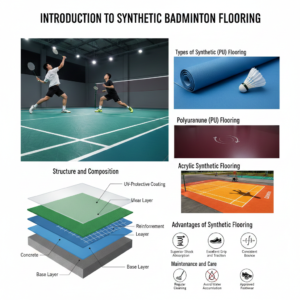
Synthetic badminton flooring refers to specialized sports surfaces made from PVC (Polyvinyl Chloride) or PU (Polyurethane) materials. These flooring systems are engineered to provide the right blend of cushioning, grip, and durability required for professional badminton play.
Unlike traditional wooden or cement surfaces, synthetic floors are multi-layered, ensuring even distribution of impact energy and reducing stress on players’ joints and muscles. They are designed to meet BWF (Badminton World Federation) standards for both recreational and competitive use.
The modern synthetic floor not only enhances gameplay but also offers aesthetic appeal, low maintenance, and long-term cost-effectiveness.
2. Structure and Composition of Synthetic Flooring
A typical synthetic badminton flooring system consists of multiple layers, each serving a distinct purpose:
-
Base Layer (Subfloor): Usually made of concrete or plywood, it provides structural stability.
-
Cushion Layer: This elastic layer absorbs impact and provides shock absorption.
-
Reinforcement Layer: Adds dimensional stability and prevents surface deformation.
-
Wear Layer: The topmost surface that offers excellent grip, slip resistance, and abrasion protection.
-
UV-Protective Coating: In outdoor applications, a UV coating shields the surface from color fading and heat damage.
Each layer contributes to overall performance, making synthetic flooring an advanced solution for modern badminton courts.
3. Types of Synthetic Badminton Flooring
Depending on the requirement, location, and level of gameplay, several types of synthetic flooring are used:
a) PVC Vinyl Flooring
PVC flooring is one of the most popular choices for badminton courts. It is made of multiple PVC layers fused together, offering flexibility, anti-slip properties, and easy maintenance. It comes in rolls or tiles and can be installed quickly over a concrete base.
Key Benefits:
-
Excellent grip and comfort
-
Resistant to wear, tear, and moisture
-
Economical and ideal for both schools and clubs
b) Polyurethane (PU) Flooring
PU flooring is a poured, seamless surface that provides superior elasticity and resilience. It is often used in professional indoor stadiums due to its consistent bounce and long-lasting finish.
Key Benefits:
-
High durability and smooth finish
-
Customizable cushioning thickness
-
Resistant to scratches and chemical spills
c) Acrylic Synthetic Flooring
Acrylic surfaces are more commonly used for outdoor badminton courts. They provide UV stability, anti-skid texture, and weather resistance.
Key Benefits:
-
Suitable for all weather conditions
-
Low maintenance and long lifespan
-
Available in various vibrant colors
5. Advantages of Synthetic Badminton Flooring
Synthetic flooring has transformed the way badminton courts are built. Here are its key advantages:
a) Superior Shock Absorption
The elastic cushioning layer absorbs impact efficiently, reducing strain on knees, ankles, and joints — a must for professional athletes and young players alike.
b) Excellent Grip and Traction
The surface texture prevents slipping while allowing smooth movement, ensuring players can perform quick footwork and directional changes confidently.
c) Consistent Bounce
Synthetic surfaces provide a uniform bounce across the entire court, which is crucial for fair and predictable gameplay.
d) Low Maintenance
Unlike wooden courts that require frequent polishing, synthetic floors only need periodic cleaning and occasional recoating, saving both time and money.
e) Durability and Weather Resistance
PVC and PU materials are highly resistant to wear, moisture, and temperature variations. They can withstand daily use without losing performance.
f) Cost-Effective and Long-Lasting
Although the initial investment may be moderate, synthetic courts offer great value due to their extended lifespan and minimal maintenance costs.
g) Eco-Friendly Options
Many manufacturers now use recyclable and low-VOC materials, aligning synthetic floors with modern sustainability standards.
6. Maintenance and Care
Proper maintenance extends the lifespan and performance of synthetic badminton flooring:
-
Regular Cleaning: Use a soft mop or vacuum to remove dust and dirt.
-
Avoid Water Accumulation: Keep the surface dry to prevent slippage.
-
Use Approved Footwear: Non-marking shoes maintain the surface finish.
-
Periodic Recoating: For PU and acrylic floors, recoat every 3–5 years to restore shine and grip.
Professional maintenance contracts ensure the court remains in top condition for long-term playability.
7. Cost of Synthetic Badminton Flooring in India
The cost varies depending on the material type, thickness, and installation area. On average:
-
PVC Flooring: ₹250–₹450 per sq. ft.
-
PU Flooring: ₹350–₹600 per sq. ft.
-
Acrylic Flooring: ₹200–₹400 per sq. ft.
Additional costs include sub-base construction, line marking, and accessories. However, the long-term durability and performance benefits justify the investment.
8. Applications of Synthetic Badminton Flooring
Synthetic badminton flooring is ideal for:
-
Indoor sports complexes and academies
-
Schools and universities
-
Private clubs and gyms
-
Residential societies and recreation centers
-
Multi-purpose halls and event spaces
Its versatility, appearance, and performance make it a preferred flooring solution for both recreational and professional environments.
9. Why Choose Professionals for Installation
Professional installation teams:
-
Use BWF-approved materials and adhesives
-
Ensure perfect leveling and joint sealing
-
Provide warranty and after-sales support
-
Customize color, thickness, and branding based on client needs
Partnering with experts guarantees that your court meets international standards for safety and performance.
10. Conclusion
In today’s era of modern sports infrastructure, synthetic badminton flooring stands as the benchmark for quality, safety, and endurance. It combines engineering excellence with playability, offering athletes a smooth, resilient, and high-performance surface.
Whether for a training academy, school, or club, synthetic flooring transforms ordinary spaces into world-class badminton arenas. With superior grip, durability, and aesthetics, it delivers a perfect fusion of technology and athletic spirit.
Investing in professional synthetic badminton flooring is more than just building a court — it’s creating an environment that nurtures champions and inspires the future of the sport.