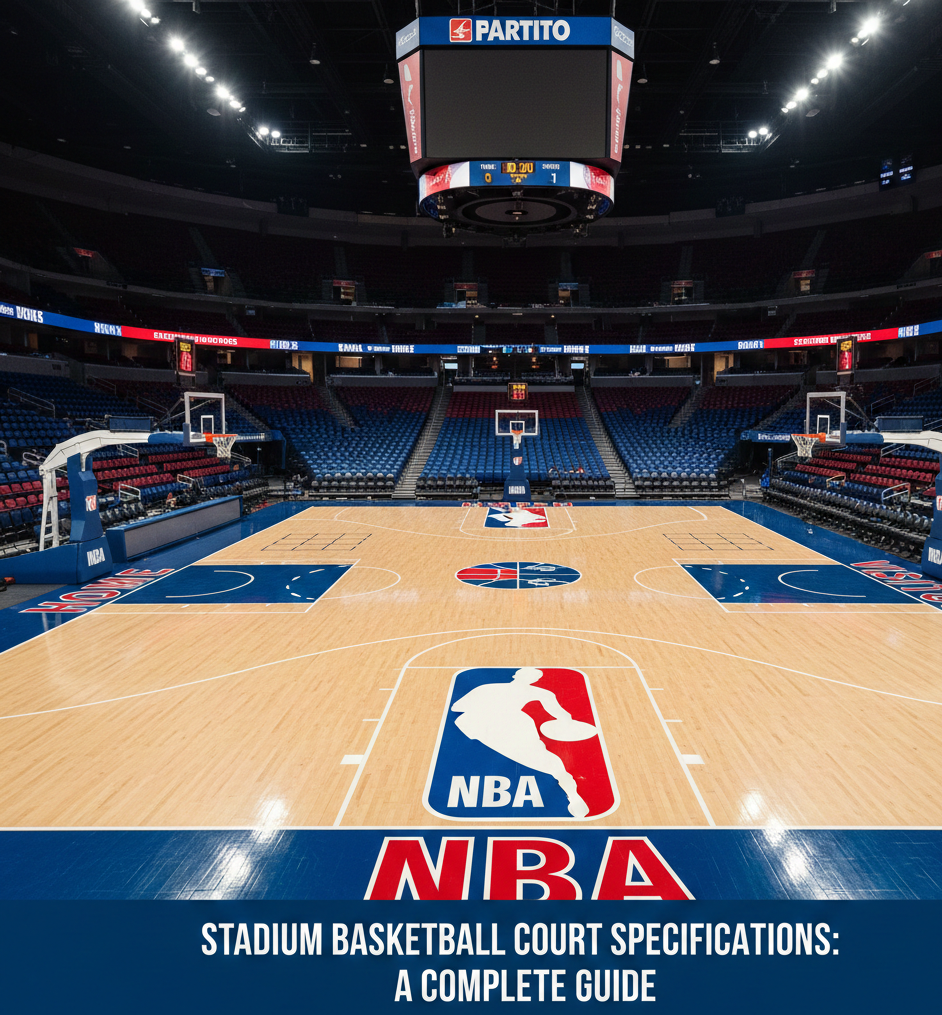
Stadium basketball courts are the pinnacle of professional basketball infrastructure, designed to host competitive matches, tournaments, and international events. These courts are meticulously planned to meet international standards, ensuring optimal player performance, spectator experience, and safety. Understanding the specifications of a stadium basketball court is essential for architects, sports facility managers, and event organizers.
Importance of Stadium Basketball Court Specifications
A stadium basketball court is not just a playing area; it is a high-performance sports environment. Proper specifications ensure:
-
Fair Play: Accurate dimensions and markings for competitive integrity.
-
Player Safety: High-quality flooring reduces the risk of injuries.
-
Spectator Experience: Adequate spacing and court visibility enhance the viewing experience.
-
Compliance: Meets FIBA or NBA standards for official competitions.
Standard Dimensions of a Stadium Basketball Court
Stadium basketball courts follow the official regulations set by FIBA (International Basketball Federation) and NBA (National Basketball Association):
-
Length: 28 meters (91.9 feet)
-
Width: 15 meters (49.2 feet)
-
Perimeter Clearance: Minimum 2 meters (6.5 feet) around the court for player safety and referee movement
These dimensions ensure consistent gameplay and accommodate all standard basketball activities.
Key Areas and Specifications
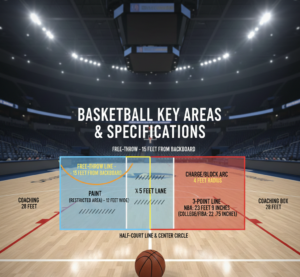
1. The Key / Restricted Area
-
Width: 4.9 meters (16 feet)
-
Length from baseline to free-throw line: 5.8 meters (19 feet)
-
Restricted Arc Radius: 1.25 meters (4 feet) from the center of the basket
This area is critical for post plays, rebounding, and defensive positioning.
2. Free-Throw Line
-
Distance from baseline: 5.8 meters (19 feet)
-
Line Width: 10–15 cm (4–6 inches)
Free-throw lines are essential for scoring precision and standardized practice during games.
3. Three-Point Line
-
NBA Standard: 7.24 meters (23 feet 9 inches) at the top, 6.7 meters (22 feet) in corners
-
FIBA Standard: 6.75 meters (22 feet 1.7 inches)
The three-point line is an essential scoring zone and a major tactical component of modern basketball.
4. Basket and Backboard Placement
-
Basket Height: 3.05 meters (10 feet)
-
Backboard Width: 1.8 meters (6 feet)
-
Backboard Height: 1.05 meters (3.5 feet)
-
Distance from baseline to backboard: 1.2 meters (4 feet)
Precise placement ensures accurate gameplay and helps players adjust shooting mechanics.
5. Other Court Markings
-
Center Circle: 3.6 meters (12 feet) diameter
-
Free-Throw Circle: 1.8 meters (6 feet) radius
-
No-Charge Semi-Circle: 1.25 meters (4 feet) radius under the basket
-
Sidelines and Baselines: Clearly marked with high-contrast paint
All markings must be precise and durable, supporting professional-level gameplay and refereeing.
Flooring Specifications
The flooring of a stadium basketball court is critical for performance, durability, and safety:
-
Material: Premium-grade hardwood (maple) or high-quality synthetic flooring
-
Surface Finish: Smooth, non-slip, and impact-absorbing
-
Thickness: Typically 25–30 mm for hardwood, with adequate underlay for shock absorption
-
Maintenance: Regular polishing and cleaning to maintain performance standards
High-quality flooring ensures longevity and supports high-intensity games without compromising player safety.
Lighting and Surrounding Specifications
In addition to court dimensions, stadiums must meet specific environmental standards:
-
Lighting: Uniform illumination of 1500–2000 lux for professional matches
-
Seating Clearance: Minimum 2 meters from sidelines and baselines
-
Scoreboards and Displays: Visible to both players and spectators without glare
These elements ensure the court is competition-ready and spectator-friendly.
Conclusion
Stadium basketball courts represent the gold standard in professional sports facilities. By adhering to precise dimensions, high-quality flooring, and appropriate court markings, stadiums provide athletes with a safe and competitive environment while enhancing the experience for spectators. Whether hosting national tournaments, international championships, or professional leagues, a well-designed stadium basketball court ensures fairness, performance, and excitement at every level of play.
Stadium Basketball Court Specifications – FAQs
1. What are the standard dimensions of a stadium basketball court?
A professional FIBA (International Basketball Federation) court measures:
-
Length: 28 meters (91.9 ft)
-
Width: 15 meters (49.2 ft)
For NBA standards:
-
Length: 94 ft (28.65 m)
-
Width: 50 ft (15.24 m)
Other key areas include:
-
Free-throw line: 4.6 m (15 ft) from the backboard
-
Three-point line: 6.75 m (22.15 ft) for FIBA, 7.24 m (23.75 ft) for NBA
-
Restricted area (paint): 4.9 m (16 ft) wide × 5.8 m (19 ft) long in FIBA, slightly larger in NBA
2. What type of flooring is used in stadium basketball courts?
Most professional stadiums use hardwood flooring, usually maple wood, due to its durability and shock absorption. Key features:
-
High-performance hardwood surface for optimal ball bounce
-
Cushioned subfloor system for player safety and reduced joint strain
-
Anti-slip finish for consistent traction
3. Why is a subfloor system important?
A subfloor or sprung floor:
-
Absorbs shock to prevent injuries
-
Provides consistent and uniform ball bounce
-
Enhances player agility and performance
-
Extends the life of the hardwood surface
4. What markings are required on a stadium basketball court?
Essential court markings include:
-
Center circle (1.8 m / 6 ft radius)
-
Three-point line (arc around the key)
-
Free-throw line and lane (key)
-
Restricted area (semi-circle under basket)
-
Sidelines and baselines
-
Team benches, coach areas, and substitution zones
All markings must be clear, uniform, and conform to FIBA or NBA specifications.
5. What type of finish is used on the court?
Professional basketball courts use:
-
Matte or semi-gloss finish for reduced glare
-
Anti-slip coatings to prevent injuries
-
Durable polyurethane or acrylic finishes that withstand heavy foot traffic and maintenance
6. What maintenance is required for a stadium basketball court?
Maintenance includes:
-
Daily dry dust mopping
-
Weekly cleaning with approved hardwood solutions
-
Regular inspection for scratches, cracks, or warping
-
Periodic sanding and recoating every 3–5 years
-
Maintaining humidity at 45–55% to prevent wood damage
7. What is the typical lifespan of a stadium basketball court?
With proper installation and maintenance:
-
Hardwood courts: 15–25 years
-
Subfloor systems may need periodic replacement every 10–15 years
Lifespan depends on usage frequency, indoor climate, and maintenance quality.
8. What are the lighting requirements for a stadium basketball court?
Proper lighting ensures visibility and player performance:
-
Minimum 1500 lux for professional competitions
-
Even distribution with no glare or shadows
-
LED or high-efficiency floodlights are preferred
9. Can synthetic flooring be used instead of hardwood?
Yes, synthetic sports flooring (vinyl or PU) can be used for:
-
Training courts
-
Multi-purpose halls
-
Cost-effective alternatives
However, hardwood is preferred for professional stadiums and competitive play due to better ball response and durability.
10. Is professional installation necessary?
Absolutely. Professional installation ensures:
-
Compliance with FIBA/NBA standards
-
Correct subfloor and moisture management
-
Accurate court dimensions and line markings
-
Safety and longevity of the court