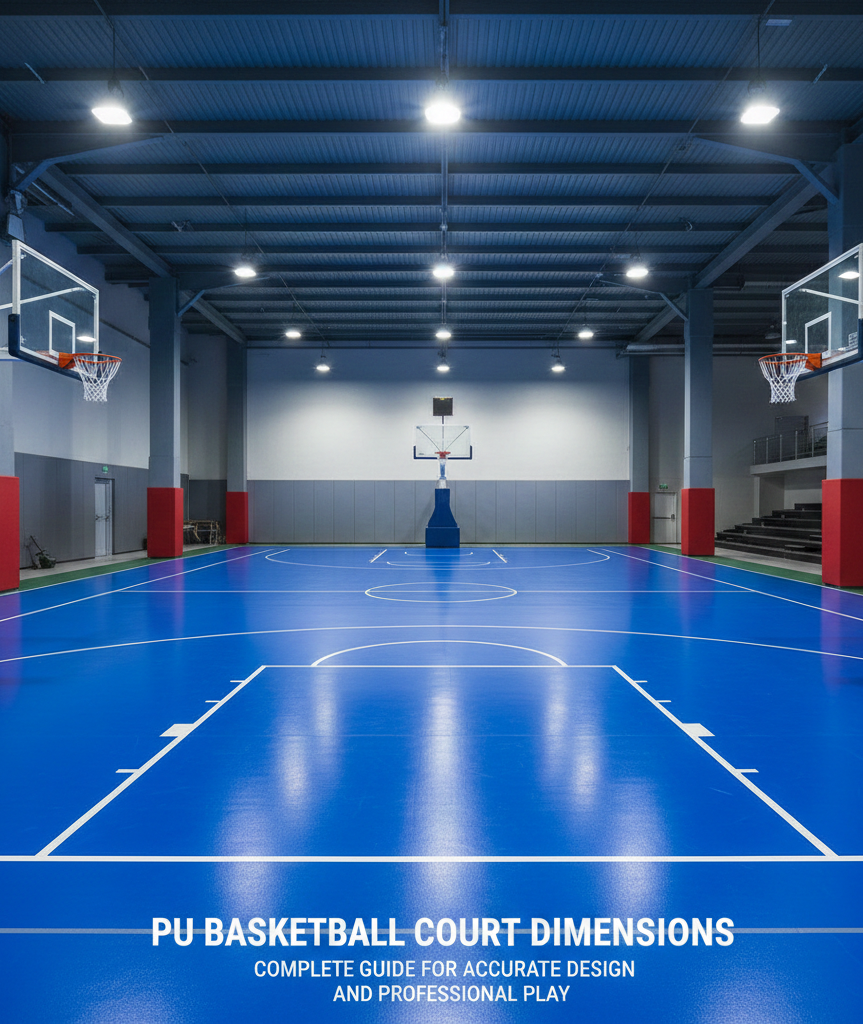
Designing a basketball court is not just about installing hoops and painting lines—it requires precise planning, correct dimensions, and the right surface system to ensure safety, performance, and durability. Among modern sports flooring solutions, PU (Polyurethane) basketball courts have become a preferred choice for schools, colleges, sports academies, residential societies, and professional arenas due to their shock absorption, seamless finish, and long service life.
Understanding PU basketball court dimensions is essential to ensure that the court meets official standards, provides fair gameplay, and delivers a professional playing experience. This detailed guide explains standard court measurements, key playing zones, and important design considerations specific to PU basketball courts.
What Is a PU Basketball Court?
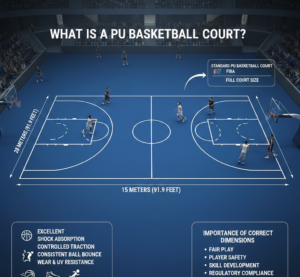
A PU basketball court is a sports surface created by applying multiple layers of polyurethane material over a properly prepared concrete or asphalt base. The result is a seamless, elastic, and high-performance surface suitable for both indoor and outdoor use.
PU flooring is engineered to provide:
-
Excellent shock absorption
-
Controlled traction and slip resistance
-
Consistent ball bounce
-
Resistance to wear, moisture, and UV exposure
Because of these features, PU courts are commonly used for basketball as well as other sports like volleyball, badminton, and multi-purpose activities.
Importance of Correct PU Basketball Court Dimensions
Accurate court dimensions are critical for:
-
Fair and standardized gameplay
-
Player safety and movement efficiency
-
Skill development and training accuracy
-
Compliance with national and international basketball regulations
Improper measurements can negatively impact shooting angles, spacing, and overall play quality. Whether the court is built for competition, training, or recreation, correct dimensions ensure the game is played as intended.
Standard PU Basketball Court Dimensions
Most PU basketball courts follow FIBA (International Basketball Federation) standards, although NBA and training courts may vary slightly.
Full Basketball Court Size
-
Length: 28 meters (91.9 feet)
-
Width: 15 meters (49.2 feet)
These dimensions apply to professional and international-level courts. For schools, academies, or space-limited facilities, scaled-down courts may be constructed while maintaining proportional markings.
Key Court Zones and Their Dimensions
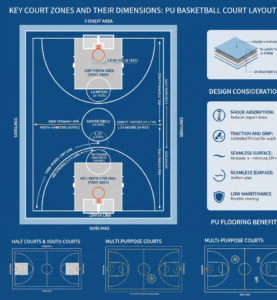
Understanding each playing area is essential when laying out a PU basketball court.
1. Center Circle
The center circle is located at the midpoint of the court and is used for tip-off at the start of the game.
-
Diameter: 3.6 meters (12 feet)
-
Radius: 1.8 meters (6 feet)
The center line divides the court into two equal halves, and accurate marking is essential for proper game flow.
2. The Key / Restricted Area (Paint Area)
The key area is one of the most active zones on the court, used for rebounds, layups, and defensive positioning.
-
Width: 4.9 meters (16 feet)
-
Length (Baseline to Free-Throw Line): 5.8 meters (19 feet)
This area must be clearly marked with high-contrast paint to ensure visibility on the PU surface.
3. Free-Throw Line and Free-Throw Circle
The free-throw line is critical for shooting fouls and practice drills.
-
Distance from Baseline: 5.8 meters (19 feet)
-
Line Width: 10–15 cm (4–6 inches)
The free-throw circle has:
-
Radius: 1.8 meters (6 feet)
Only the top half of the circle is marked in front of the free-throw line.
4. Three-Point Line
The three-point line defines long-range scoring zones and varies slightly depending on governing standards.
-
FIBA Standard Radius: 6.75 meters (22 feet 1.7 inches)
-
NBA Standard Radius: 7.24 meters (23 feet 9 inches)
-
Corner Distance (NBA): 6.7 meters (22 feet)
For PU basketball courts in India and most international facilities, the FIBA measurement is commonly used unless specified otherwise.
5. No-Charge Semi-Circle (Restricted Arc)
This semi-circular area under the basket helps officials determine charging and blocking fouls.
-
Radius: 1.25 meters (4 feet)
-
Center Point: Directly below the center of the basket
This marking must be precise to ensure fair officiating during games.
6. Basket and Backboard Dimensions
Accurate hoop placement is crucial for realistic gameplay and training.
-
Basket Height (from floor): 3.05 meters (10 feet)
-
Backboard Width: 1.8 meters (6 feet)
-
Backboard Height: 1.05 meters (3.5 feet)
-
Distance from Baseline to Backboard: 1.2 meters (4 feet)
The rim must be level, securely fixed, and aligned perfectly with the court markings.
Boundary Lines and Markings
-
Sidelines and Baselines: Clearly defined court boundaries
-
Line Width: Typically 5 cm (2 inches)
-
Color Contrast: Lines should contrast sharply with the PU surface color for maximum visibility
PU-compatible, UV-resistant paint is used to ensure markings remain crisp and durable over time.
Flooring Benefits Specific to PU Basketball Courts
PU flooring enhances the performance and safety of basketball courts in several ways:
Shock Absorption
The elastic nature of PU reduces impact stress on knees, ankles, and hips, helping prevent injuries.
Traction and Grip
PU surfaces provide controlled friction, allowing quick direction changes without slipping.
Seamless Surface
Unlike tile-based systems, PU courts are joint-free, ensuring uniform play and ball response.
Durability
PU flooring resists abrasion, moisture, UV rays, and heavy foot traffic, making it suitable for long-term use.
Low Maintenance
Routine cleaning and periodic inspections are enough to maintain surface quality.
Design Considerations for PU Basketball Courts
When designing a PU basketball court, several technical factors must be considered alongside dimensions.
Base Preparation
A properly leveled concrete or asphalt base is essential for PU application and long-term stability.
PU Layer Thickness
Typically ranges from 4 mm to 8 mm, depending on usage intensity and shock absorption requirements.
Safety Run-Off Area
Adequate free space around the court perimeter is necessary for player safety and movement.
Indoor vs Outdoor Design
Outdoor courts require additional UV-resistant and weatherproof coatings, while indoor courts focus more on cushioning and acoustics.
Custom and Training Court Dimensions
-
Half Courts: Ideal for practice and skill development
-
Youth Courts: Scaled-down dimensions for younger players
-
Multi-Purpose Courts: Basketball lines integrated with other sports markings
Even in custom designs, maintaining proportional measurements is essential for proper gameplay.
Conclusion
Understanding and implementing correct PU basketball court dimensions is fundamental to building a safe, professional, and high-performing sports facility. From full-court size to key areas, three-point arcs, and basket placement, every measurement plays a role in gameplay quality and athlete development.
When combined with high-quality PU flooring, accurate dimensions create a court that delivers superior comfort, durability, and consistency. Whether for schools, sports academies, residential projects, or professional arenas, PU basketball courts designed to proper standards provide long-term value and an exceptional playing experience.
PU Basketball Court Dimensions – FAQs
1. What is a PU basketball court?
A PU (Polyurethane) basketball court is a high-performance indoor sports surface made of polyurethane layers over a concrete or asphalt base. It offers:
-
Excellent shock absorption
-
Smooth, uniform ball bounce
-
Slip-resistant traction
-
Durability for heavy use in schools, clubs, and arenas
2. What are the standard dimensions of a professional basketball court?
-
FIBA (International) standard: 28 m × 15 m (91.9 ft × 49.2 ft)
-
NBA standard: 28.65 m × 15.24 m (94 ft × 50 ft)
-
High school courts: Typically 26 m × 14 m (85 ft × 46 ft)
These dimensions include the playing area only, not safety run-offs or buffer zones.
4. Can PU basketball courts be customized in size?
Yes. PU flooring can be installed for:
-
Full-size professional courts
-
Half courts or practice courts
-
Small indoor or multipurpose areas
Custom sizing is often done for schools, gyms, and residential sports setups.
5. What is the standard thickness of PU basketball flooring?
-
Top polyurethane wear layer: 2–4 mm
-
Shock-absorbing intermediate layer (optional): 6–10 mm
-
Total thickness: 8–14 mm depending on shock absorption and comfort requirements
Thicker layers provide better joint protection and durability.
6. Does PU flooring affect ball bounce and gameplay?
Yes. PU basketball flooring provides:
-
Consistent ball rebound
-
Controlled traction for players
-
Slight cushioning to reduce joint impact
7. What base is required for a PU basketball court?
A strong, level base is essential:
-
RCC or PCC concrete slab
-
Smooth finish, crack-free surface
-
Moisture barrier or primer layer for durability
Base quality directly affects performance and lifespan.
8. Are PU basketball courts suitable for multi-sport use?
Yes. PU courts can be designed for:
-
Basketball
-
Volleyball
-
Badminton
-
Indoor futsal
9. How long does it take to install a PU basketball court?
-
Standard indoor PU court installation: 7–15 days
-
Larger arenas or custom designs may take longer
-
Includes base preparation, PU layers, finishing, and line marking
10. How long does a PU basketball court last?
With proper maintenance:
-
Lifespan: 8–12 years for indoor professional use