A properly sized pickleball court is the foundation of fair gameplay, player safety, and optimal performance. Whether you are planning a residential backyard pickleball court, a school or community facility, or a professional tournament venue, following official court dimensions is essential. Even small deviations in size, spacing, or markings can affect the quality of play and the overall experience.
This Pickleball Court Dimensions Guide provides a comprehensive overview of standard measurements, recommended clearances, surface markings, indoor requirements, and conversion options. Understanding these dimensions ensures your pickleball court meets regulation standards and delivers a consistent, enjoyable playing environment.
Why Pickleball Court Dimensions Matter
Pickleball is a sport built on precision, movement, and quick reactions. Correct court dimensions ensure:
-
Fair and balanced gameplay for singles and doubles
-
Consistent ball bounce and shot placement
-
Adequate space for volleys, dinks, and baseline rallies
-
Reduced risk of player collisions or injuries
-
Compliance with recreational and tournament standards
A court that follows official dimensions allows players to train, compete, and enjoy the game as it was intended.
Official Pickleball Court Dimensions
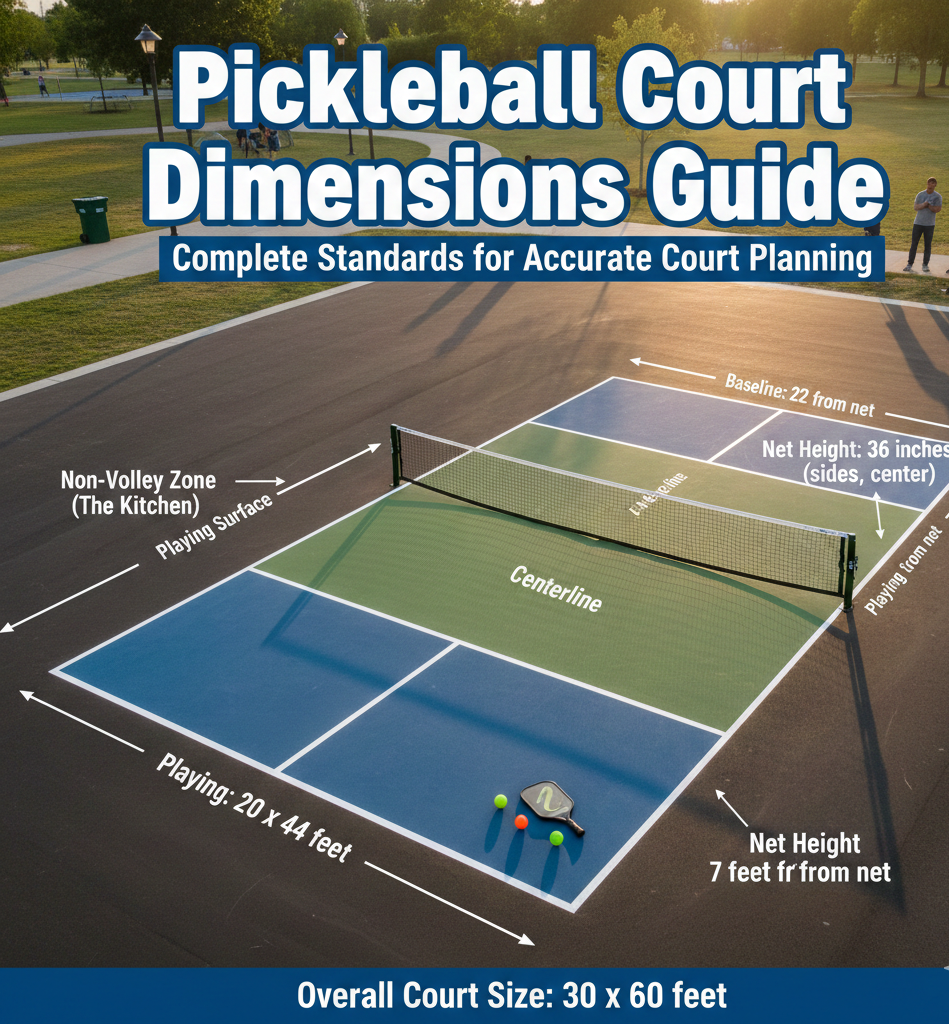
According to recognized pickleball standards, the playing area of the court is the same for both singles and doubles matches.
Total Court Size
-
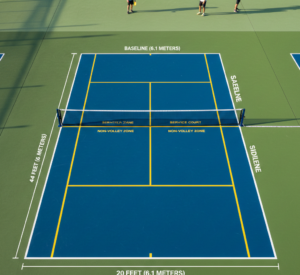
Width: 20 feet (6.1 meters)
-
Length: 44 feet (13.4 meters)
This measurement includes all playing lines and applies universally, regardless of skill level or court type.
Key Zones of a Pickleball Court
Understanding the different zones within the court is critical when following a pickleball court dimensions guide.
Non-Volley Zone (Kitchen)
-
Extends 7 feet (2.13 meters) from the net on each side
-
Runs the full width of the court (20 feet)
Players are not allowed to volley the ball (hit it in the air without letting it bounce) while standing inside this zone. The non-volley zone is one of the most distinctive features of pickleball and plays a major role in strategy and fairness.
Service Courts
Each side of the net is divided into right and left service courts by a centerline:
-
Service courts are used during serves
-
Players must serve diagonally into the opposite service box
-
The serve must clear the non-volley zone
Accurate dimensions of the service courts are essential for correct serving and scoring.
Baselines and Sidelines
-
Sidelines: 20 feet apart
-
Baselines: 44 feet apart
These lines define the outer boundaries of the playing area. Proper spacing ensures fair judgment of in-bounds and out-of-bounds shots.
Net Height Requirements
Net height is a critical part of pickleball court dimensions and directly affects gameplay.
-
36 inches (91.44 cm) at the sidelines
-
34 inches (86.36 cm) at the center
The slight dip in the middle helps maintain consistent play and allows for proper ball clearance during rallies.
Line Width and Court Markings
Standard Line Width
-
All court lines must be 2 inches (5.08 cm) wide
Lines are considered part of the playing area they define. Consistency in line width is essential for accurate calls and professional appearance.
Required Court Lines
A complete pickleball court includes:
-
Baselines
-
Sidelines
-
Centerlines
-
Non-volley zone lines
-
Center mark (optional, for alignment)
High-contrast colors are recommended to ensure clear visibility of the ball and court boundaries.
Recommended Surrounding Space (Run-Off Area)
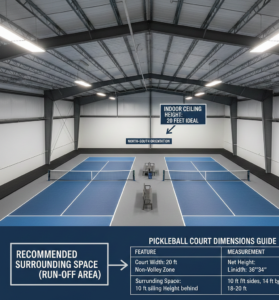
While the official court size is 20 × 44 feet, additional surrounding space is crucial for safety and comfort.
Minimum Recommended Clearances
-
Side clearance: Minimum 10 feet (3 meters) on each side
-
End clearance: Minimum 14 feet (4.3 meters) behind each baseline
With these clearances, the total recommended play area becomes approximately:
-
30 feet wide × 72 feet long
This additional space allows players to chase shots safely and reduces the risk of injury.
Indoor Pickleball Court Height Requirements
For indoor facilities, ceiling height is a critical consideration.
Recommended Ceiling Height
-
Minimum: 18 feet (5.5 meters)
-
Ideal: 20 feet (6 meters) or more
Adequate ceiling height prevents interference with high lobs and overhead shots, ensuring uninterrupted play.
Pickleball Court Orientation
Although not a fixed dimension, court orientation is an important design consideration.
-
Preferred orientation: North–South
-
This minimizes sun glare during morning and evening play on outdoor courts
Correct orientation improves player comfort and visibility.
Multi-Court and Facility Planning
When designing facilities with multiple pickleball courts, spacing between courts becomes equally important.
Recommended Spacing Between Courts
-
Minimum 10 feet between adjacent courts
-
Additional space if fencing, seating, or walkways are included
Proper spacing ensures player safety and smooth movement within the facility.
Multi-Purpose Court Conversion Dimensions
One of the advantages of pickleball is that courts can be overlaid on existing tennis or basketball courts, reducing construction costs.
Conversion Guidelines
-
Ensure pickleball court dimensions remain 20 × 44 feet
-
Use contrasting colors for pickleball lines
-
Maintain accurate non-volley zone and service court markings
-
Avoid overlapping lines that may confuse players
Temporary tape lines or permanent painted lines can be used depending on usage frequency.
Outdoor vs Indoor Pickleball Court Dimension Considerations
| Feature | Outdoor Court | Indoor Court |
|---|---|---|
| Court Size | 20 × 44 ft | 20 × 44 ft |
| Surrounding Space | Essential | Essential |
| Drainage | Required | Not required |
| Ceiling Height | Not applicable | 18–20 ft |
| Orientation | North–South preferred | Flexible |
While the playing dimensions remain the same, environmental requirements differ significantly.
Common Mistakes to Avoid in Court Dimensions
When planning a pickleball court, avoid these common errors:
-
Insufficient run-off space
-
Incorrect non-volley zone measurement
-
Improper net height
-
Narrow side clearances
-
Inconsistent or faded line markings
Following a detailed pickleball court dimensions guide helps avoid costly corrections later.
Benefits of Accurate Pickleball Court Dimensions
-
Ensures regulation-compliant play
-
Improves player confidence and movement
-
Reduces injury risks
-
Supports competitive and tournament play
-
Enhances the professional appearance of the court
Proper dimensions are especially important for schools, clubs, and facilities hosting organized events.
Summary Table: Pickleball Court Dimensions Guide
| Feature | Measurement |
|---|---|
| Court Width | 20 feet (6.1 m) |
| Court Length | 44 feet (13.4 m) |
| Non-Volley Zone | 7 feet (2.13 m) from net |
| Net Height | 36” sidelines, 34” center |
| Line Width | 2 inches (5.08 cm) |
| Recommended Surrounding Space | 10 ft sides, 14 ft behind baselines |
| Indoor Ceiling Height | 18–20 ft (5.5–6 m) |
Conclusion
This Pickleball Court Dimensions Guide highlights the importance of accuracy, spacing, and adherence to official standards when designing or building a pickleball court. From the regulation 20 × 44-foot playing area to proper run-off space, net height, and indoor ceiling clearance, every measurement plays a vital role in safety and performance.
Whether you are constructing a residential court, converting an existing sports surface, or developing a professional pickleball facility, following correct dimensions ensures fair gameplay, long-term usability, and player satisfaction. Investing time in proper planning and measurement results in a pickleball court that performs exceptionally and meets the expectations of both recreational and competitive players.
Pickleball Court Dimensions Guide – FAQ
1. What is a pickleball court?
A pickleball court is a playing surface designed for the sport of pickleball, a combination of tennis, badminton, and table tennis. Courts can be indoor or outdoor and are built to standard dimensions to ensure fair play.
2. What are the official pickleball court dimensions?
According to the USA Pickleball Association (USAPA):
-
Court length: 44 ft (13.41 m)
-
Court width: 20 ft (6.10 m)
-
Non-volley zone (“kitchen”): 7 ft (2.13 m) from the net on each side
-
Net height: 36 in (0.914 m) at posts, 34 in (0.86 m) at the center
These standards apply to singles and doubles play.
3. How much space is needed around the court?
-
Side and back clearance: Minimum 10–15 ft recommended
-
Total space including run-off: 64–70 ft length × 34–40 ft width
Adequate space ensures player safety and allows for movement outside the playing area.
4. Can pickleball courts be combined with other sports courts?
Yes. Multi-purpose courts can share space with:
-
Tennis (half-court)
-
Mini-tennis
-
Indoor badminton (if dimensions allow)
Contractors must carefully plan line markings to avoid confusion during play.
5. What is the recommended orientation of the court?
-
North-South alignment is ideal for outdoor courts to reduce sun glare
-
East-West orientation is not recommended for competitive play
6. How many courts can fit in a typical area?
Depends on the area and spacing:
-
Two courts side by side: Requires ~34–40 ft width × 64–70 ft length per court
-
Multi-court complexes: Need 10–15 ft clearance between courts and around edges
Designers often stagger courts to maximize space and prevent interference.
7. What surface types are compatible with these dimensions?
-
Outdoor: Acrylic or PU-coated concrete/asphalt, interlocking tiles
-
Indoor: Wooden flooring, cushioned PU, or synthetic sports flooring
-
The surface must be level and consistent across the entire court to maintain accurate play.
8. What is the height requirement for indoor courts?
-
Ceiling height: Minimum 18–20 ft to prevent interference with high shots
-
Outdoor courts generally have no height restrictions but may include overhead netting or fencing for safety
9. How do dimensions affect line marking?
-
Baseline: 22 ft from the net (half of court length)
-
Sidelines: 10 ft from center line (half of court width)
-
Non-volley zone (“kitchen”) lines: 7 ft from net on each side
Accurate line marking is critical for official play and tournaments.
10. Can court dimensions be adjusted for recreational use?
Yes. For small residential or community spaces:
-
Mini courts: Slightly shorter or narrower, but proportions must remain consistent
-
Not recommended for official competition
11. What other dimensions are important for design?
-
Net posts: Positioned just outside the sidelines
-
Non-volley zone depth: 7 ft
-
Service area: Each side divided into left and right service courts
These dimensions must be precise for proper gameplay.
12. How does proper court planning improve play?
-
Ensures fair and accurate gameplay
-
Reduces injury risk
-
Improves flow and spacing for singles and doubles matches
-
Facilitates coaching, tournaments, and club usage