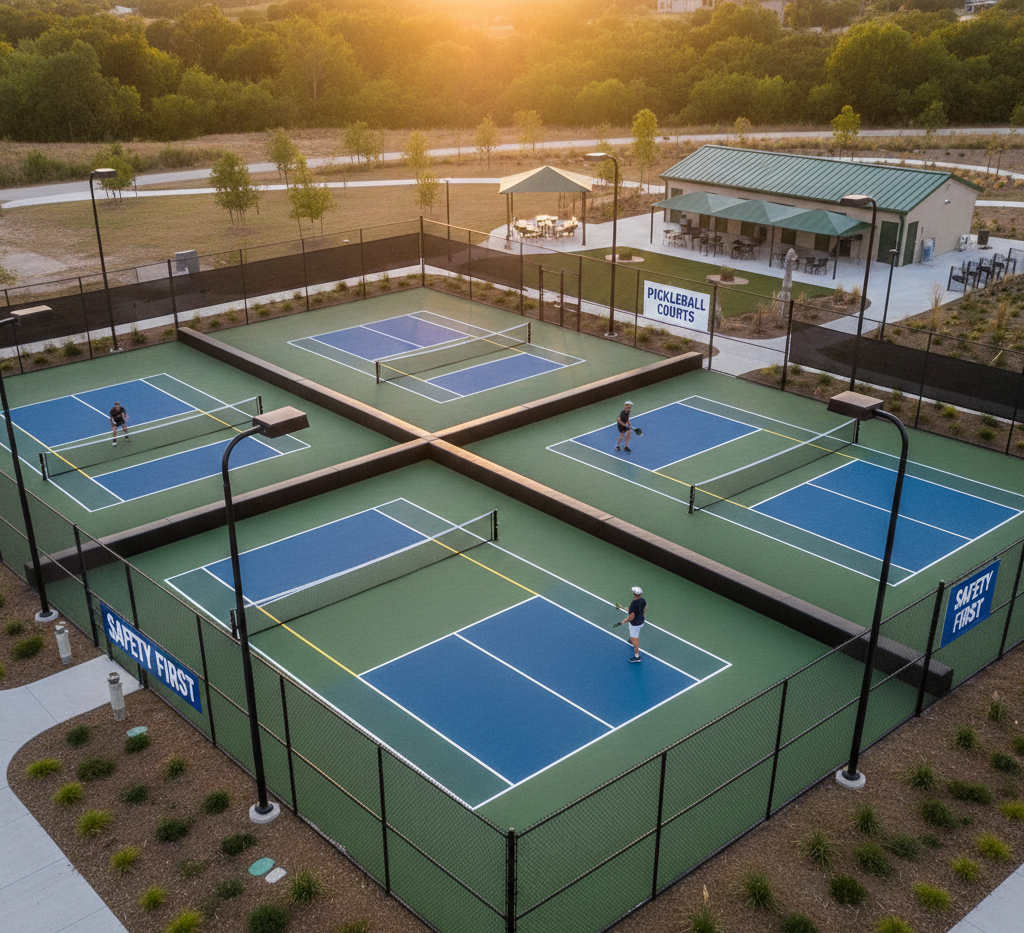
Pickleball is one of the fastest-growing sports globally, combining the best elements of tennis, badminton, and table tennis into an exciting and accessible game. As the sport gains popularity across residential communities, schools, sports clubs, resorts, and public parks, the demand for professionally designed pickleball courts continues to rise. At the heart of every successful pickleball facility lies a well-planned pickleball court design.
A professional pickleball court design goes beyond simple markings on a surface. It ensures correct dimensions, proper layout orientation, safe movement zones, effective drainage, appropriate surface selection, and visually appealing aesthetics. When designed correctly, a pickleball court offers superior playability, long-term durability, and an enjoyable experience for players of all skill levels.
Importance of a Professional Pickleball Court Design
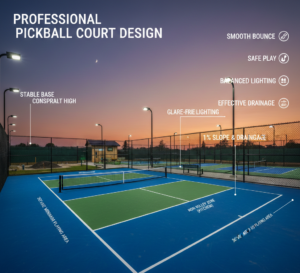
A thoughtfully designed pickleball court plays a crucial role in the overall quality of the game. Poor design can lead to uneven bounce, player discomfort, drainage issues, and higher maintenance costs. On the other hand, a professional pickleball court design ensures:
-
Smooth and consistent ball bounce
-
Safe player movement with non-slip surfaces
-
Proper space utilization for comfort and gameplay flow
-
Balanced lighting without glare or shadows
-
Effective drainage for outdoor courts
-
Enhanced visual appeal through customized colors and layouts
The right design forms the foundation for long-term performance and helps extend the lifespan of the court.
Standard Pickleball Court Dimensions and Layout
Understanding regulation dimensions is a key part of pickleball court design. A standard pickleball court measures:
-
20 feet wide and 44 feet long (for both singles and doubles play)
To ensure safe player movement and adequate run-off space, the recommended minimum total playing area is:
-
30 feet by 60 feet
Key Court Zones
A professional pickleball court design clearly defines the following zones:
-
Non-Volley Zone (Kitchen): A 7-foot area on both sides of the net where volleys are prohibited
-
Service Areas: Divided into right and left service courts by centerlines
-
Baselines and Sidelines: Clearly marked for accurate gameplay
Precise line marking and spacing are essential for fair play, player comfort, and adherence to official rules.
Core Elements of an Effective Pickleball Court Design
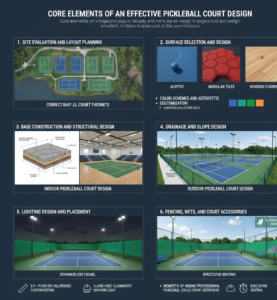
1. Site Evaluation and Layout Planning
Every pickleball court design begins with a detailed site assessment. Designers analyze available space, ground conditions, surrounding structures, and environmental factors. Court orientation is typically planned along a north-south axis to minimize sun glare during play.
Layout planning ensures:
-
Efficient use of available space
-
Proper spacing between multiple courts
-
Safe clearance around the playing area
-
Accessibility for players and spectators
2. Surface Selection and Design
Surface choice is one of the most critical decisions in pickleball court design, as it directly affects playability, safety, and maintenance.
Popular Surface Options
-
Acrylic Sports Flooring: Ideal for outdoor courts, offering excellent durability, weather resistance, and consistent bounce
-
Modular Interlocking Tiles: Easy to install, shock-absorbent, and suitable for multipurpose use
-
Vinyl or Wooden Flooring: Best for indoor courts, providing smooth play and a premium aesthetic
Each surface type is designed to deliver optimal traction, uniform ball response, and long-term performance.
3. Base Construction and Structural Design
A stable base is essential for any pickleball court design. Typically constructed using concrete or asphalt, the base must be properly compacted and leveled to prevent cracks, uneven surfaces, or water pooling.
Design considerations include:
-
Correct base thickness
-
Soil condition and load capacity
-
Expansion joints to manage temperature changes
A strong base ensures the court remains structurally sound for many years.
4. Drainage and Slope Design
Drainage is a critical element in outdoor pickleball court design. Courts are built with a gentle slope of approximately 1% to allow water runoff without affecting gameplay.
Effective drainage design includes:
-
Proper surface slope
-
Drainage channels or perimeter systems
-
Prevention of water stagnation and surface damage
A well-designed drainage system protects the court surface and reduces long-term maintenance costs.
5. Lighting Design and Placement
Lighting design is essential for courts intended for evening or night play. A professional pickleball court design incorporates energy-efficient LED lighting that provides uniform illumination across the court.
Lighting considerations include:
-
Proper pole placement
-
Glare-free illumination
-
Even light distribution without shadows
-
Compliance with recreational or tournament lighting standards
Good lighting enhances visibility, safety, and the overall playing experience.
6. Fencing, Nets, and Court Accessories
A complete pickleball court design includes all necessary accessories:
-
Fencing: Typically 8 to 10 feet high to contain balls while maintaining visibility
-
Nets and Posts: Installed at regulation height and tension
-
Seating Areas: Benches or spectator seating for comfort
-
Wind Screens: Optional additions for outdoor courts
These elements are integrated seamlessly into the overall design to create a functional and professional court.
Color Schemes and Aesthetic Customization
Modern pickleball court design allows for a wide range of color combinations. Popular choices include blue and green surfaces, but custom colors can be used to match branding or architectural themes.
Color design serves both aesthetic and functional purposes:
-
Improves ball visibility
-
Enhances contrast between court zones
-
Creates a visually appealing sports environment
Custom logos, school emblems, or sponsor branding can also be incorporated into the court surface.
Indoor vs Outdoor Pickleball Court Design
While the basic court dimensions remain the same, indoor and outdoor pickleball court designs differ in several key aspects:
| Feature | Indoor Court Design | Outdoor Court Design |
|---|---|---|
| Surface Type | Vinyl / Wooden | Acrylic / Modular Tiles |
| Lighting | Ceiling-mounted lights | LED floodlights |
| Drainage | Not required | Essential |
| Base Structure | Concrete subfloor | Asphalt or concrete with slope |
| Usage | Year-round play | Recreational and competitive play |
Understanding these differences helps in selecting the right design approach for each environment.
Sustainable Pickleball Court Design
Sustainability is becoming an important consideration in modern pickleball court design. Eco-friendly design elements include:
-
Recyclable surface materials
-
Low-VOC paints and coatings
-
Energy-efficient LED lighting
-
Water-efficient drainage systems
Sustainable designs reduce environmental impact while lowering long-term operational costs.
Benefits of Hiring Professional Pickleball Court Designers
Working with experienced professionals ensures:
-
Regulation-compliant court dimensions and layout
-
Optimal space utilization
-
Accurate slope and leveling
-
Expert material and surface recommendations
-
Seamless coordination between design and construction
Professional designers transform raw spaces into high-performance pickleball courts that meet recreational, institutional, and professional standards.
Conclusion
A well-executed pickleball court design is the foundation of an exceptional playing experience. From accurate layout planning and surface selection to drainage, lighting, and aesthetic detailing, every design element plays a vital role in performance, safety, and durability.
Whether you are building a pickleball court for a private residence, school, community park, or sports club, investing in professional design ensures long-lasting value, superior playability, and visual appeal. A thoughtfully designed pickleball court not only supports great gameplay but also enhances the overall sports environment, making it enjoyable for players and spectators alike.
Pickleball Court Design – FAQ
1. What is pickleball court design?
Pickleball court design involves planning and constructing a court that meets official size standards, provides a safe playing environment, and optimizes performance and durability. It includes layout, surface selection, net placement, fencing, lighting, and amenities.
2. What are the official dimensions for a pickleball court?
According to the USA Pickleball Association (USAPA):
-
Court length: 44 ft (13.41 m)
-
Court width: 20 ft (6.10 m)
-
Non-volley zone (“kitchen”): 7 ft (2.13 m) from the net
-
Net height: 36 in (0.914 m) at the sidelines, 34 in (0.86 m) at the center
Designs must respect these dimensions for competitive play.
3. What factors should be considered in pickleball court design?
-
Site selection: Flat, well-drained area
-
Court orientation: Preferably north-south to minimize sun glare
-
Surface type: Acrylic, PU, modular tiles, or indoor wood flooring
-
Safety clearances: Minimum 10–15 ft around court, with higher for tournaments
-
Amenities: Fencing, lighting, seating, and shade
4. What surface materials are suitable for high-performance courts?
-
Acrylic/PU-coated concrete or asphalt: Durable, low-maintenance, weather-resistant
-
Interlocking modular tiles: Shock-absorbing, portable, easy installation
-
Indoor wood or cushioned PU: High-performance, ideal for indoor competitive play
Surface choice affects play quality, traction, and injury risk.
5. How much space is needed around the court?
-
Side and back clearance: Minimum 10–15 ft for safety
-
Total recommended space: 64–70 ft (length) × 34–40 ft (width) including run-off areas
-
Clearance allows players to move freely without hitting fences or walls
6. How should lighting be designed for pickleball courts?
-
Even, glare-free lighting is critical for evening play
-
Recommended height: 12–14 ft LED floodlights
-
Illumination level: 150–300 lux for recreational, 300–500 lux for tournament-level play
7. What safety features should be included?
-
Non-slip, shock-absorbing surfaces
-
Adequate clearance around courts
-
Fencing (10–12 ft) to prevent balls from leaving the area
-
Well-marked lines and consistent net placement
8. Can pickleball courts be multi-purpose?
Yes. Courts can be designed to accommodate:
-
Tennis (half-court)
-
Mini-tennis
-
Badminton (indoors or larger outdoor courts)
Careful line marking and surface selection ensure safety and performance for all sports.
9. What is the recommended orientation of a court?
-
North-South alignment is ideal to reduce sun glare for players during morning and evening play
-
Avoid East-West orientation for outdoor competitive courts
10. How are nets and poles incorporated into design?
-
Net height: 36 in (posts), 34 in (center)
-
Net tension: Adjustable to maintain level across the court
-
Post placement: Outside playing area for safety
-
Optional padding can reduce injury risk on outdoor courts