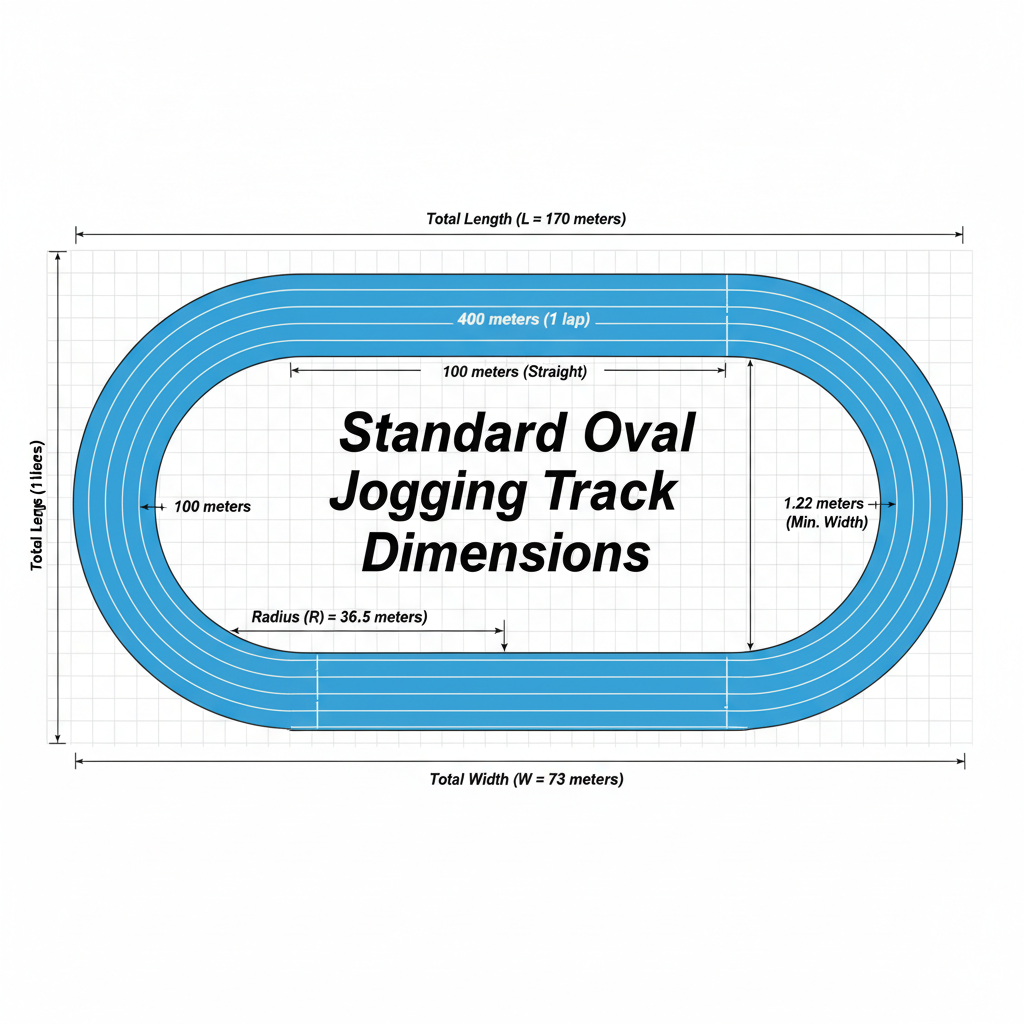
When developing a jogging or running facility, understanding oval jogging track dimensions is one of the most important aspects of planning. The shape, size, and layout of a jogging track directly influence user comfort, safety, lap accuracy, and efficient land utilization. This is why the oval format has become the most widely used design for jogging and athletic tracks across the world.
From compact residential jogging loops to full-sized professional athletics tracks, oval jogging tracks provide smooth movement, natural running flow, and precise distance measurement. Whether the goal is daily fitness, school training, or competitive athletics, correct dimensions ensure the track performs as intended.
What Is an Oval Jogging Track?

An oval jogging track is a continuous loop made up of two straight sections connected by two curved ends. The curves are usually semicircular, allowing runners to maintain rhythm without abrupt turns. This design reduces strain on joints and improves overall running efficiency.
Oval jogging tracks are commonly found in:
-
Schools and colleges
-
Stadiums and sports complexes
-
Residential societies
-
Public parks and green spaces
-
Corporate wellness zones
-
Athletic training centers
The oval layout is preferred because it balances comfort, safety, and space efficiency, making it suitable for both casual joggers and professional athletes.
Why Oval Jogging Track Dimensions Matter
Accurate oval jogging track dimensions are critical for several reasons:
Consistent Distance Measurement
Each lap covers a fixed length, making it easy for runners to track distance, pace, and endurance.
Safe and Comfortable Running
Proper curve radius reduces stress on ankles and knees during turns.
Efficient Use of Space
The oval design fits well within rectangular plots while maximizing usable track length.
Multi-User Compatibility
Tracks can accommodate walkers, joggers, and runners simultaneously when designed correctly.
Compliance with Athletic Standards
For schools and stadiums, correct dimensions ensure compatibility with training and competitions.
Standard Oval Jogging Track Dimensions (400-Meter Track)
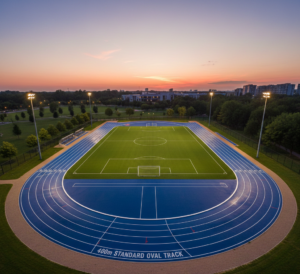
The 400-meter oval track is the globally accepted standard for athletics and professional jogging facilities. Its dimensions are regulated by World Athletics (formerly IAAF).
Key Dimensions of a Standard 400m Oval Track
| Component | Measurement |
|---|---|
| Total Lap Length | 400 meters |
| Shape | Two straights + two semicircular curves |
| Lane Width | 1.22 meters |
| Number of Lanes | 6 to 8 (standard) |
| Total Track Width (8 lanes) | 9.76 meters |
| Radius of Inner Curve | 36.5 meters |
| Length of Each Straight | 84.39 meters |
| Total Length (End to End) | Approx. 176–182 meters |
| Total Width | Approx. 73–78 meters |
| Total Area Required | 5,500 – 6,000 sq. meters |
Important Measurement Notes
-
The 400m lap is measured 30 cm from the inner edge of Lane 1.
-
Additional lanes increase overall width, not lap length.
-
Proper banking or gradual curves ensure runner safety at higher speeds.
Mini Oval Jogging Track Dimensions for Smaller Spaces
Not every project has space for a full 400-meter track. Mini oval jogging tracks are ideal for residential, institutional, or recreational areas where land availability is limited.
Common Mini Oval Track Sizes
| Track Length | Area Required (Approx.) | Suitable Locations |
|---|---|---|
| 200 meters | 2,500 – 3,000 sq. m | Schools, parks |
| 150 meters | 1,800 – 2,200 sq. m | Clubs, societies |
| 100 meters | 1,000 – 1,500 sq. m | Gyms, rooftops |
| 50 meters | 500 – 800 sq. m | Compact fitness zones |
Mini tracks usually feature 1 to 3 lanes, with lane widths ranging from 2.5 to 5 meters, depending on walking or jogging intensity.
Layout Structure of an Oval Jogging Track
A properly designed oval jogging track consists of the following elements:
1. Straight Sections
-
Positioned opposite each other
-
Ideal for steady pace running
-
Length depends on total track size
2. Curved Ends
-
Smooth semicircular curves
-
Radius adjusted based on track length
-
Designed to minimize centrifugal force
3. Inner Boundary (Curbing)
-
Defines the inner edge of the track
-
Made from concrete, rubber, or metal
-
Enhances safety and lane clarity
4. Outer Safety Zone
-
Additional walking paths or landscaping
-
Improves aesthetics and circulation
Space Calculation for Oval Jogging Track Dimensions
A simplified method to estimate space requirements:
Approximate Area Formula:
Area ≈ (2 × Straight Length × Track Width) + (π × Radius²)
For a 400m track, the total area generally falls between 5,500 and 6,000 square meters, including safety zones.
Smaller tracks require proportionally less space while maintaining similar design principles.
Customization Options for Oval Jogging Tracks
Oval jogging track dimensions can be adapted to suit specific needs:
Lane Configuration
-
Single-lane tracks for walking
-
Multi-lane tracks for jogging and training
Surface Materials
-
PU synthetic systems
-
EPDM rubber flooring
-
Acrylic coatings
-
Rubber tiles for terraces
Visual Customization
-
Red, blue, green, or custom colors
-
Distance markers and lap indicators
-
Start and finish lines
Lighting & Drainage
-
LED or solar lighting for evening use
-
Sloped or subsurface drainage systems
Material Options for Oval Jogging Tracks
Choosing the right surface enhances comfort and longevity.
| Material | Key Features | Best Use |
|---|---|---|
| PU Synthetic | Elastic, professional-grade | Stadiums, schools |
| EPDM Rubber | Shock-absorbent, colorful | Parks, societies |
| Acrylic | Budget-friendly, UV-resistant | Fitness tracks |
| Rubber Tiles | Portable, quick installation | Rooftops, indoor areas |
Construction Cost of Oval Jogging Tracks in India (Approx.)
Costs vary depending on size, surface, and site conditions.
| Surface Type | Cost (₹/sq.ft) | Application |
|---|---|---|
| EPDM Rubber | ₹350 – ₹700 | Residential, schools |
| PU Synthetic | ₹600 – ₹1,200 | Stadiums, training |
| Acrylic | ₹250 – ₹500 | Budget tracks |
| Rubber Tiles | ₹400 – ₹800 | Indoor/terrace |
A full 400-meter oval jogging track can cost between ₹60 lakh and ₹1 crore, depending on specifications.
Key Construction Stages
-
Site inspection and layout planning
-
Earthwork and ground leveling
-
Sub-base and drainage preparation
-
Asphalt or concrete base construction
-
Surface installation
-
Line marking and curbing
-
Final inspection and handover
Benefits of an Oval Jogging Track
-
Smooth, continuous running loop
-
Accurate distance tracking
-
Reduced joint impact
-
Suitable for all age groups
-
Visually attractive design
-
Long-lasting and low maintenance
Conclusion
Understanding oval jogging track dimensions is essential for designing a functional, safe, and efficient running facility. Whether constructing a professional 400-meter athletics track or a compact residential jogging loop, precise measurements, proper layout, and quality materials make a significant difference.
A well-designed oval jogging track not only enhances fitness and performance but also becomes a valuable long-term asset that promotes health, recreation, and community engagement. With thoughtful planning and professional execution, an oval jogging track delivers both performance and longevity for years to come.
Oval Jogging Track Dimensions – FAQ
1. What is an oval jogging track?
An oval jogging track is a closed-loop track, typically with two straight sections connected by curved ends, designed for running, walking, and fitness activities. Its shape allows continuous laps with minimal turning effort.
2. What are the standard dimensions of an oval jogging track?
There is no fixed standard, but commonly used dimensions are:
-
Track length (1 lap): 200 m, 300 m, 400 m, or 500 m
-
Track width: 1.2–2 m for a single lane; 2.5–3 m for multiple lanes
The choice depends on space availability, expected user traffic, and purpose (recreational or training).
3. How many lanes does an oval jogging track usually have?
-
Single-lane tracks: 1.2–2 m wide, suitable for casual joggers or residents
-
Double/multi-lane tracks: 2.5–3 m wide, suitable for schools, clubs, or municipal parks
4. What is the recommended radius for curved ends?
-
Inner radius: 10–20 m for compact tracks
-
Outer radius: Adjusted according to lane width (each lane adds 1.2–1.5 m)
Proper radius ensures smooth turns and reduces injury risk.
5. What surface materials are used for oval jogging tracks?
-
Synthetic rubber/EPDM tracks: Shock absorption, weather-resistant
-
Acrylic/PU coatings over concrete/asphalt: Durable, low maintenance
-
Interlocking modular tiles: Portable and easy to install
-
Gravel or compacted soil: Cost-effective for parks
6. Can an oval jogging track fit in a small residential area?
Yes. Oval tracks are highly adaptable. Even spaces as small as 25–30 m long and 10–15 m wide can accommodate a mini oval track for walking or jogging.
7. What clearance is recommended around the track?
-
Side clearance: Minimum 1–2 m
-
End clearance: 2–3 m
Clear space ensures safety and allows for landscaping or benches.
8. Is lighting required for outdoor oval jogging tracks?
-
Recommended for evening and early morning use
-
LED pole lights or low-level pathway lights are common
-
Ensures safety and visibility for users
9. What is the ideal slope for an oval jogging track?
-
Maximum slope: 1–2% for water drainage
-
Curves: Must be designed to avoid sharp angles to prevent strain on joints
10. How many laps equal 1 kilometer on an oval track?
-
200 m track: 5 laps = 1 km
-
400 m track: 2.5 laps = 1 km
-
500 m track: 2 laps = 1 km
Track length should be measured along the inner lane.