Outdoor volleyball has gained immense popularity across schools, colleges, sports academies, residential societies, resorts, and recreational parks. As the sport continues to grow, the demand for high-quality outdoor volleyball court flooring solutions has increased significantly. A volleyball court is only as good as its surface — the right flooring ensures player safety, consistent performance, and long-term durability despite constant exposure to weather and heavy use.
Outdoor volleyball courts face far more challenges than indoor ones. Intense sunlight, rainfall, temperature changes, dust, and continuous foot movement can quickly degrade low-quality surfaces. This makes professional flooring selection and installation essential for building a court that performs reliably and looks great for years.
Importance of Choosing the Right Outdoor Volleyball Court Flooring
Volleyball is a high-impact sport involving quick lateral movements, jumps, dives, and sudden stops. Poor-quality or improperly installed flooring can increase injury risk, reduce player confidence, and lead to frequent maintenance issues.
A professionally designed outdoor volleyball court flooring system offers:
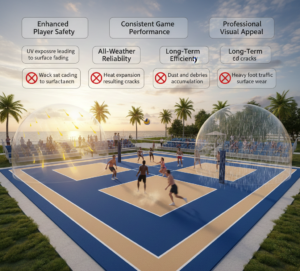
Enhanced Player Safety
Shock-absorbing and non-slip surfaces reduce stress on joints, ankles, and knees while minimizing slip-related injuries.
Consistent Game Performance
Uniform texture and grip ensure smooth player movement and predictable ball response.
All-Weather Reliability
Weather-resistant materials prevent cracking, fading, and water retention.
Long-Term Cost Efficiency
Durable flooring reduces repair frequency and lowers long-term maintenance costs.
Professional Visual Appeal
Modern colors, clean finishes, and proper markings elevate the overall look of the facility.
Challenges of Outdoor Volleyball Court Flooring
Outdoor volleyball courts must be engineered to handle harsh environmental conditions. Common challenges include:
UV exposure leading to surface fading
Water stagnation causing slipperiness or base damage
Heat expansion resulting in cracks
Dust and debris accumulation
Heavy foot traffic causing surface wear
Only specialized outdoor volleyball court flooring solutions can effectively address these challenges.
Types of Outdoor Volleyball Court Flooring Solutions
Types of Outdoor Volleyball Court Flooring Solutions
Different playing environments and budgets require different flooring systems. Below are the most effective and widely used outdoor volleyball flooring options.
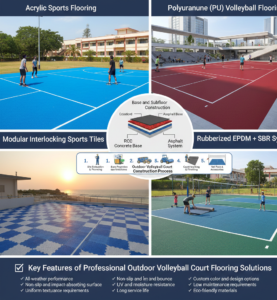
1. Acrylic Sports Flooring
Acrylic-coated surfaces are one of the most popular outdoor volleyball court flooring solutions due to their durability and affordability.
Key Features:
UV-resistant and weatherproof
Anti-slip textured finish
Excellent color retention
Compatible with concrete or asphalt bases
Easy maintenance and long service life
Best Suited For: Schools, colleges, municipal parks, and public sports facilities.
2. Polyurethane (PU) Volleyball Flooring
PU flooring systems are designed for higher performance and comfort. These seamless surfaces provide excellent shock absorption and player support.
Advantages:
Superior cushioning and elasticity
High resistance to abrasion and moisture
Seamless finish with consistent traction
Suitable for intensive training and competitions
Best Suited For: Professional courts, sports academies, and premium sports complexes.
3. Modular Interlocking Sports Tiles (PP Tiles)
Modular polypropylene tiles are a modern and flexible solution for outdoor volleyball courts.
Key Benefits:
Perforated design for instant water drainage
UV-stabilized for long-lasting color
Easy installation without adhesives
Damaged tiles can be individually replaced
No repainting or resurfacing required
Best Suited For: Resorts, rooftop courts, clubs, and multi-sport areas.
4. Rubberized Flooring (EPDM + SBR Systems)
Rubber-based flooring systems combine comfort, grip, and durability, making them ideal for training and recreational use.
Highlights:
High shock absorption and slip resistance
Crack-resistant and fade-resistant
Eco-friendly and recyclable materials
Excellent performance in extreme weather
Best Suited For: Schools, training centers, and multi-purpose sports complexes.
Base and Subfloor Construction for Volleyball Courts
A strong base is essential for the longevity of any outdoor volleyball court flooring solution. Improper base construction can lead to cracks, uneven surfaces, and water damage.
Common Base Options:
Asphalt Base
Flexible and durable
Excellent drainage capability
Ideal for outdoor sports courts
RCC Concrete Base
Strong, stable, and long-lasting
Suitable for acrylic and PU coatings
Cushioned Base Systems
Combines rubber layers with synthetic coatings
Enhances comfort and reduces impact injuries
Professional base preparation includes proper compaction, leveling, slope creation, and drainage planning to ensure year-round playability.
Outdoor Volleyball Court Construction Process
Outdoor Volleyball Court Construction Process
A systematic construction approach ensures consistent quality and performance.
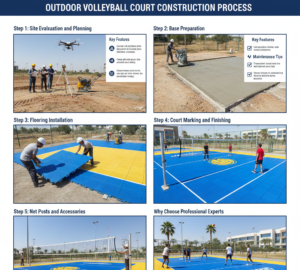
Step 1: Site Evaluation and Planning
The process begins with a detailed inspection of the site, including soil condition, space availability, drainage flow, and environmental factors. A customized layout is then prepared.
Step 2: Base Preparation
High-quality concrete or asphalt is laid and leveled with the correct slope to prevent water accumulation.
Step 3: Flooring Installation
The selected flooring system (acrylic, PU, tiles, or rubber) is installed using professional techniques to ensure uniform thickness, grip, and durability.
Step 4: Court Marking and Finishing
Standard volleyball court markings are applied using UV-resistant paints. Custom colors, logos, or branding can also be added.
Step 5: Net Posts and Accessories
High-quality net posts, boundary markings, and accessories are installed according to international volleyball standards.
Key Features of Professional Outdoor Volleyball Court Flooring Solutions
✔ All-weather performance ✔ Non-slip and impact-absorbing surface ✔ Uniform texture and bounce ✔ UV and moisture resistance ✔ Custom color and design options ✔ Low maintenance requirements ✔ Long service life ✔ Eco-friendly materials
Maintenance of Outdoor Volleyball Court Flooring
Proper maintenance ensures long-term performance with minimal effort.
Basic Maintenance Tips:
Clean the surface regularly to remove dust and debris
Avoid sharp objects or heavy dragging
Inspect drainage systems after rainfall
Recoat or refresh line markings when needed
With proper care, high-quality outdoor volleyball flooring can last 8–10 years or more without major repairs.
Applications of Outdoor Volleyball Court Flooring Solutions
Our flooring systems are suitable for a wide range of environments:
Schools and colleges
Sports academies and coaching centers
Residential societies and clubhouses
Resorts and hotels
Corporate recreational spaces
Municipal sports parks
Multi-sport complexes
Each project is customized to meet the specific needs of the location and users.
Why Choose Professional Outdoor Volleyball Flooring Experts?
Choosing experienced professionals ensures accuracy, durability, and compliance with international standards.
Key Advantages:
Skilled installation teams
Use of certified, high-quality materials
Customized designs and color schemes
End-to-end project execution
Transparent pricing and reliable timelines
Post-installation support and maintenance guidance
A professionally built volleyball court not only enhances gameplay but also reflects the quality and credibility of your sports facility.
Conclusion
Investing in the right outdoor volleyball court flooring solutions is essential for creating a safe, durable, and high-performing sports environment. From surface selection and base preparation to professional installation and maintenance, every detail plays a critical role in the court’s success.
Outdoor Tennis Court in Delhi – FAQ
1. What is an outdoor tennis court?
An outdoor tennis court is a full‑size playing surface built outdoors, typically with a hard acrylic or synthetic finish over a concrete or asphalt base. It’s designed for recreational play, coaching, club matches, and community use.
2. What are the standard tennis court dimensions?
A standard tennis court for singles and doubles measures:
Length: 23.77 m
Width: 10.97 m (for doubles)
Net height: 0.91 m at the centre These are universal ITF‑compliant dimensions and apply regardless of location. (General ITF standards)
3. What surface is best for outdoor tennis courts in Delhi?
The most widely used surface in Delhi is acrylic sports coating applied over a well‑prepared concrete/asphalt base, because it offers:
Good traction and ball bounce
Weather and UV resistance for hot summers
Relative affordability and ease of maintenance
4. How much does it cost to construct an outdoor tennis court in Delhi?
Approximate construction costs vary depending on quality and features:
Basic acrylic court: ₹70 – ₹110 per sq ft
Cushioned acrylic court: ₹110 – ₹180 per sq ft
Premium outdoor tournament surface: up to ₹250+ per sq ft
A full standard outdoor tennis court (≈7200–8000 sq ft of play area) typically costs ₹6 lakh to ₹18 lakh+, based on materials, base prep, drainage, fencing, and lighting.
5. What is included in the construction process?
Typical construction steps are:
Site preparation: clearing, levelling, and soil compaction
Base construction: concrete or asphalt layer with proper slope and drainage
Accessories: net posts, fencing, and optionally lighting
6. How long does outdoor tennis court construction take?
Installation timelines vary, but a well‑planned outdoor court normally takes:
Base and civil work: 2–3 weeks
Surface application and curing: 1–1.5 weeks
Accessories & finishing: 3–5 days Total: ~3–5 weeks, depending on weather and contractor workflow.
7. What are common maintenance requirements?
Outdoor tennis courts need:
Regular sweeping and cleaning
Occasional water washing to remove dirt
Resurfacing or recoating every 5–7 years to maintain play quality
Checking and repairing cracks or drainage issues
8. Are lighting and fencing necessary?
Yes — for safety and usability:
Fencing (≈10–12 ft) keeps balls within the court
LED floodlights enable evening play These are recommended but optional based on how the court will be used.
9. Can tennis courts be multipurpose?
Yes. Courts can be marked and used for related games such as pickleball or mini‑tennis with different line colours, provided the base and surface comply with safety norms and dimensions.
10. Where can I play or book outdoor tennis courts in Delhi?
Delhi has many outdoor tennis facilities including:
Delhi Lawn Tennis Association – iconic tennis venue with multiple courts and coaching programs.
R.K. Khanna Tennis Stadium – major tennis hub in Hauz Khas.
Tennis Courts Vasant Vihar Club, DDA Tennis Court, and other club/academy courts like Bharat Tennis Academy, ILTA Tennis Academy Pitampura, and AES Janakpuri Tennis Court.
Community and sports complexes often have outdoor courts too.
Private academies and neighbourhood courts also offer coaching and court hire.
11. How do booking and usage work?
Booking processes depend on the facility — larger complexes like the DLTA or DDA courts may require membership, advance booking, or pay‑and‑play arrangements, while private academies may offer hourly booking and coaching packages.
12. What should I consider before building a court in Delhi?
Key factors include:
Site selection & accessibility
Drainage and water logging prevention
Material quality (acrylic system and base)
Maintenance plan
Budget for lighting and fencing
Proper planning helps ensure a long‑lasting, safe, and good‑playing surface.
13. Are there public initiatives for tennis infrastructure in Delhi?
Yes — projects like the Sukhdev Vihar sports complex and expanded amenities under DDA’s infrastructure programs are boosting outdoor tennis and multi‑sport facilities for residents.
If you’d like, I can also provide a detailed cost estimate with surface comparisons for Delhi (acrylic vs cushioned vs premium), or a step‑by‑step construction timeline checklist.
4.5
Delhi Lawn Tennis Association
4.4
R.K. Khanna Tennis Stadium
4.5
Tennis Courts, IIT Delhi
4.8
Tennis Courts Vasant Vihar Club
4.5
DDA Tennis Court
4.6
Bharat Tennis Academy
4.7
ILTA Tennis Academy Pitampura & Shalimar Bagh- Tennis as sports
Outdoor Volleyball Court Flooring Solutions write a faq
Here’s a comprehensive FAQ on Outdoor Volleyball Court Flooring Solutions — perfect for planners, clubs, schools, and residential projects 🏐
Outdoor Volleyball Court Flooring Solutions – FAQ
1. What is an outdoor volleyball court flooring?
Outdoor volleyball court flooring refers to the surface materials and systems used to create a playable, safe, weather‑resistant area for outdoor volleyball games. This includes sand surfaces, synthetic sports flooring, and multipurpose acrylic or PU coatings.
2. What are the common types of outdoor volleyball court flooring?
The most widely used outdoor volleyball surfaces are:
🏐 Sand Court (Beach Volleyball)
Standard for beach and recreational play
Natural shock absorption
Requires proper drainage and raking
🎯 Acrylic / PU Coated Hard Court
Applied over concrete or asphalt
Best for club, school, or community courts
Durable and low maintenance
🏃 Interlocking Modular Tiles
Portable, easy to install
Good drainage and shock absorption
Suitable for multipurpose sports areas
🟦 Synthetic Rubber / EPDM Flooring
Flexible and slip‑resistant
Comfortable underfoot
Good for fitness courts or recreational zones
3. What surface is best for competitive outdoor volleyball?
Beach volleyball: Sand surface
Hard court outdoor volleyball: High‑quality acrylic or PU sports coating over concrete/asphalt with proper drainage
The choice depends on usage type (beach vs hard court) and budget.
4. What are standard volleyball court dimensions?
Outdoor hard court volleyball follows international standards:
Court size: 18 m × 9 m
Free zone: Minimum 3 m on all sides
Equipment: 2.43 m net height (men), 2.24 m (women)
For beach volleyball (sand):
Court size: 16 m × 8 m
Free zone: Minimum 3 m on all sides
5. What base is required for outdoor volleyball flooring?
A level and compacted base is essential.
Concrete or asphalt slab recommended for acrylic/PU surfaces.
For sand courts, geotextile fabric and edging help contain the sand and assist drainage.
6. What are the advantages of synthetic outdoor volleyball flooring?
Durable and long‑lasting
Weather resistant (UV, heat, rain)
Consistent traction and ball response
Low maintenance compared to sand or loose surfaces
7. Is drainage important for outdoor courts?
Yes. Proper drainage prevents water pooling, surface damage, and slips. Sloping the base (≈1–2% gradient) and including drainage channels improves performance and longevity.
8. How long does installation take?
Sand court setup: 1–3 days (depending on base prep)
Hard synthetic surface: 5–10 days (base prep, coatings, curing, line marking)
Modular tile system: 1–3 days
Time varies with site conditions and size.
9. How much maintenance is required?
Sand courts:
Regular raking to level the surface
Removing debris
Periodic sand replenishment
Synthetic surfaces:
Sweep or wash to remove dirt
Inspect and repair surface cracks or line wear
Recoating or resealing every few years (depending on use)
10. Can outdoor flooring be multipurpose?
Yes. Acrylic, PU, and modular tile surfaces can be line‑marked for multiple sports like basketball, badminton, or pickleball — ideal for community courts.
11. What are the safety considerations?
Slip‑resistant surface
Proper padding or edging around the court
No standing water after rain
Adequate free zone around play area
Good design and quality materials reduce injury risk.
12. Are outdoor volleyball courts suitable for all age groups?
Yes — properly surfaced outdoor courts are safe for: