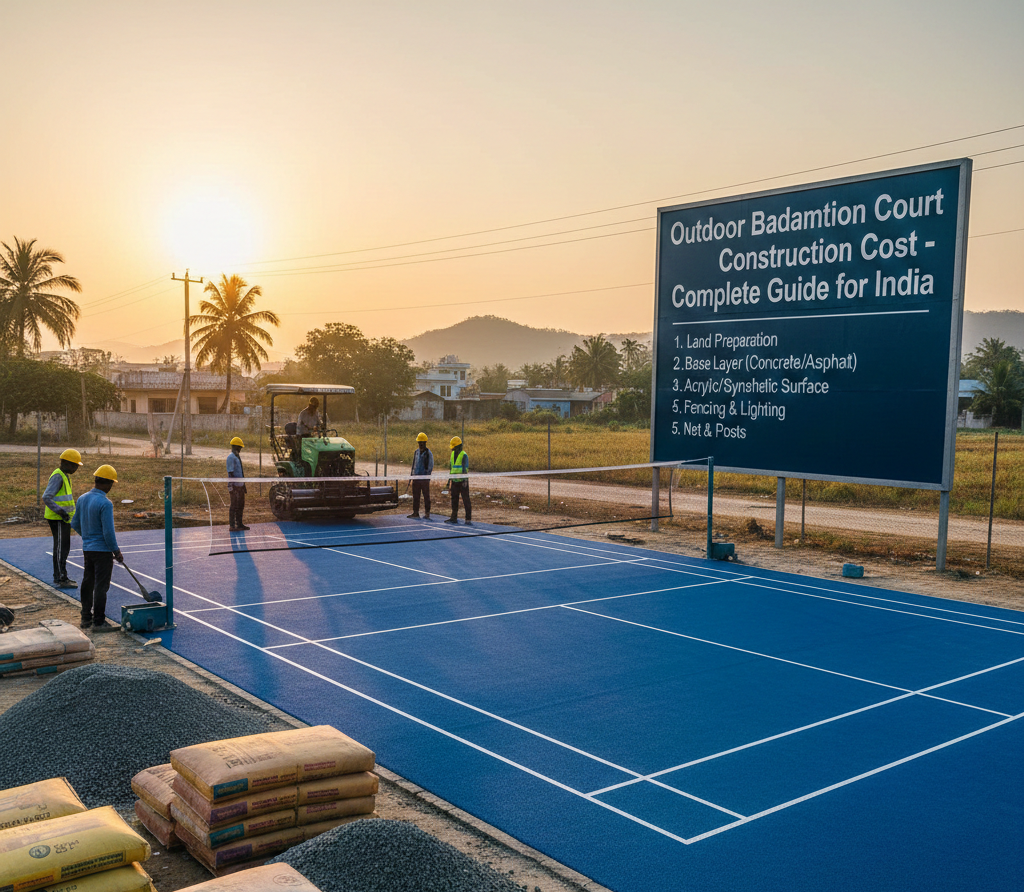
Badminton has become one of the most popular sports in India, enjoyed by people of all age groups. From residential societies and schools to sports academies and clubs, the demand for outdoor badminton courts is growing rapidly. An outdoor badminton court offers flexibility, durability, and year-round usability when designed and constructed correctly.
One of the first questions that arises during planning is:
“How much does it cost to construct an outdoor badminton court?”
The cost of outdoor badminton court construction depends on multiple factors such as surface type, base preparation, drainage, fencing, lighting, and location. This detailed guide explains the cost structure, construction process, materials used, and factors that influence the final budget, helping you make an informed decision.
1. Understanding Outdoor Badminton Court Construction
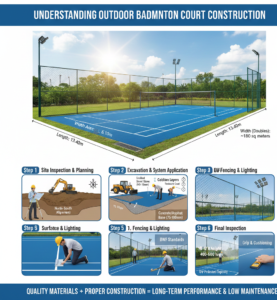
Outdoor badminton courts are designed to withstand changing weather conditions, including sunlight, rain, and temperature variations. Unlike indoor courts that usually use wooden flooring, outdoor courts rely on synthetic acrylic, PU, or turf surfaces installed over a strong concrete or asphalt base.
A professionally constructed outdoor badminton court should offer:
-
Compliance with BWF (Badminton World Federation) dimensions
-
Non-slip, shock-absorbing playing surface
-
Proper slope and drainage to avoid water accumulation
-
UV-resistant coatings for color stability and durability
-
Long service life with minimal maintenance
While the upfront cost may vary, investing in quality materials and construction ensures long-term performance and lower maintenance expenses.
2. Standard Size and Area Requirement
Before estimating construction cost, it is essential to understand the standard court size.
Official Badminton Court Dimensions (BWF)
-
Length: 13.40 meters (44 feet)
-
Width (Singles): 5.18 meters (17 feet)
-
Width (Doubles): 6.10 meters (20 feet)
Area Requirement
-
Playing Area (Doubles): Approx. 82 sq. meters (880 sq. ft.)
-
Recommended Total Area (with run-off and safety clearance):
Around 180 sq. meters (1,900–2,000 sq. ft.)
This additional space is necessary for player movement, fencing installation, and safety.
3. Outdoor Badminton Court Construction Process
The construction cost is closely linked to the quality of execution. Below is a standard step-by-step construction process.
Step 1: Site Inspection and Planning
A professional site survey assesses:
-
Soil condition
-
Natural slope
-
Drainage feasibility
-
Orientation (north-south alignment preferred to reduce sun glare)
Proper planning at this stage avoids future repair costs.
Step 2: Excavation and Base Preparation
-
Excavation depth: approx. 250–300 mm
-
Sub-base: crushed stone or granular layer (100–150 mm)
-
Base layer: asphalt or PCC concrete (75–100 mm)
A gentle slope of about 1% ensures smooth rainwater runoff.
Step 3: Surface System Application
Depending on the selected surface, multiple layers are applied:
-
Primer for bonding
-
Cushion layers for shock absorption
-
Color and texture coats for grip
-
UV-protected topcoat for durability
Each layer is cured properly to ensure surface consistency and longevity.
Step 4: Line Marking
Court lines are marked strictly as per BWF standards using UV-stable paint. Clear contrast improves visibility during outdoor play.
Step 5: Fencing and Lighting
-
Chain-link fencing (10–12 feet height) for safety and ball containment
-
LED floodlights (400–600 lux) for evening play
Step 6: Final Inspection
The court is checked for:
-
Surface level accuracy
-
Drainage efficiency
-
Grip and cushioning
-
Line precision
4. Types of Outdoor Badminton Court Surfaces and Their Costs
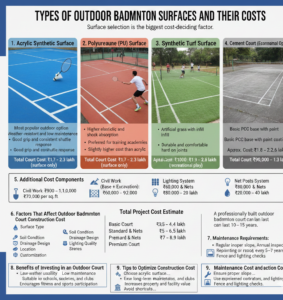
Surface selection is the biggest cost-deciding factor.
Acrylic Synthetic Surface
-
Most popular outdoor option
-
Weather-resistant and low maintenance
-
Good grip and consistent shuttle response
Approx. Cost: ₹900 – ₹1,200 per sq. ft.
Total Court Cost: ₹1.7 – ₹2.3 lakh (surface only)
Polyurethane (PU) Surface
-
Higher elasticity and shock absorption
-
Preferred for training academies
-
Slightly higher cost than acrylic
Approx. Cost: ₹1,000 – ₹1,400 per sq. ft.
Total Court Cost: ₹1.9 – ₹2.6 lakh
Synthetic Turf Surface
-
Artificial grass with infill
-
Durable and comfortable
-
Suitable for recreational play
Approx. Cost: ₹1,000 – ₹1,300 per sq. ft.
Total Court Cost: ₹1.8 – ₹2.4 lakh
Cement Court (Economical Option)
-
Basic PCC base with paint coating
-
Low initial cost but hard on joints
Approx. Cost: ₹500 – ₹700 per sq. ft.
Total Court Cost: ₹90,000 – ₹1.3 lakh
5. Additional Cost Components
An outdoor badminton court is incomplete without supporting infrastructure.
Approximate Cost Breakdown
-
Civil Work (Base + Excavation): ₹70,000 – ₹1,00,000
-
Fencing (GI Chain Link): ₹60,000 – ₹90,000
-
Lighting System: ₹80,000 – ₹1.2 lakh
-
Net Posts & Nets: ₹10,000 – ₹20,000
-
Drainage System: ₹20,000 – ₹40,000
Total Project Cost Estimate
-
Basic Court: ₹3.5 – ₹4.5 lakh
-
Standard Court: ₹5 – ₹6.5 lakh
-
Premium Court: ₹7 – ₹9 lakh
These estimates include material, labor, installation, and finishing.
6. Factors That Affect Outdoor Badminton Court Construction Cost
Several variables influence the final cost:
-
Surface Type: PU and acrylic coatings cost more than cement.
-
Soil Condition: Weak soil requires additional stabilization.
-
Drainage Design: Better drainage adds cost but prevents damage.
-
Lighting Quality: Higher lux LED systems increase expenses.
-
Location: Labor and material prices vary by region.
-
Customization: Branding, color choices, and fencing height add to cost.
7. Maintenance Cost and Lifespan
A professionally built outdoor badminton court can last 10–15 years.
Maintenance Requirements:
-
Regular cleaning
-
Annual inspection
-
Repainting or recoating every 5–7 years
-
Fence and lighting checks
Annual maintenance costs are relatively low compared to indoor wooden courts.
8. Benefits of Investing in an Outdoor Badminton Court
-
All-weather usability
-
Low long-term maintenance
-
Suitable for schools, societies, and clubs
-
Increases property and facility value
-
Encourages fitness and sports participation
9. Tips to Optimize Construction Cost
-
Choose acrylic surface for best cost-to-performance ratio
-
Ensure proper slope to reduce future repairs
-
Use experienced sports flooring contractors
-
Plan fencing and lighting at the design stage
-
Avoid shortcuts in base preparation
10. Conclusion
The cost of outdoor badminton court construction in India typically ranges between ₹4 lakh and ₹7 lakh, depending on surface type, civil work, fencing, and lighting. While the initial investment may vary, a well-constructed outdoor court delivers excellent durability, safety, and playability for many years.
By selecting the right materials, following BWF standards, and working with professional sports infrastructure experts, you can build an outdoor badminton court that offers long-term value and superior performance.
Official Badminton Court Size – Dimensions, Standards, and Layout (FAQ)
1. What is the official size of a badminton court?
As per Badminton World Federation (BWF) standards, the official badminton court dimensions are:
-
Length: 13.40 meters
-
Width (Doubles): 6.10 meters
-
Width (Singles): 5.18 meters
These measurements apply to both professional and competitive play.
2. What is the difference between singles and doubles court size?
The court length remains the same for both formats, but the width differs:
-
Singles: 5.18 m (side tramlines excluded)
-
Doubles: 6.10 m (full width including side tramlines)
This is why doubles courts have extra boundary lines on the sides.
3. What is the height of the badminton net?
The official net height is:
-
1.55 meters at the posts
-
1.524 meters at the center
The net must be stretched tightly and made of dark-colored cord.
4. What are the service court dimensions?
Service court measurements are:
-
Short service line: 1.98 m from the net
-
Center line: Divides left and right service courts
-
Long service line (Doubles): 0.76 m inside the back boundary
-
Long service line (Singles): Back boundary line itself
5. What is the recommended clearance around a badminton court?
For safe play and movement:
-
Side clearance: Minimum 1.25–1.5 meters
-
Back clearance: Minimum 2–2.5 meters
For international matches, larger run-off areas are recommended.
6. What is the minimum ceiling height for an indoor badminton court?
Recommended ceiling heights are:
-
Recreational play: Minimum 7 meters
-
Competitive / tournament play: 9–12 meters
Adequate height ensures unobstructed shuttle flight.
7. What is the standard line width on a badminton court?
All court lines must be:
-
40 mm wide
-
Easily distinguishable (commonly white or yellow)
-
Considered part of the playing area
8. What flooring is suitable for official badminton courts?
Approved flooring options include:
-
Wooden sports flooring (sprung system preferred)
-
Synthetic badminton mats
-
PVC or PU sports flooring
Concrete floors are not recommended for competitive play due to injury risk.
9. Can an outdoor badminton court follow official dimensions?
Yes, outdoor courts can follow official dimensions, but:
-
Wind affects shuttle flight
-
Surface must be non-slip
-
Outdoor play is usually recreational, not competitive
10. Are badminton court dimensions the same worldwide?
Yes. BWF court dimensions and markings are globally standardized and followed for national and international competitions.