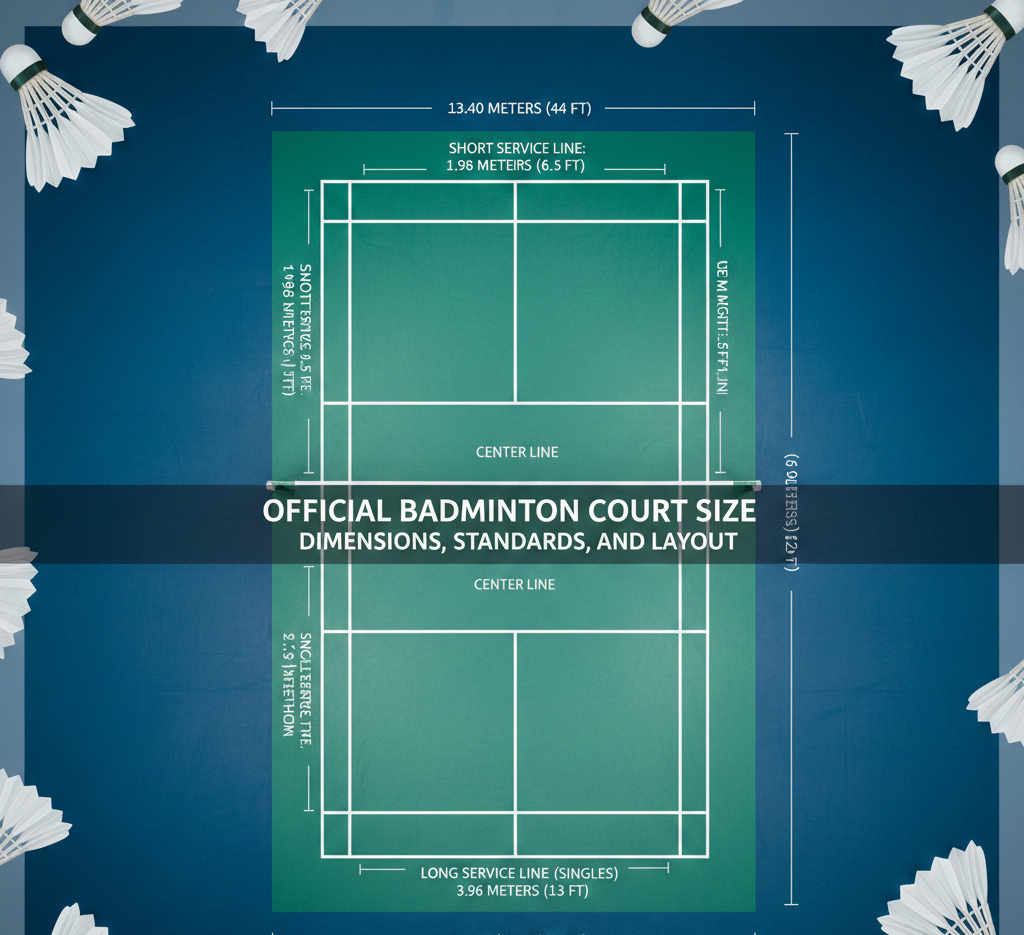
A badminton court is not just a playing surface; it is the foundation on which the entire game is built. Accurate court size, proper markings, and correct layout are essential to ensure fair play, player safety, and consistent performance. Whether the court is designed for residential use, schools, clubs, academies, or professional tournaments, following the official badminton court dimensions and standards is critical.
Badminton is a fast-paced sport that demands precision, agility, and accuracy. Even small deviations in court size or line placement can affect gameplay, training quality, and match outcomes. That is why all professional badminton courts follow the standards prescribed by the Badminton World Federation (BWF), which governs the official rules, dimensions, and court layout worldwide.
Understanding the Official Badminton Court Dimensions
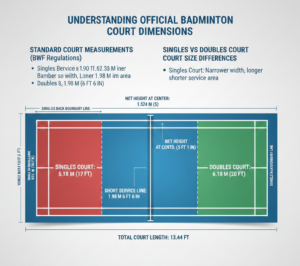
A standard badminton court is rectangular in shape and divided into two equal halves by a net. While the length of the court remains the same for both singles and doubles matches, the width varies depending on the format of play.
Standard Court Measurements (As per BWF Regulations)
-
Total Court Length: 13.40 meters (44 feet)
-
Court Width for Doubles: 6.10 meters (20 feet)
-
Court Width for Singles: 5.18 meters (17 feet)
-
Net Height at Center: 1.524 meters (5 feet)
-
Net Height at Posts: 1.55 meters (5 feet 1 inch)
-
Short Service Line Distance: 1.98 meters (6 feet 6 inches) from the net
-
Back Boundary Line (Singles): Positioned 0.76 meters (2 feet 6 inches) inside the doubles back boundary line
These measurements are internationally accepted and must be followed for official matches, tournaments, and professional training facilities.
Singles vs Doubles Court Size Differences
One of the most important aspects of badminton court design is understanding the difference between singles and doubles play:
-
Singles Court: Narrower width, longer service area
-
Doubles Court: Wider width, shorter service area
The side boundary lines and back service lines change depending on whether the game is singles or doubles. This distinction allows fair play and ensures the court matches the specific demands of each format.
Clear and accurate marking of these boundaries is essential to avoid confusion during play.
Badminton Court Layout Explained
The badminton court layout is carefully designed to divide the playing area into functional zones that regulate service, rallies, and scoring.
Key Components of Court Layout
1. Center Net Line
The net stretches across the width of the court, dividing it into two equal halves. Each half mirrors the other in dimensions and layout.
2. Service Courts
Each side of the court is divided into:
-
Left service court
-
Right service court
These are used for serving and receiving the shuttle, depending on the score and game format.
3. Short Service Line
Located close to the net, this line defines the minimum distance a serve must travel to be valid.
4. Center Line
The center line divides the left and right service courts.
5. Back Boundary Lines
These lines mark the end of the court. Their position differs for singles and doubles play.
6. Side Lines
Side lines determine the width of the court and change based on whether singles or doubles is being played.
A correctly designed layout ensures accurate officiating, smooth gameplay, and compliance with official rules.
Net Height and Positioning Standards
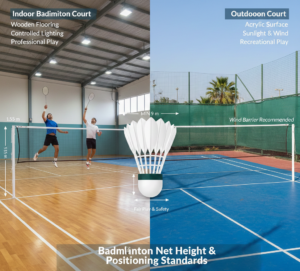
The badminton net plays a vital role in maintaining fairness and consistency during matches.
-
The net must be 1.55 meters high at the posts
-
The height at the center of the net should be 1.524 meters
-
Net posts must be placed directly on the doubles side lines, even during singles matches
Proper net tension and height consistency are essential for professional gameplay.
Indoor vs Outdoor Badminton Courts
Although the official court dimensions remain the same, indoor and outdoor badminton courts differ in construction requirements and surrounding conditions.
Indoor Badminton Courts
-
Preferred for professional and competitive play
-
Require controlled lighting, ventilation, and flooring
-
Minimum recommended ceiling height is 9 meters for tournaments
-
Flooring is usually wooden or synthetic to reduce impact on joints
Outdoor Badminton Courts
-
Typically used for recreational play
-
Must account for wind, sunlight, and weather conditions
-
Acrylic or synthetic surfaces are commonly used
-
Wind barriers or partial enclosures are recommended
Indoor courts are strongly preferred for serious training and competitive matches due to environmental control.
Height Clearance and Safety Space Requirements
Adequate clearance around and above the court is crucial for safe movement and uninterrupted play.
Recommended Clearances
-
Vertical Clearance:
-
Minimum 9 meters for professional play
-
Minimum 6.1 meters for recreational or training courts
-
-
Side Clearance:
-
At least 2 meters on each side
-
-
Back Clearance:
-
Minimum 2 meters behind the back boundary line
-
These clearances allow players to move freely, jump, and execute shots safely.
Badminton Court Surface Requirements
Choosing the right surface is just as important as correct court size.
Common Flooring Options
Wooden Flooring
-
Used in professional tournaments
-
Provides excellent shock absorption
-
Enhances player comfort and reduces injury risk
Synthetic Flooring (PVC, PU, Vinyl)
-
Durable and cost-effective
-
Slip-resistant and easy to maintain
-
Ideal for schools, clubs, and academies
Cushioned Flooring Systems
-
Reduces stress on knees and ankles
-
Improves long-term player safety
The surface must be even, non-slip, and suitable for high-speed movement.
Badminton Court Marking Standards
Court markings must follow strict guidelines to ensure clarity and accuracy:
-
Line width should be 40–50 mm
-
Lines must be clearly visible and contrast with the flooring
-
Common line colors include white or yellow
-
All markings must be straight, precise, and permanent
Clear distinction between singles and doubles lines is essential to prevent gameplay errors.
Importance of Official Badminton Court Dimensions
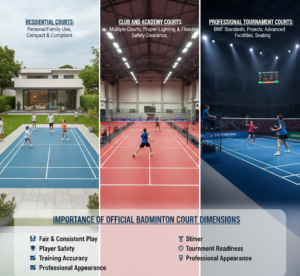
Following official standards offers multiple benefits:
Fair and Consistent Play
Players experience the game exactly as intended under international rules.
Player Safety
Correct spacing and layout reduce collision risks and injuries.
Training Accuracy
Athletes train on courts that match tournament conditions.
Tournament Readiness
Courts meet BWF and national federation requirements.
Professional Appearance
Accurate dimensions and markings enhance the quality and credibility of the facility.
Types of Badminton Courts Based on Usage
Residential Courts
-
Designed for personal or family use
-
Compact but compliant with official dimensions
Club and Academy Courts
-
Multiple courts in one facility
-
Proper lighting, flooring, and safety clearance
Professional Tournament Courts
-
Fully compliant with BWF standards
-
Advanced lighting, flooring, seating, and referee facilities
Best Practices for Setting Up a Badminton Court
-
Always follow official BWF dimensions
-
Maintain adequate clearance around the court
-
Use high-quality, non-slip flooring
-
Install professional-grade nets and posts
-
Ensure uniform lighting without glare
-
Regularly inspect and maintain markings and surfaces
Conclusion
Understanding and implementing the official badminton court size, dimensions, standards, and layout is essential for creating a safe, professional, and high-performance playing environment. From accurate measurements and clear markings to proper net height and surface selection, every element contributes to fair play and player satisfaction.
Official Badminton Court Size – Dimensions, Standards, and Layout (FAQ)
1. What is the official size of a badminton court?
As per Badminton World Federation (BWF) standards, the official badminton court dimensions are:
-
Length: 13.40 meters
-
Width (Doubles): 6.10 meters
-
Width (Singles): 5.18 meters
These measurements apply to both professional and competitive play.
2. What is the difference between singles and doubles court size?
The court length remains the same for both formats, but the width differs:
-
Singles: 5.18 m (side tramlines excluded)
-
Doubles: 6.10 m (full width including side tramlines)
This is why doubles courts have extra boundary lines on the sides.
3. What is the height of the badminton net?
The official net height is:
-
1.55 meters at the posts
-
1.524 meters at the center
The net must be stretched tightly and made of dark-colored cord.
4. What are the service court dimensions?
Service court measurements are:
-
Short service line: 1.98 m from the net
-
Center line: Divides left and right service courts
-
Long service line (Doubles): 0.76 m inside the back boundary
-
Long service line (Singles): Back boundary line itself
5. What is the recommended clearance around a badminton court?
For safe play and movement:
-
Side clearance: Minimum 1.25–1.5 meters
-
Back clearance: Minimum 2–2.5 meters
For international matches, larger run-off areas are recommended.
6. What is the minimum ceiling height for an indoor badminton court?
Recommended ceiling heights are:
-
Recreational play: Minimum 7 meters
-
Competitive / tournament play: 9–12 meters
Adequate height ensures unobstructed shuttle flight.
7. What is the standard line width on a badminton court?
All court lines must be:
-
40 mm wide
-
Easily distinguishable (commonly white or yellow)
-
Considered part of the playing area
8. What flooring is suitable for official badminton courts?
Approved flooring options include:
-
Wooden sports flooring (sprung system preferred)
-
Synthetic badminton mats
-
PVC or PU sports flooring
Concrete floors are not recommended for competitive play due to injury risk.
9. Can an outdoor badminton court follow official dimensions?
Yes, outdoor courts can follow official dimensions, but:
-
Wind affects shuttle flight
-
Surface must be non-slip
-
Outdoor play is usually recreational, not competitive
10. Are badminton court dimensions the same worldwide?
Yes. BWF court dimensions and markings are globally standardized and followed for national and international competitions.