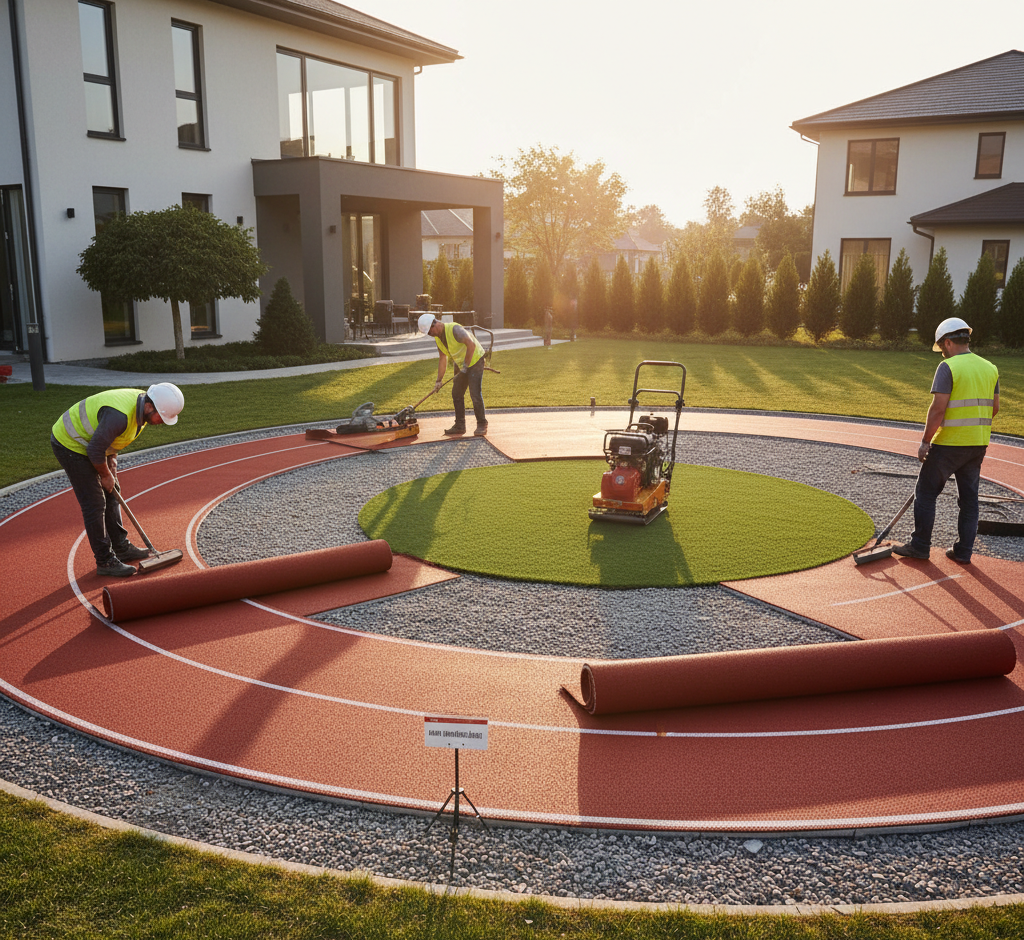
As urban environments continue to grow denser, the availability of large open areas for sports and fitness infrastructure has become increasingly limited. Schools, residential communities, corporate campuses, and public parks often struggle to accommodate full-sized athletic facilities. In such scenarios, mini running track installation emerges as an efficient and practical alternative, offering the benefits of professional running tracks within compact spaces.
A mini running track provides a dedicated area for jogging, sprinting, fitness training, and recreational running, all while making optimal use of available land. Through thoughtful design, high-quality materials, and professional execution, mini running tracks deliver safety, durability, and performance comparable to larger tracks—without requiring extensive space or high investment.
What Is a Mini Running Track?
A mini running track is a scaled-down version of a standard athletics track, designed to fit within smaller plots while maintaining essential functional features. These tracks typically range from 50 meters to 200 meters in lap length, depending on site conditions and intended usage.
Mini running tracks can be configured in various shapes such as ovals, loops, rectangles, or customized layouts that adapt to the surrounding environment. Whether installed outdoors in parks and residential complexes or indoors in fitness centers and sports halls, mini tracks offer a reliable and safe running surface for users of all age groups.
Importance of Mini Running Track Installation
Efficient Use of Limited Space
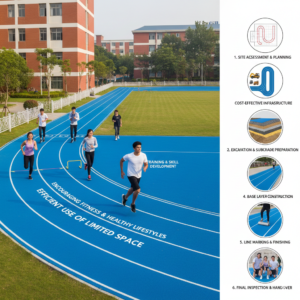
One of the primary reasons for installing a mini running track is space optimization. Where constructing a standard 400-meter track is impractical, a mini track allows institutions and communities to provide a functional running facility within a restricted footprint. Unused corners, narrow plots, or landscaped areas can be transformed into active fitness zones.
Encouraging Fitness and Healthy Lifestyles
Mini running tracks make regular exercise more accessible. By placing a running facility within easy reach, they encourage walking, jogging, and sprint training as part of daily routines. This supports physical fitness programs in schools, promotes wellness in residential communities, and enhances employee health in corporate environments.
Training and Skill Development
Although compact, mini running tracks are highly effective for athletic training. They support sprint drills, interval workouts, relay practice, and agility exercises. For students and amateur athletes, mini tracks serve as an excellent practice ground to develop endurance, speed, and coordination.
Cost-Effective Infrastructure
Compared to full-size tracks, mini running tracks require significantly less material, labor, and maintenance. This makes them a cost-efficient option for institutions and organizations with budget constraints while still delivering long-term value and usability.
Flexible and Customizable Design
Mini running track installation allows for extensive customization. Track shape, length, number of lanes, and surface type can be tailored to site conditions and user needs. These tracks can be installed indoors or outdoors, making them suitable for a wide range of environments.
Key Design Features of a Mini Running Track
Track Length and Layout
Mini running tracks are typically designed with lap lengths ranging from 50 to 200 meters. The layout may be oval, rectangular, or irregular, depending on space availability. Smooth curves and straight sections are essential to ensure runner comfort and safety.
Lane Configuration
Most mini tracks feature one to four lanes, with each lane measuring approximately 1 to 1.22 meters in width. Lane markings help organize movement, prevent collisions, and allow multiple users to run simultaneously.
Surface Selection
The running surface plays a crucial role in performance and safety. Popular surface options include:
-
Synthetic polyurethane (PU)
-
EPDM rubber systems
-
Rubber granule coatings
These materials provide shock absorption, slip resistance, and weather durability. For budget-focused projects, asphalt or compacted gravel may be used for low-intensity running.
Safety Zones and Buffers
Safety is a key consideration in mini running track installation. Buffer zones of 0.5 to 1 meter are often provided around the track to protect runners from nearby obstacles. Landscaping, soft edges, or low fencing further enhance safety and aesthetics.
Step-by-Step Mini Running Track Installation Process
Materials Used in Mini Running Track Installation
-
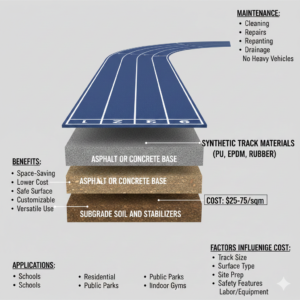
Subgrade Soil and Stabilizers: Form the foundation of the track
-
Crushed Stone or Gravel: Provides drainage and structural strength
-
Asphalt or Concrete Base (Optional): Ensures surface uniformity
-
Synthetic Track Materials: PU, EPDM, or rubber systems for performance
-
Line Marking Paints: Durable coatings for lanes and markings
Factors Influencing Installation Cost
Several factors affect the overall cost of mini running track installation:
-
Track size and layout complexity
-
Type of surface material selected
-
Extent of site preparation and drainage work
-
Inclusion of safety features, fencing, or lighting
-
Labor and equipment costs
On average, installation costs range from $25 to $75 per square meter, depending on materials and site conditions.
Benefits of Mini Running Track Installation
-
Optimized use of limited space
-
Lower construction and maintenance costs
-
Safe, cushioned, and weather-resistant surfaces
-
Customizable design for various applications
-
Suitable for fitness, training, and recreation
Common Applications
-
Schools and universities
-
Residential communities
-
Public parks and recreation areas
-
Corporate and business campuses
-
Indoor sports and fitness facilities
These tracks enable physical activity even where space constraints prevent large-scale athletic facilities.
Maintenance and Longevity
Routine maintenance ensures long-term performance:
-
Regular cleaning to remove debris
-
Prompt repair of surface damage
-
Repainting lane markings when required
-
Ensuring drainage systems remain clear
-
Preventing heavy vehicle access
Proper care extends the lifespan of the track and maintains user safety.
Conclusion
Mini running track installation is a practical, flexible, and cost-effective solution for promoting fitness in space-limited environments. Through careful planning, quality materials, and professional construction, mini tracks deliver safe and durable running surfaces suitable for a wide range of users.