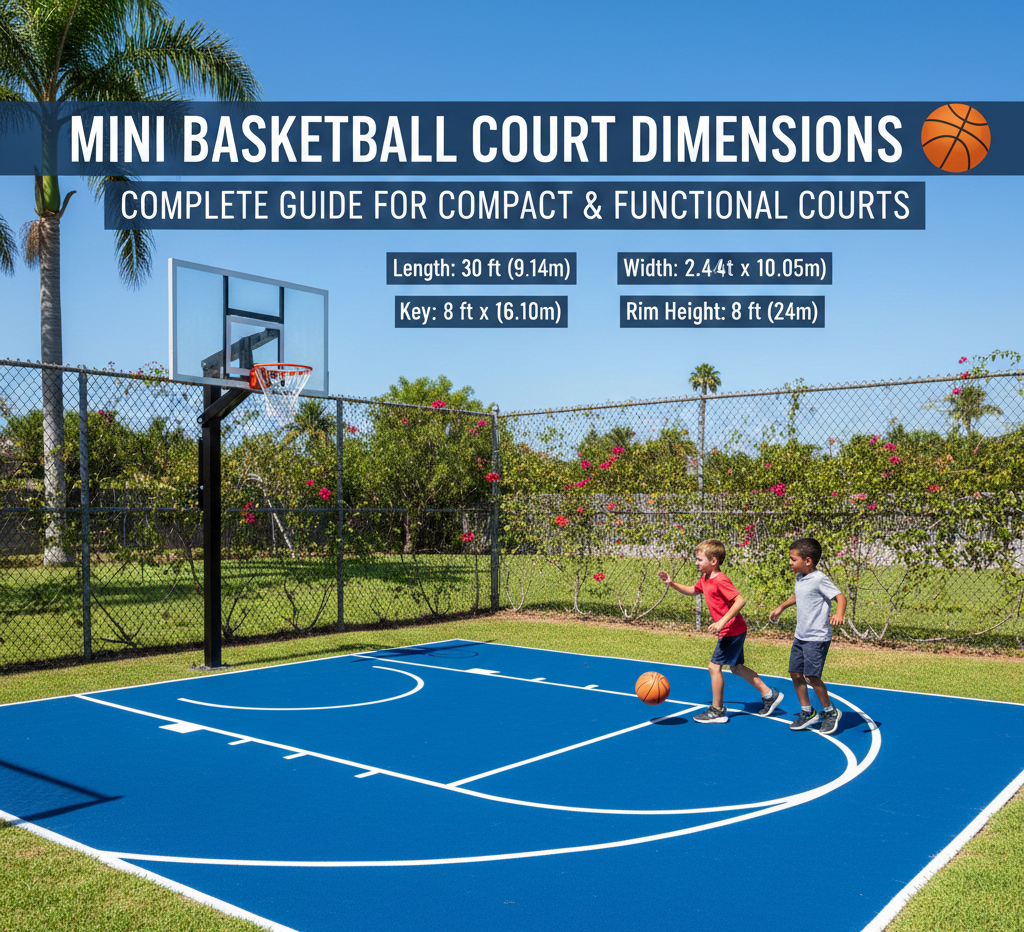
Mini basketball courts are an ideal solution for spaces where constructing a full-size basketball court is not possible. Designed to fit into smaller areas while preserving the core experience of the game, mini courts offer a safe, engaging, and practical way to enjoy basketball. From schools and residential societies to indoor recreation centers and home backyards, mini basketball courts have become increasingly popular for skill development, fitness, and fun.
Understanding the correct dimensions and layout of a mini basketball court is crucial to creating a playable and well-balanced court. Proper proportions ensure smooth gameplay, player safety, and long-term usability, even within limited space.
What Is a Mini Basketball Court?
A mini basketball court is a scaled-down version of a standard basketball court, designed to accommodate smaller areas while maintaining the essential elements of the game. Unlike full courts that require extensive land, mini courts are adapted to fit compact indoor or outdoor spaces without losing the structure of basketball rules and movements.
These courts are especially suitable for:
-
Schools and educational institutions
-
Residential complexes and gated communities
-
Playgrounds and children’s activity zones
-
Indoor sports halls and recreational centers
-
Home backyards and private sports areas
Mini basketball courts are commonly used by children, beginners, and recreational players, helping them learn fundamentals such as shooting, dribbling, passing, and positioning in a comfortable environment.
Importance of Correct Mini Basketball Court Dimensions
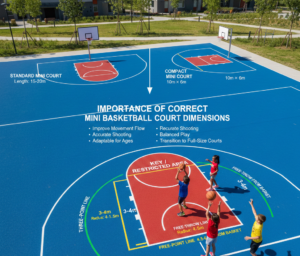
Accurate dimensions are the foundation of a functional mini basketball court. Even though the court is smaller than a regulation-sized court, maintaining correct proportions is essential for realistic gameplay and skill development.
Properly planned dimensions help:
-
Improve movement flow and player positioning
-
Maintain accurate shooting distances
-
Reduce the risk of collisions or injuries
-
Ensure balanced offense and defense play
-
Make the court adaptable for multiple age groups
Well-defined dimensions also allow players to transition more easily to full-size courts as their skills improve.
Standard Mini Basketball Court Size
There is no single fixed size for a mini basketball court, as dimensions vary depending on available space and intended use. However, commonly accepted size ranges provide an ideal balance between playability and space efficiency.
Typical Mini Basketball Court Dimensions:
-
Length: 15 to 20 meters (approximately 49 to 65 feet)
-
Width: 7 to 10 meters (approximately 23 to 33 feet)
These dimensions allow for half-court or reduced full-court play while maintaining realistic spacing for passing, shooting, and movement.
Compact Mini Court Option:
For locations with severe space limitations, courts as small as:
-
10 × 6 meters (33 × 20 feet)
can still function effectively for practice, training, and recreational play.
Key Areas and Markings on a Mini Basketball Court
Even in a reduced-size layout, a mini basketball court should include all essential playing zones. Each area is scaled proportionally to maintain game structure.
1. The Key / Restricted Area (Paint Area)
The key area is critical for close-range shots, rebounding, and defensive positioning.
Standard Dimensions:
-
Width: 3 to 4 meters (10 to 13 feet)
-
Length (baseline to free-throw line): 4 to 5 meters (13 to 16 feet)
This area allows players to practice layups, post moves, and defensive drills comfortably without crowding.
2. Free-Throw Line and Free-Throw Circle
The free-throw area helps replicate match situations and shooting practice.
Free-Throw Line:
-
Distance from baseline: 4 to 5 meters (13 to 16 feet)
-
Line width: 10 to 15 cm (4 to 6 inches)
Free-Throw Circle:
-
Radius: 1 to 1.5 meters (3 to 5 feet)
These measurements ensure realistic shooting distance while being suitable for younger players or beginners.
3. Three-Point Line
The three-point line on a mini basketball court is shortened compared to regulation courts but still allows players to practice long-range shooting.
Distance from the basket:
-
4.5 to 6 meters (15 to 20 feet)
This adjusted range maintains challenge while fitting within the limited court size.
-
Children: 2.6 to 2.8 meters (8.5 to 9 feet)
-
Youth & Adults: Up to 3.05 meters (10 feet)
Adjustable hoops are highly recommended to accommodate different age groups.
Backboard Dimensions:
-
Width: 1.2 to 1.8 meters (4 to 6 feet)
-
Height: 0.9 to 1.05 meters (3 to 3.5 feet)
-
Distance from baseline: 1 to 1.2 meters (3 to 4 feet)
These sizes ensure accurate rebounding and shot alignment while fitting compact layouts.
5. Center Circle and Boundary Lines
Even on a mini court, proper markings help maintain game structure.
Center Circle:
-
Diameter: 2 to 3 meters (6 to 10 feet)
Boundary Lines:
-
Clearly marked sidelines and baselines ensure safe play and proper movement control.
Accurate markings support organized play and training drills.
Indoor Mini Basketball Courts
Indoor courts are often more space-restricted, making compact dimensions essential. These courts typically use:
-
Hardwood
-
Vinyl
-
Synthetic sports flooring
Dimensions may be closer to the lower range, such as 12 × 7 meters, depending on hall size.
Outdoor Mini Basketball Courts
Outdoor courts usually allow more flexibility in size. Common outdoor dimensions range from:
-
15 × 8 meters
-
18 × 9 meters
Surfaces include concrete, asphalt, acrylic coatings, or modular sports tiles.
Flooring and Safety Considerations
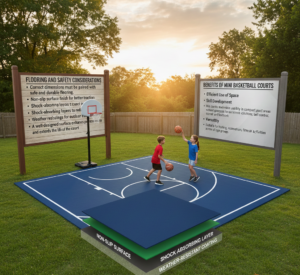
Correct dimensions must be paired with safe and durable flooring.
-
Non-slip surface finish for better traction
-
Shock-absorbing layers to reduce impact on joints
-
Weather-resistant coatings for outdoor courts
A well-designed surface enhances performance and extends the life of the court.
Benefits of Mini Basketball Courts
Efficient Use of Space
Mini courts maximize usability in compact areas without compromising gameplay.
Skill Development
Shorter distances help beginners and children improve shooting accuracy, ball control, and footwork.
Cost-Effective Construction
Smaller dimensions reduce construction, material, and maintenance costs.
Versatility
Suitable for training, recreation, and fitness activities across all age groups.
Conclusion
Mini basketball courts are a practical and effective way to bring the excitement of basketball into limited spaces.
Mini Basketball Court Dimensions – FAQ
1. What is a mini basketball court?
A mini basketball court is a scaled-down version of a full basketball court, designed for homes, schools, training facilities, or small recreational spaces. It’s ideal for kids, beginners, and casual play.
2. What are the standard dimensions of a mini basketball court?
There’s no single official size, but common mini court dimensions are:
-
Length: 25–50 feet (7.6–15.2 m)
-
Width: 15–30 feet (4.6–9.1 m)
The size depends on available space and intended use.
3. How big is a half mini basketball court?
A half mini court typically measures:
-
25–30 feet long
-
15–25 feet wide
This setup usually includes one hoop and basic markings like the key and free-throw line.
4. What is the recommended ceiling height for an indoor mini court?
For comfortable play:
-
Minimum: 10 feet
-
Recommended: 12–14 feet
Higher ceilings allow better shooting arcs and safer play.
5. What is the hoop height on a mini basketball court?
Hoop height varies by age group:
-
Ages 5–7: 6–7 feet
-
Ages 8–10: 8 feet
-
Teens & adults (practice): 9–10 feet
Many mini courts use adjustable hoops for flexibility.
6. Can mini basketball courts be customized?
Yes. Mini courts are highly customizable, including:
-
Court size
-
Hoop height
-
Line markings
-
Flooring material
-
Indoor or outdoor installation
Customization helps maximize smaller or irregular spaces.
7. What surface is best for a mini basketball court?
Popular surfaces include:
-
Interlocking sports tiles
-
Rubber flooring
-
Concrete (outdoor)
-
Wooden or synthetic sports flooring (indoor)
The choice depends on location, budget, and player safety.
8. Is a mini basketball court suitable for adults?
Absolutely. While designed for smaller spaces, mini courts are great for adult shooting drills, fitness, and casual games.
9. How much space do I need around the court for safety?
It’s recommended to leave:
-
3–5 feet of clearance around all sides
This helps prevent injuries and allows free movement.
10. Are mini basketball courts good for training?
Yes. Mini courts are excellent for:
-
Shooting accuracy
-
Ball handling
-
Footwork drills
-
Youth skill development