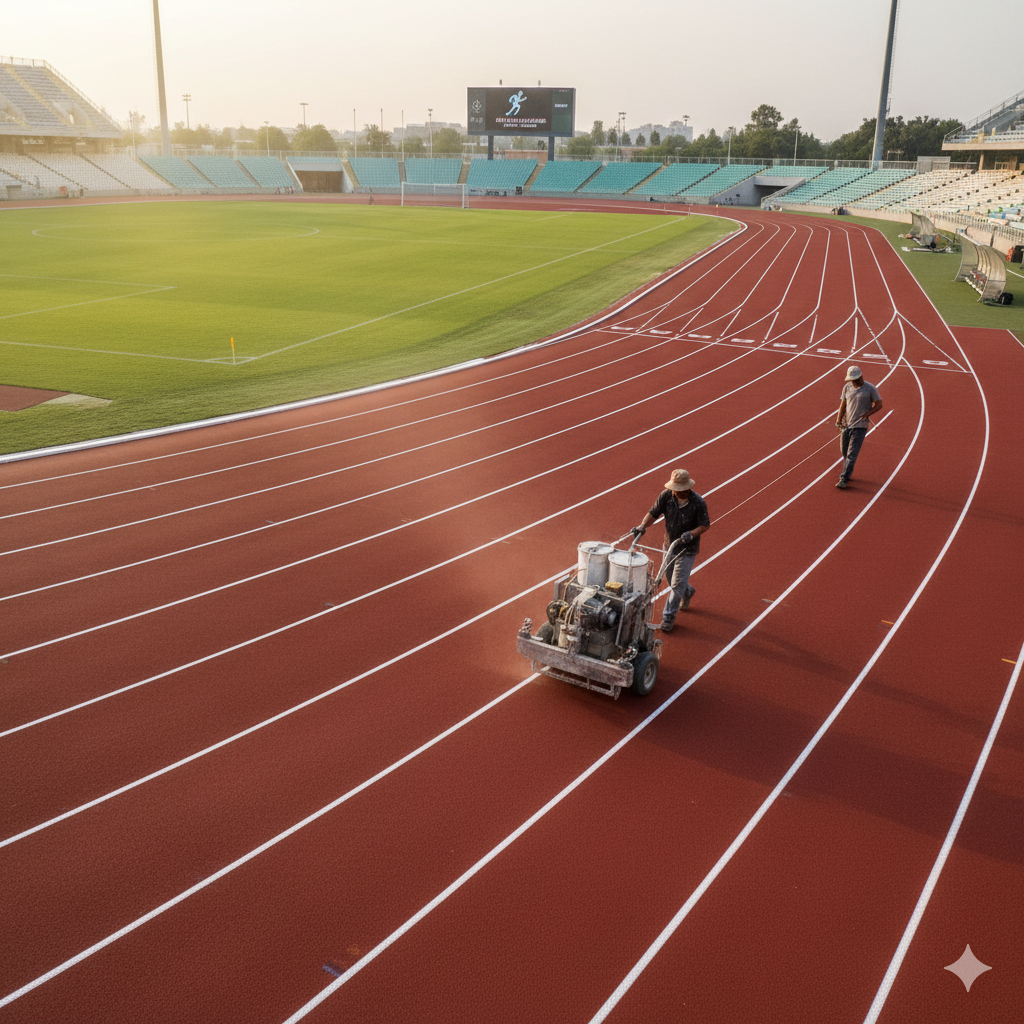
Line marking is essential for athlete safety, fair competition, and compliance with international standards. Properly marked lanes, start/finish lines, and field event zones help athletes navigate the track efficiently and ensure the facility meets World Athletics (IAAF) regulations.
1. Importance of Line Marking on a Running Track
-
Athlete Guidance
-
Lane markings, curves, and staggered start lines direct athletes and minimize collisions.
-
-
Fair Competition
-
Accurate distances, lanes, and markings ensure all athletes compete under the same conditions.
-
-
Event Organization
-
Clearly marked start/finish lines, relay zones, and hurdles simplify event management.
-
-
Safety
-
Prevents athletes from crossing lanes incorrectly and reduces risk of injuries.
-
-
Compliance
-
Tracks with proper markings meet national and international athletics standards, enabling official competitions.
-
2. Key Components of Running Track Line Marking
A running track includes various line markings, each with a specific purpose:
-
Lane Lines
-
Divide the track into standard lanes, typically 1.22 meters wide.
-
Number of lanes ranges from 6–10 depending on the facility size.
-
-
Start and Finish Lines
-
Sprint events require specific start lines based on distance (100m, 200m, etc.).
-
Finish lines are marked clearly and precisely.
-
-
Staggered Start Lines
-
Applied to races on curves (200m, 400m, 800m relays) to ensure equal distance for all lanes.
-
-
Relay Exchange Zones
-
20-meter zones for baton exchange in 4x100m and 4x400m races.
-
Marked with clear colored lines for visibility.
-
-
Hurdle and Steeplechase Markings
-
Indicate positions for hurdle placement, water jump, and approach zones.
-
-
Finish Area and Photo-Finish Lines
-
Clearly marked lines for timing equipment alignment.
-
-
Field Event Lines
-
Zones for javelin, discus, long jump, and high jump are integrated near the track with precise measurement markings.
-
3. Materials Used in Line Marking
-
Acrylic Paint
-
Weather-resistant and long-lasting; ideal for synthetic tracks.
-
Available in vibrant colors for visibility.
-
-
Thermoplastic Paint
-
Provides durability in high-traffic areas; often used on school and professional tracks.
-
-
Pre-Made Tape or Vinyl Lines
-
Quick and easy installation for temporary or semi-permanent markings.
-
-
Polyurethane-Based Paint
-
Ensures strong adhesion on polyurethane and Tartan surfaces.
-
Resistant to wear, UV, and water damage.
-
4. Steps in Line Marking for Running Tracks
Step 1: Measurement and Layout
-
Survey the track to determine lane width, staggered start positions, and relay zones.
-
Use laser levels, measuring tapes, and marking chalk to outline lines.
Step 2: Surface Preparation
-
Clean the track surface thoroughly, removing dust, debris, and moisture.
-
Ensure the surface is smooth and dry for optimal paint adhesion.
-
Use stencils or laser-guided equipment to apply paint evenly.
-
Ensure lines are straight, smooth, and conform to measurement standards.
-
Allow sufficient drying time to prevent smudging or peeling.
-
Check for accuracy in lane width, staggered positions, and event zones.
-
Adjust any discrepancies to ensure compliance with official regulations.
5. Factors Affecting Line Marking Quality
-
Surface Material – Different paints adhere differently on polyurethane, Tartan, or EPDM surfaces.
-
Environmental Conditions – Temperature, humidity, and rain can affect paint curing.
-
Precision of Measurement – Accurate surveying is critical for fair competition.
-
Maintenance Practices – Regular inspection and touch-ups prevent fading and wear.
6. Maintenance of Line Markings
-
Regular Cleaning – Remove dirt, debris, and leaves to maintain visibility.
-
Periodic Repainting – Essential every 2–3 years or after heavy use.
-
Check Event Zones – Ensure relay, hurdle, and field event markings remain accurate.
Maintaining line markings ensures safety, compliance, and a professional appearance.
7. Challenges in Line Marking
-
Curved Lane Accuracy
-
Solution: Use laser-guided or string-guided methods for precise curves.
-
-
Weather Interference
-
Surface Compatibility
-
Solution: Choose paints or marking materials compatible with the track surface (polyurethane, Tartan, or EPDM).
-
-
High Traffic Areas
-
Solution: Use thermoplastic or polyurethane-based paints for durability in heavy-use zones.
-
8. Advantages of Professional Line Marking
-
Ensures Compliance – Meets IAAF and national athletic standards.
-
Enhances Performance – Accurate lines guide athletes effectively.
-
Improves Safety – Reduces collisions, missteps, and injuries.
-
Boosts Visual Appeal – Clear, vibrant lines give a professional appearance to stadiums.
-
Reduces Maintenance Costs – Durable markings require less frequent repainting.
9. Applications
Line marking is essential for all running tracks:
-
Olympic and Professional Stadiums
-
University and School Athletic Tracks
-
Community Sports Complexes
-
Indoor Synthetic Tracks
-
Training and Multi-Sport Facilities
Correct line marking ensures facilities can host official competitions, training sessions, and recreational events safely and efficiently.
10. Conclusion
It is a precision task that directly affects athlete safety, performance, and regulatory compliance. From lane lines and staggered starts to relay exchange zones and field event markings, every line must be measured, applied, and maintained carefully.
Investing in accurate and durable line marking is an essential step in creating a world-class athletic facility.