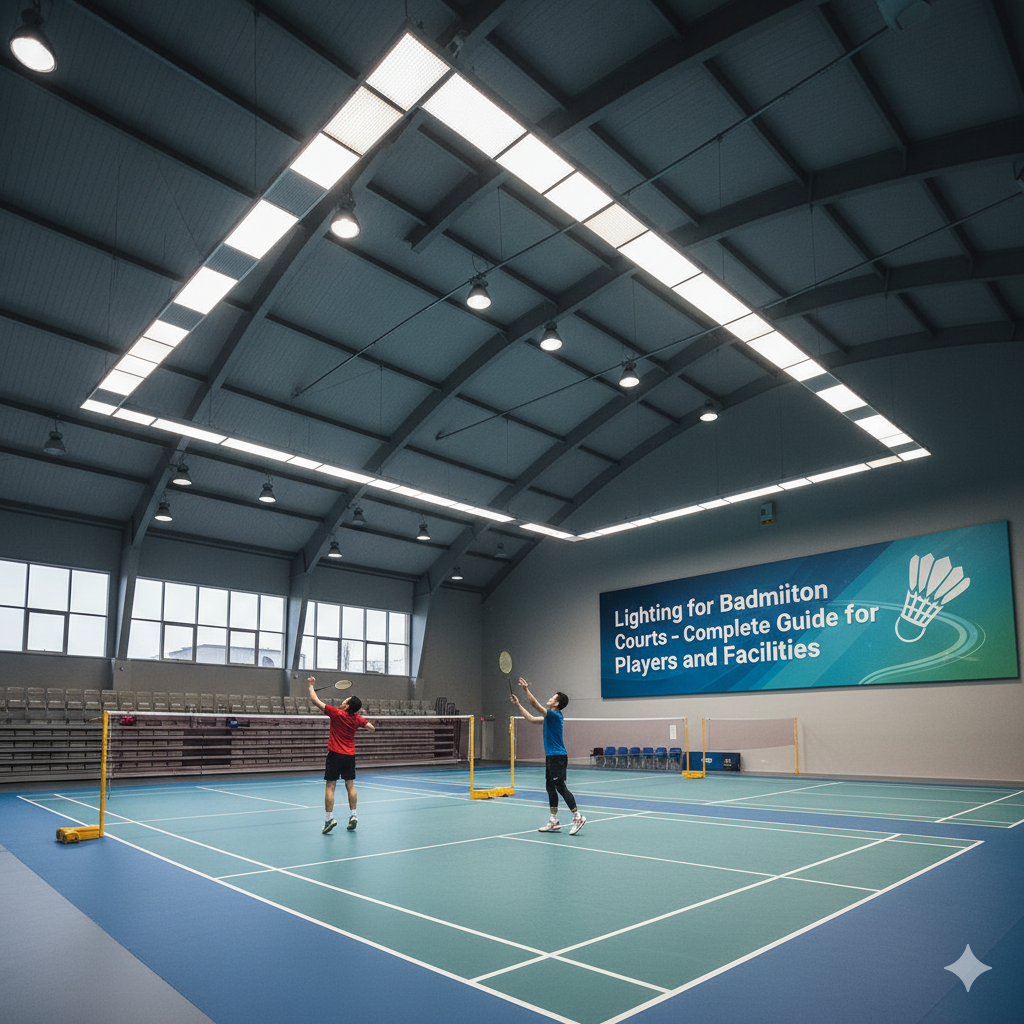
Lighting plays a crucial role in the performance, safety, and overall experience of badminton. Proper illumination ensures players can track the fast-moving shuttle, make precise shots, and maintain competitive intensity without straining their eyes. Inadequate or uneven lighting can lead to poor visibility, misjudged shots, and even injuries. For sports facilities, professional tournaments, schools, and recreational halls, understanding the standards, design, and maintenance of badminton court lighting is essential. This article provides a detailed guide on badminton court lighting, its requirements, installation best practices, and maintenance, while also highlighting its impact on gameplay.
1. Importance of Proper Lighting in Badminton
Badminton is a sport that requires high-speed reflexes, precision, and excellent hand-eye coordination. The shuttlecock can travel at speeds exceeding 300 km/h in professional matches, making proper lighting essential. Key benefits of appropriate lighting include:
-
Improved Visibility: Players can accurately track the shuttlecock and anticipate opponents’ movements.
-
Reduced Eye Strain: Uniform lighting minimizes glare and shadow effects, protecting players’ vision during long practice sessions or tournaments.
-
Enhanced Gameplay Quality: Well-lit courts help in precise judgment of shuttle positions, reducing in/out call disputes.
-
Professional Presentation: High-quality lighting improves the viewing experience for spectators and ensures broadcast-ready conditions for televised matches.
Without proper lighting, even the most skilled players may struggle to perform at their best.
2. Standard Lighting Requirements for Badminton Courts
The Badminton World Federation (BWF) and international facility standards recommend specific lighting levels to ensure uniform visibility:
-
Illumination Levels:
-
Recreational or School Courts: 300–500 lux
-
Professional and Tournament Courts: 750–1000 lux
-
-
Uniformity Ratio: Lighting should be evenly distributed across the court with a uniformity ratio of at least 0.7 to 0.8, minimizing dark spots or bright glare zones.
-
Color Temperature: 4000–6000 Kelvin (neutral to daylight white) ensures natural visibility without causing eye fatigue.
-
Glare Control: Lights should be positioned to avoid direct glare into players’ eyes during high jumps, smashes, or lifts.
Proper lux levels and uniform distribution are essential to ensure a competitive, safe, and professional environment.
3. Types of Lighting Used in Badminton Courts
Different types of lighting are suitable for indoor badminton courts, depending on facility size, budget, and intended use:
a. LED Lighting
-
Advantages: Energy-efficient, long lifespan, uniform light distribution, low heat emission.
-
Best Use: Professional, school, and multi-court setups.
-
Features: Adjustable intensity, dimming options, and minimal glare.
b. Fluorescent Lighting
-
Advantages: Economical and widely available.
-
Disadvantages: Shorter lifespan, flicker issues, and limited uniformity.
-
Best Use: Recreational or small-scale indoor courts.
c. Metal Halide (MH) Lamps
-
Advantages: High brightness, strong penetration, good color rendering.
-
Disadvantages: High energy consumption, warm-up time, and heat generation.
-
Best Use: Large professional halls and stadiums.
d. High-Intensity Discharge (HID) Lights
-
Advantages: Extremely bright, suitable for televised events.
-
Disadvantages: Energy-consuming, may produce glare if not positioned correctly.
LED lighting is becoming the preferred choice worldwide due to its efficiency, uniform illumination, and long-term cost savings.
4. Lighting Design Considerations
Proper lighting design is crucial for maximizing visibility and minimizing fatigue or glare:
-
Height of Fixtures: Lights should be installed at least 7–9 meters above the court surface to prevent obstruction and glare. Professional stadiums may have higher mounting points.
-
Beam Angle and Distribution: Wide-angle lighting ensures uniform illumination across the court, avoiding dark zones or overly bright areas.
-
Positioning: Lights are typically mounted along the length of the hall and oriented parallel to the sidelines to prevent direct glare during overhead shots.
-
Control Systems: Dimming options or programmable systems allow flexible lighting intensity based on usage, from casual practice to professional tournaments.
A well-designed lighting layout ensures a professional-grade court that meets international standards.
5. Impact of Lighting on Player Performance
Proper lighting has a direct effect on player performance and safety:
-
Tracking Shuttlecock: The speed of shuttle movement requires precise visibility; shadows or glare can lead to misjudged shots.
-
Reaction Time: Consistent lighting allows quicker response to smashes, drops, and clears.
-
Reducing Fatigue: Eye strain from poor lighting reduces concentration and stamina over extended matches.
-
Enhanced Safety: Players are less likely to collide or misstep when visibility is optimal, reducing injury risk.
Therefore, lighting is not just a technical requirement—it is a performance enhancer.
6. Lighting for Multi-Court Setups
For facilities with multiple badminton courts:
-
Uniform Distribution: Each court must receive uniform lighting without overlap causing glare.
-
Separation: Lighting for adjacent courts should prevent shadows crossing into neighboring courts.
-
Control Systems: Individual control allows courts to be lit only when in use, saving energy.
Multi-court facilities require careful planning to maintain consistent standards across all playing areas.
7. Maintenance of Badminton Court Lighting
To maintain optimal performance:
-
Regular Cleaning: Dust and dirt on fixtures can reduce light output by up to 30%.
-
Inspection: Check bulbs, connections, and glare shields periodically.
-
Replacement: Replace failing lamps immediately to maintain uniformity.
-
Energy Efficiency: Consider upgrading to LED systems for long-term energy savings and reduced maintenance costs.
Proper maintenance ensures long-term compliance with international lighting standards and uninterrupted play.
8. Lighting in Outdoor Badminton Courts
While indoor lighting is critical, outdoor courts also benefit from artificial illumination for evening play:
-
Pole Height: 6–9 meters, depending on court size and surrounding structures.
-
Lux Level: 200–400 lux for recreational play, higher for professional outdoor events.
-
Weather-Proof Fixtures: Outdoor lights should be resistant to rain, dust, and wind.
Adequate outdoor lighting extends play hours and makes courts accessible to more players, enhancing facility utility.
9. Conclusion
Lighting is a critical component of badminton court design, directly influencing player performance, safety, and the overall sporting experience. Proper illumination ensures that shuttlecock tracking, player positioning, and refereeing are accurate and consistent. International standards recommend 750–1000 lux for professional indoor courts, with even distribution, minimal glare, and suitable color temperature.
With advancements in LED technology, modern facilities can achieve energy-efficient, uniform, and glare-free lighting that enhances training and tournament environments. Proper design, installation, and maintenance of lighting systems not only comply with professional standards but also improve the overall experience for players, coaches, and spectators.