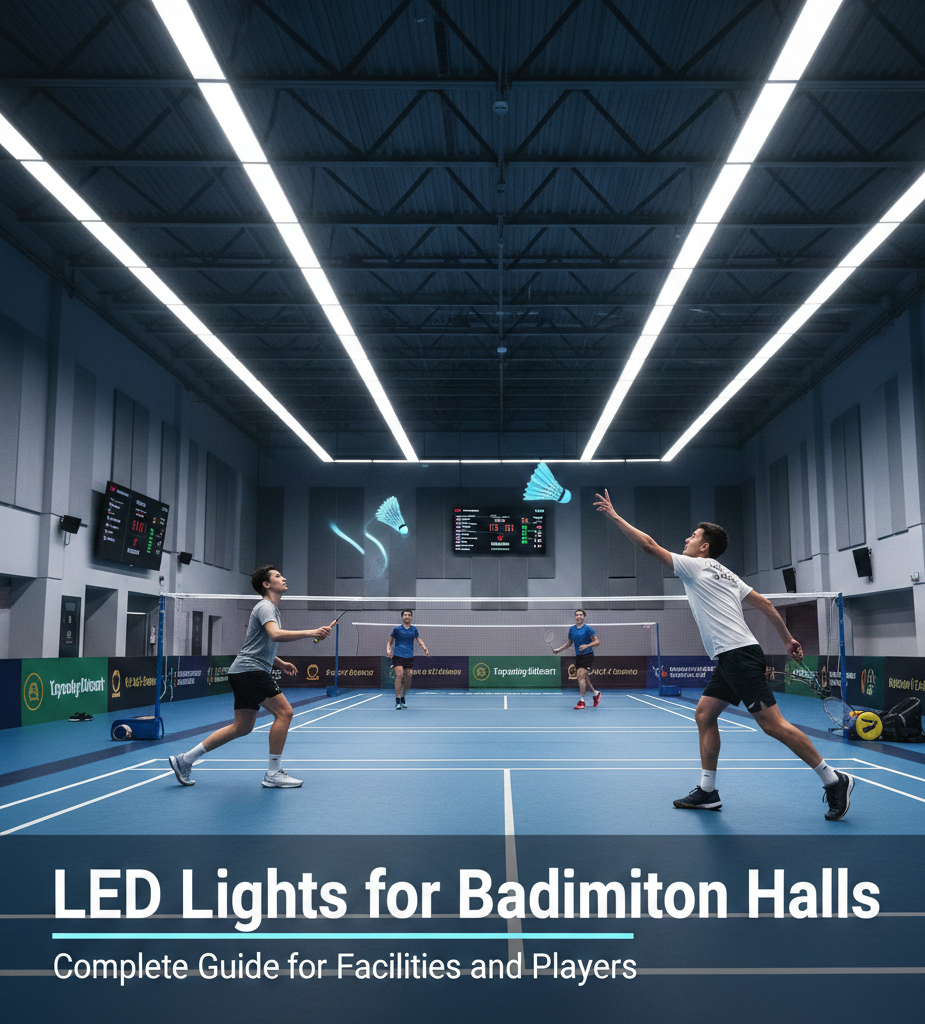
Lighting is one of the most critical aspects of any badminton hall. The speed and precision required in badminton demand uniform, glare-free, and high-intensity illumination. Among the modern lighting solutions available, LED lights have emerged as the preferred choice for badminton facilities worldwide. LED lighting not only enhances visibility and player performance but also reduces energy consumption and maintenance costs, making it a sustainable solution for sports infrastructure. This article explores LED lights for badminton halls in detail, covering benefits, installation standards, design considerations, maintenance, and performance impact.
1. Importance of Proper Lighting in Badminton Halls
Badminton is a high-speed indoor sport where shuttlecocks can travel over 300 km/h in professional matches. Proper lighting is crucial for:
-
Visibility: Players need to track the shuttlecock accurately to execute smashes, drops, and clears.
-
Safety: Uniform illumination reduces shadows and glare, minimizing the risk of accidents and collisions.
-
Performance: High-quality lighting improves reaction time and precision, enhancing overall gameplay.
-
Professional Standards: For tournaments and professional play, lighting must meet strict international standards set by the Badminton World Federation (BWF).
Without adequate lighting, even well-constructed halls fail to provide a professional playing environment.
2. Why LED Lights Are Ideal for Badminton Halls
LED (Light Emitting Diode) technology offers several advantages over traditional lighting solutions such as fluorescent or metal halide lamps:
-
Energy Efficiency: LEDs consume 50–70% less energy than traditional lighting, significantly reducing operational costs.
-
Long Lifespan: With a lifespan of 50,000–100,000 hours, LEDs require minimal replacements, lowering maintenance efforts.
-
Uniform Illumination: LEDs provide even light distribution, eliminating dark spots and shadows on the court.
-
Instant On/Off: Unlike metal halide lamps, LEDs reach full brightness instantly without warm-up periods.
-
Reduced Glare: Properly designed LED fixtures minimize glare, protecting players’ eyes during high-speed rallies.
-
Eco-Friendly: LEDs contain no mercury and emit lower carbon emissions, making them environmentally sustainable.
These advantages make LED lights the preferred choice for modern badminton halls aiming for professional standards and energy efficiency.
3. Lighting Standards for LED-Badminton Halls
Proper LED lighting design ensures compliance with BWF standards and optimal playing conditions:
-
Illumination Level:
-
Recreational Courts: 300–500 lux
-
Professional Courts: 750–1000 lux
-
-
Uniformity Ratio: Minimum 0.7–0.8, ensuring even lighting across the court.
-
Color Temperature: 4000–6000 Kelvin (neutral or daylight white) to reduce eye fatigue.
-
Height of Fixtures: Typically 7–9 meters above the court surface to prevent obstruction and glare.
-
Beam Angle: Wide-angle LED lights ensure full court coverage without overly concentrated light zones.
Adhering to these standards ensures players experience consistent visibility and professional-quality illumination.
4. LED Light Design Considerations
Designing LED lighting for badminton halls involves careful planning to maximize performance and efficiency:
a. Fixture Placement
-
Lights are usually mounted along the length of the hall, parallel to the sidelines, to minimize shadows on the court.
-
Fixtures should be positioned to prevent direct glare into players’ eyes during jumps and smashes.
b. Light Distribution
-
Use wide-angle or asymmetric lenses to ensure uniform illumination across the entire court.
-
Avoid overlapping light patterns that can cause uneven brightness or glare spots.
c. Dimming and Control
-
Modern LED systems can integrate dimming options, allowing adjustment for different purposes such as practice sessions, casual play, or professional tournaments.
-
Smart control systems can reduce energy usage when courts are unoccupied.
d. Multiple Court Layouts
-
In halls with multiple courts, ensure each court receives equal illumination without interference from adjacent court lighting.
-
Independent control for each court is recommended for energy efficiency and operational flexibility.
5. Advantages of LED Lighting for Players
LED lighting positively affects player performance and experience in several ways:
-
Enhanced Shuttlecock Visibility: Clear, bright, and evenly distributed light helps players track high-speed shuttle movements accurately.
-
Reduced Eye Strain: Uniform illumination prevents glare and shadows, reducing eye fatigue during long training or tournament sessions.
-
Faster Reaction Times: With better visibility, players can react faster to smashes, net shots, and clears, improving gameplay.
-
Injury Prevention: Proper lighting ensures players can judge distances accurately, reducing missteps and collisions.
A well-lit court supports both skill development and competitive performance.
6. Maintenance of LED Lights in Badminton Halls
While LED lights are low-maintenance compared to traditional lighting, regular checks ensure long-term performance:
-
Cleaning: Dust and debris on fixtures reduce light output by up to 30%, so regular cleaning is essential.
-
Inspection: Check for flickering, loose connections, or damaged lenses periodically.
-
Replacement: LEDs have a long lifespan, but faulty fixtures should be replaced promptly to maintain uniformity.
-
Upgrades: As technology advances, facilities may upgrade to more efficient or higher-lumen LED models for enhanced performance.
Proper maintenance guarantees energy savings, consistent lighting, and a professional environment.
7. Energy Efficiency and Cost Benefits
LED lights are an investment that reduces long-term operational costs:
-
Lower Electricity Bills: Up to 50–70% reduction in energy consumption compared to metal halide or fluorescent lights.
-
Reduced Replacement Costs: With a lifespan of 50,000–100,000 hours, LEDs require fewer replacements and labor costs.
-
Sustainable Operations: Lower energy use and reduced carbon footprint make LED-equipped halls environmentally friendly.
Facilities can recover initial investment within a few years due to reduced energy and maintenance expenses.
8. LED Lights for Multi-Purpose Sports Halls
Many indoor sports facilities host multiple activities alongside badminton, such as volleyball, table tennis, or basketball. LED lighting provides flexibility:
-
Adjustable Intensity: Dim or brighten lighting according to the sport’s requirements.
-
Directional Control: Use focused LED panels to illuminate specific areas without affecting surrounding spaces.
-
Enhanced Safety: Consistent visibility across the hall improves safety for all sports activities.
LED systems offer the adaptability needed for modern multi-purpose sports halls.
9. Conclusion
LED lights have revolutionized lighting for badminton halls, offering unmatched energy efficiency, uniform illumination, and long-term reliability. Properly designed and installed LED systems enhance shuttlecock visibility, reduce eye strain, improve player reaction times, and maintain safety across training and tournament environments.
With standards recommending 750–1000 lux for professional play and careful attention to placement, color temperature, and beam distribution, LED lighting ensures a high-quality playing experience. Maintenance is minimal compared to traditional lighting, while long-term cost savings make LED technology a smart investment for sports facilities.