Introduction
Kabaddi, a fast-paced and high-intensity contact sport, has seen a surge in popularity across India, including the northernmost state of Jammu and Kashmir (J&K). The growing interest in kabaddi at the school, college, and professional level necessitates well-designed infrastructure. Among the critical components of a professional kabaddi setup, court flooring is paramount. Proper flooring ensures safety, optimal performance, and durability, all while adapting to the unique climatic and geographic conditions of J&K.
Understanding the Regional Context
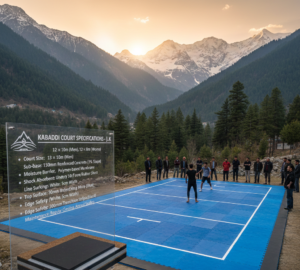
Jammu and Kashmir present a variety of terrain conditions, ranging from plains in Jammu to high-altitude hilly and mountainous regions in Kashmir. The state experiences cold winters with snowfall, moderate to heavy rains, and humid summers in certain areas. These factors significantly influence the selection of flooring materials and installation techniques. Outdoor courts must be resistant to moisture, freezing temperatures, and UV exposure, while indoor courts require good insulation and non-slip surfaces to maintain consistent playing conditions.
Standard Dimensions and Regulations
The standard kabaddi court dimensions must be considered when planning flooring:
-
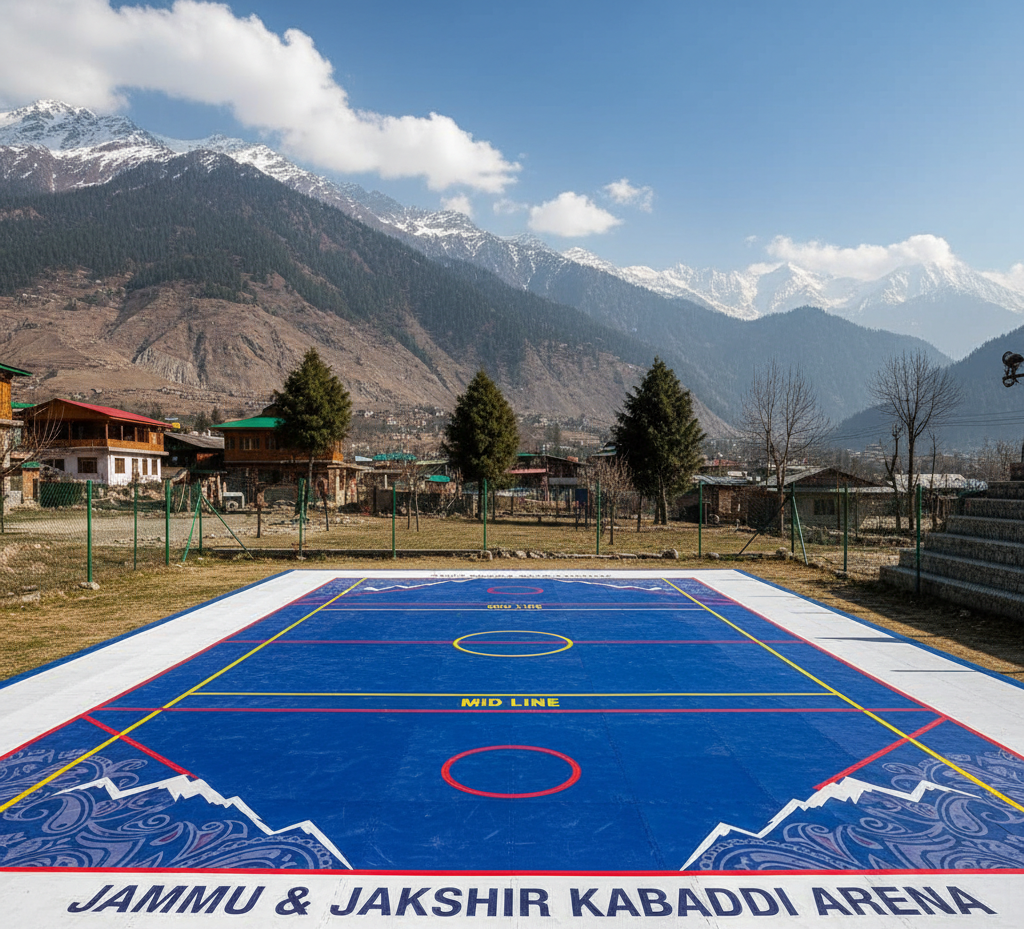
Men’s and junior boys’ courts: 13 meters × 10 meters (length × width)
-
Women’s and junior girls’ courts: 12 meters × 8 meters
-
Safety margins: At least 1–2 meters around the court for player safety and movement
These dimensions are critical because the flooring material must extend beyond the marked play area to ensure safe landings during raids, tackles, and dives.
Flooring Options Suitable for J&K
Selecting the right flooring in Jammu and Kashmir involves balancing player safety, durability, weather resistance, and maintenance requirements. Some common flooring options include:
-
Traditional Clay or Mud Courts
-
Historically used in rural and school grounds
-
Low initial cost
-
Requires regular maintenance and is vulnerable to rain and snow
-
Surface irregularities can increase injury risk
-
-
Synthetic Rubber or EVA Mats
-
Interlocking mats provide shock absorption and traction
-
Thickness usually ranges from 20–40 mm
-
Resistant to moisture and cold weather, making them ideal for J&K winters
-
Low maintenance and modular for easy repair
-
-
Rubberized or Polyurethane (PU) Coatings on Concrete
-
Provides a durable, even, and smooth surface
-
Suitable for indoor courts or high-traffic areas
-
Good resistance to moisture and temperature changes
-
-
Hybrid Systems
-
Concrete base with synthetic or rubber overlay
-
Provides both stability and shock absorption
-
Suitable for professional or state-level tournaments
-
For J&K, synthetic mats or hybrid systems are often recommended because they withstand the cold and wet conditions better than traditional clay floors.
Construction Steps for a Kabaddi Court in J&K
A well-constructed kabaddi court in J&K requires careful planning and execution:
-
Site Preparation
-
Clear debris, level the ground, and ensure proper drainage, especially in snowy or hilly regions
-
Compact the subsoil to prevent uneven settling
-
-
Base Layer
-
Outdoor courts: Reinforced concrete slab (100–150 mm) with a 1% slope for water drainage
-
Indoor courts: Smooth concrete or structural floor with insulation for temperature control
-
-
Moisture Barrier
-
Apply polymer-based sealing or membrane to prevent moisture from affecting mats or PU surfaces
-
-
Shock Absorbent Under-layer
-
Optional but recommended: foam or rubber sheets improve safety and reduce impact on joints
-
-
Top Surface Installation
-
EVA mats: Interlock mats over the sub-base covering the play area plus safety margins
-
PU/rubber coating: Apply layers according to manufacturer’s instructions and allow proper curing
-
-
Line Marking
-
Standard markings: mid-line, baulk lines, bonus lines, and lobby margins
-
Lines typically 5 cm wide and contrasting color for visibility
-
-
Edge Finishing and Safety Zones
-
Ensure smooth transitions at boundaries
-
Maintain at least 2 meters of clear area around the court
-
-
Inspection and Testing
-
Verify surface evenness, grip, shock absorption, and proper line markings
-
Test under slightly damp conditions to simulate outdoor use
-
-
Maintenance Plan
-
Daily sweeping, weekly mopping, and monthly inspection for mat edges or surface cracks
-
Annual sealing or repair for PU or hybrid surfaces as needed
-
Importance of Proper Flooring in J&K
-
Player Safety: Kabaddi involves sudden movements, dives, and tackles. Flooring must absorb shocks and prevent slips or joint injuries.
-
Climate Adaptation: Surfaces must handle snow, frost, heavy rainfall, and UV exposure. Mats or rubberized flooring mitigate these environmental risks.
-
Year-round Playability: Proper drainage and non-slip surfaces ensure that the court can be used in all seasons.
-
Hosting Competitions: Professional-quality flooring makes the venue suitable for district, state, and national-level tournaments.
-
Cost-Effectiveness: Durable, low-maintenance flooring reduces recurring expenses in remote regions of J&K.
Implementation Challenges and Solutions
-
Material Transport: High-altitude regions and hilly areas can make transporting mats or PU coatings challenging. Planning logistics is essential.
-
Ground Stability: Some locations may experience minor soil shifts; a compacted and reinforced base is essential.
Recommended Specification for J&K Kabaddi Court
-
Court size: 13 × 10 meters (men), 12 × 8 meters (women) + 1–2 m safety margin
-
Sub-base: 150 mm reinforced concrete with 1% slope
-
Moisture barrier: Polymer-based membrane
-
Shock absorbent under-layer: 10 mm foam or rubber sheet
-
Top surface: EVA interlocking mats, 30 mm thickness, density ~120 kg/m³, hardness ~30 Shore A
-
Line markings: White, 5 cm width, adhering to standard rules
-
Edge safety: 200 mm transition strips around mats
-
Maintenance: Sweep and mop regularly, inspect monthly, reseal annually
Conclusion
Constructing a high-quality kabaddi court in Jammu and Kashmir requires careful consideration of climate, terrain, and safety standards. Selecting the right flooring material—preferably synthetic or hybrid systems—ensures durability, player protection, and long-term usability.
FAQ
1. What types of flooring are suitable for a Kabaddi court in Jammu & Kashmir?
-
Synthetic mats: Interlocking PVC or PU mats, ideal for indoor courts.
-
Wooden flooring: High-quality hardwood with anti-slip finishes, usually for professional indoor arenas.
-
Clay or soil courts: Traditional outdoor courts, often covered with soft soil or clay.
-
Epoxy or rubber flooring: Provides excellent shock absorption and durability.
2. What is the standard size of a Kabaddi court?
-
Men’s court: 13 meters × 10 meters (approx. 42.65 × 32.8 ft)
-
Women’s court: 12 meters × 8 meters (approx. 39.37 × 26.25 ft)
Additional space around the court is recommended for safety and seating arrangements.
4. How long does it take to install a Kabaddi court floor?
-
Synthetic mats: 2–4 days depending on size and site conditions.
Professional installation ensures safety, durability, and a smooth surface for players.
5. How much does Kabaddi court flooring cost in Jammu & Kashmir?
The cost depends on the type of flooring:
-
Synthetic interlocking mats: ₹600–₹1,200 per sq. m
-
Wooden indoor flooring: ₹1,500–₹3,000 per sq. m
-
Clay/soil outdoor courts: ₹200–₹500 per sq. m
These are approximate rates and can vary based on supplier, installation, and customization.
6. Is maintenance required for Kabaddi flooring?
Yes. Maintenance varies by floor type:
-
Synthetic mats: Regular cleaning with mild detergent; check for wear and tear.
-
Wooden floors: Polishing and resealing annually; avoid water spillage.
-
Clay/soil courts: Regular leveling and moisture management.
Proper maintenance ensures longevity and player safety.
7. Can a Kabaddi court be installed in a school or college in Jammu & Kashmir?
Absolutely. Schools, colleges, and sports academies can install indoor or outdoor courts.
8. How do I choose the best Kabaddi flooring supplier in Jammu & Kashmir?
Look for:
-
Experience in sports flooring installation.
-
Quality certifications for mats or wood.
-
After-sales support and maintenance services.
-
References from other local sports facilities.
Professional suppliers ensure proper installation and compliance with Kabaddi standards.
9. Are there professional standards for Kabaddi flooring?
Yes. The Pro Kabaddi League (PKL) and the International Kabaddi Federation (IKF) set standards for floor type, shock absorption, and safety. Compliance is recommended for professional-level or tournament courts.
10. Can the flooring be used for other sports?
Yes. Many synthetic and wooden floors are multipurpose.
.Volleyball
-
Badminton
-
Indoor fitness activities
This adds versatility for schools and sports complexes.