The foundation of a jogging track is the most critical part of its construction. While most people focus on the top surface materials like PU, EPDM, or Acrylic, it is actually the foundation that determines how long the track will last, how safe it will be, and how well it performs under constant use.
A well-engineered jogging track foundation provides strength, stability, drainage, and smoothness — ensuring that the surface above remains free from cracks, water damage, or uneven settlement. Whether it’s a 400-meter standard track, a mini society track, or a fitness trail in a park, a solid foundation is the key to long-term success.
🧱 What Is a Jogging Track Foundation?
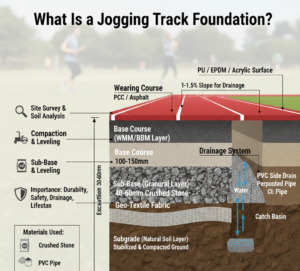
A jogging track foundation is the multi-layered structural base built beneath the surface material. It distributes the load evenly, ensures water drainage, and provides a level surface for installing the final jogging surface.
It typically consists of the following layers:
-
Subgrade (Natural Soil Layer) – Stabilized and compacted ground.
-
Sub-Base (Granular Layer) – Crushed stone or gravel for drainage and strength.
-
Base Course (WMM/WBM Layer) – Provides stability and load-bearing capacity.
-
Wearing Course (Concrete or Asphalt Base) – The top hard layer before surfacing.
Each layer plays a vital role in ensuring durability and performance.
⚙️ Importance of a Strong Foundation in Jogging Track Construction
A jogging track without a proper foundation is like a building without a base — it will fail prematurely.
Here’s why the foundation is so important:
-
Supports Surface Layers: Provides structural strength to the top coating.
-
Prevents Cracks & Erosion: Reduces stress and ground movement.
-
Ensures Drainage: Keeps the track dry and usable in all weather.
-
Improves Safety: Offers a stable, non-slippery platform for runners.
-
Increases Lifespan: Extends surface durability by up to 15 years.
A poorly designed foundation can lead to surface deformation, puddles, and cracks, requiring costly repairs later.
🧰 Step-by-Step Process of Jogging Track Foundation Construction
A strong jogging track foundation is built through a series of engineered steps. Each layer is designed for strength, slope, and stability.
1. Site Survey and Soil Analysis
Every project starts with:
-
Topographic and soil investigation
-
Compaction and bearing capacity testing
-
Drainage planning and slope design
If the soil is weak or clay-heavy, it’s stabilized with lime, cement, or fly ash before proceeding.
2. Excavation and Subgrade Preparation
The area is excavated to a depth of 300mm–600mm, depending on the surface design.
Steps include:
-
Removing vegetation and topsoil.
-
Compacting the ground using mechanical rollers.
-
Ensuring a slope of 1–2% for natural water runoff.
In some cases, geo-textile fabric is used to prevent soil migration into upper layers.
3. Sub-Base Construction (Granular Layer)
The sub-base is the first engineered layer above the subgrade.
-
Material: Crushed aggregates (40mm–60mm).
-
Thickness: 100–150mm.
-
Purpose: Provide drainage, resist load deformation, and stabilize the surface.
-
Compaction: Done with a vibratory roller for 95% density.
A strong sub-base ensures the jogging track does not sink or shift over time.
4. Base Course (WMM/WBM Layer)
The base course forms the strength core of the foundation.
-
Material: Wet Mix Macadam (WMM) or Water Bound Macadam (WBM).
-
Thickness: 100–150mm.
-
Compacted in multiple layers for uniformity.
This layer is critical for load distribution and stability, especially in heavy-use tracks like schools or stadiums.
5. Wearing Course (Concrete or Asphalt Layer)
Before the jogging surface is applied, a wearing course is installed to create a hard, even top layer.
-
For PU or EPDM tracks: Use PCC (Plain Cement Concrete) of 50–75mm.
-
For Acrylic or Bitumen tracks: Use Asphalt base.
-
The slope is maintained precisely for water drainage (1–1.5%).
This layer also acts as a bonding surface for the top coating and ensures a perfect finish.
6. Drainage System Installation
Proper drainage is an integral part of foundation design.
-
PVC or concrete side drains are installed along the track.
-
Catch basins collect water from the surface.
-
Perforated pipes are laid to channel water away from the foundation.
Good drainage prevents flooding, erosion, and water seepage into sub-layers.
7. Final Leveling and Compaction
-
Final compaction ensures no voids or weak spots.
This guarantees a smooth, stable base ready for surface installation.
🧪 Quality Tests for Jogging Track Foundation
Each stage of foundation work undergoes professional quality checks:
| Test Name | Purpose |
|---|---|
| Soil Compaction Test | Ensures subgrade firmness |
| CBR (Bearing Capacity) Test | Confirms soil strength |
| Plate Load Test | Verifies load distribution ability |
| Leveling Test | Ensures accurate slope & smoothness |
| Drainage Flow Test | Checks water discharge efficiency |
Quality control ensures that the jogging track foundation meets IS, ASTM, and World Athletics standards.
🧱 Materials Used in Jogging Track Foundation
| Layer | Material | Purpose |
|---|---|---|
| Subgrade | Natural soil / Stabilized soil | Base support |
| Sub-base | Crushed stone, gravel | Drainage & strength |
| Base Course | WMM / WBM | Load-bearing |
| Wearing Course | PCC / Asphalt | Surface leveling |
| Drainage | PVC / Concrete channels | Water management |
Each material must be durable, weather-resistant, and properly compacted to ensure foundation stability.
💰 Jogging Track Foundation Cost in India (Approx.)
| Track Type | Size | Estimated Foundation Cost (INR) |
|---|---|---|
| Mini Track (100–150m) | Parks / Schools | ₹1,00,000 – ₹1,80,000 |
| Standard 200m Track | Colleges / Societies | ₹2,50,000 – ₹3,80,000 |
| 400m Athletic Track | Stadiums / Public Grounds | ₹4,00,000 – ₹7,00,000 |
Cost includes excavation, compaction, base construction, and drainage setup.
🌿 Environmental and Design Considerations
-
Soil drainage and rainwater runoff management.
-
Eco-friendly materials to reduce carbon footprint.
-
Permeable layers to allow water filtration.
-
Erosion control landscaping around the track perimeter.
These factors ensure that the foundation remains eco-friendly and sustainable.
🏆 Advantages of a Professionally Built Foundation
-
Longer Lifespan: 15–20 years of durability.
-
Superior Drainage: Water quickly exits, keeping surface dry.
-
Perfect Smoothness: Ideal for safe and comfortable running.
-
Low Maintenance: Reduced cracking or settlement.
-
Weather Resistance: Performs well in all conditions.
-
Compatibility: Supports PU, EPDM, Acrylic, and other surfaces.
A strong foundation reduces long-term maintenance costs and ensures athletes can run safely with consistent grip and comfort.
⚠️ Common Foundation Mistakes to Avoid
❌ Insufficient compaction of subgrade.
❌ Incorrect slope leading to water stagnation.
❌ Poor-quality aggregates or uneven thickness.
❌ No drainage or weak concrete base.
❌ Rushing the curing process before surfacing.
✅ Avoid these by hiring an experienced jogging track contractor who follows industry standards for design and construction.
🏁 Conclusion
A jogging track foundation is more than just the first step in construction — it is the heart of the entire system. A properly designed and constructed foundation provides stability, strength, and sustainability, ensuring that your track performs flawlessly for years.
Frequently Asked Questions (FAQ) – Jogging Track Foundation
1. What is a jogging track foundation?
A jogging track foundation is the base layer or substructure of a jogging track that provides stability, load distribution, drainage, and long-term durability for the running surface.
2. Why is a strong foundation important?
A proper foundation ensures:
-
Even, level surface for safe running
-
Shock absorption and reduced joint stress
-
Prevention of cracks or surface deformation
-
Effective drainage to avoid water accumulation
3. What are the components of a jogging track foundation?
-
Subgrade: The natural soil, leveled and compacted
-
Sub-base: Layer of crushed stone, gravel, or sand for stability
-
Base layer: Optional concrete or bitumen layer for additional strength
-
Cushioning layer: Rubber, PU, or synthetic padding to enhance shock absorption
4. How is the subgrade prepared?
-
Clear vegetation, debris, and loose soil
-
Level and compact the ground using rollers or mechanical compactors
-
Ensure proper slope (1–2%) for water drainage
5. What materials are used in jogging track foundations?
-
Crushed stone or gravel for the sub-base
-
Sand or fine aggregates for leveling
-
Concrete or asphalt for base layers in professional tracks
-
Shock-absorbing synthetic layers (PU, EPDM, rubber) above the base
6. How thick should a jogging track foundation be?
-
Sub-base (gravel/stone): 100–150 mm
-
Base layer (optional concrete/asphalt): 50–100 mm
-
Cushioning layer (synthetic or rubber): 10–40 mm
Thickness depends on track usage, material, and expected foot traffic.
7. Can jogging tracks be built on uneven terrain?
Yes, but the foundation must be properly leveled and compacted. Additional fill or retaining walls may be required for sloped areas to ensure stability and safety.
8. Is drainage included in the jogging track foundation?
Yes, proper drainage is essential. The foundation is designed with:
-
Slight slope for water runoff
-
Side drains or trenches to prevent waterlogging
-
Permeable sub-base layers for moisture absorption
9. Can jogging track foundations support synthetic flooring?
Yes, a well-prepared foundation ensures that PU, PVC, interlocking tiles, or rubber surfaces remain even, durable, and shock-absorbing.
10. How long does it take to prepare a jogging track foundation?
-
Small residential or park tracks: 2–5 days
-
Medium or professional tracks: 5–10 days
-
Large stadium or multi-lane tracks: 2–4 weeks
Time depends on track size, materials, and terrain complexity.
11. How much does a jogging track foundation cost in India?
-
Basic gravel/sand foundation: ₹150–₹400 per sq. meter
-
Concrete or bitumen base: ₹400–₹900 per sq. meter
-
Professional cushioned base with synthetic layer: ₹900–₹1,500+ per sq. meter
12. How is foundation maintenance done?
-
Regular inspection for cracks or erosion
-
Refilling gravel or sand if necessary
-
Ensure drainage systems remain clear to prevent water accumulation
-
Foundation maintenance ensures long-lasting track performance
13. Who builds jogging track foundations?
Professional sports flooring contractors or civil engineers design and build jogging track foundations to ensure safety, durability, proper drainage, and compliance with standards.
14. How long does a jogging track foundation last?
With proper construction and maintenance:
-
Gravel/sand foundations: 10–12 years
-
Concrete or asphalt foundations: 15–20 years
-
Cushioned synthetic foundations: 10–15 years