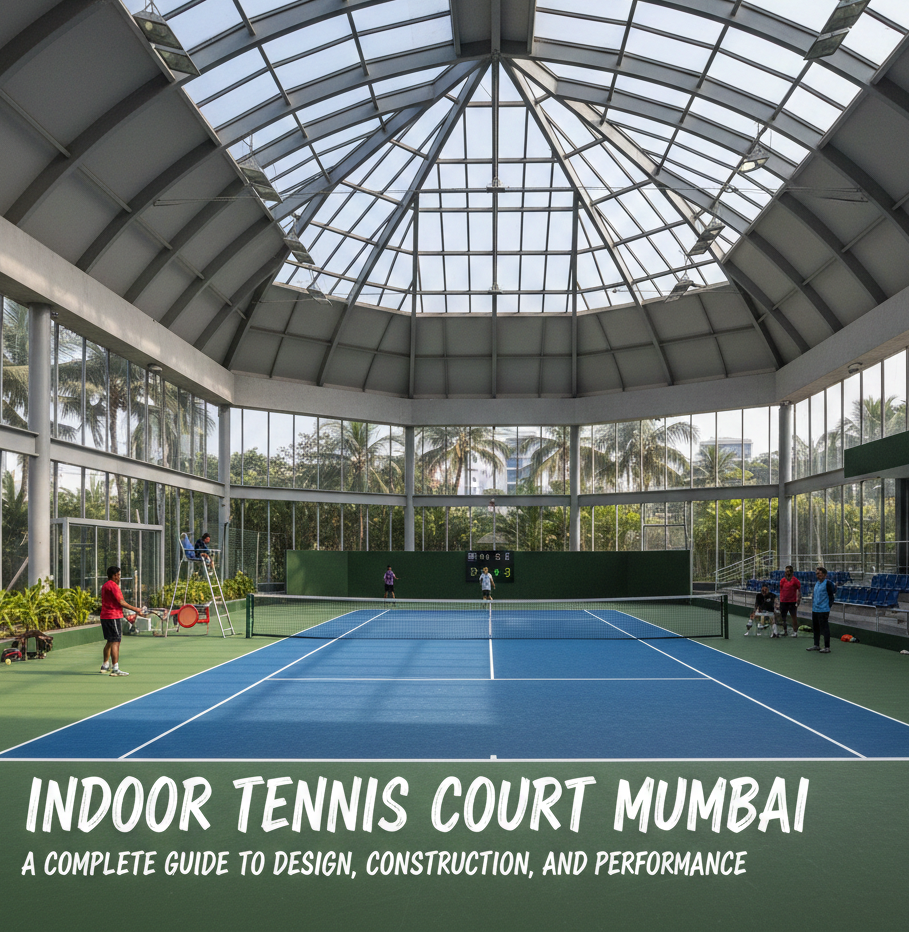
Mumbai is a city where space is premium, weather is unpredictable, and sports infrastructure is rapidly evolving. In this environment, the demand for indoor tennis courts in Mumbai has grown significantly across private residences, sports academies, schools, clubs, and luxury real estate developments. An indoor tennis court offers year-round playability, professional training conditions, and long-term durability—making it a smart investment for both personal and commercial use.
This comprehensive guide explores everything you need to know about indoor tennis courts in Mumbai, including their benefits, surface options, construction process, climate considerations, costs, and maintenance.
Why Indoor Tennis Courts Are Ideal for Mumbai
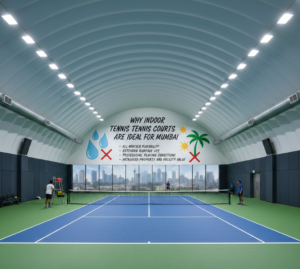
Mumbai’s coastal location brings high humidity, intense sunlight, monsoon rainfall, and salt-laden air. These environmental conditions can quickly degrade outdoor tennis courts, leading to frequent repairs and inconsistent playing conditions. Indoor tennis courts solve these challenges by creating a controlled environment optimized for performance and longevity.
Key Benefits of Indoor Tennis Courts in Mumbai
All-Weather Playability
Indoor courts allow uninterrupted play throughout the year, regardless of rain, heat, or humidity. This is especially valuable for academies and professional training centers that require consistent schedules.
Extended Surface Life
Protected from UV rays, moisture, and debris, indoor tennis court surfaces last significantly longer than outdoor courts.
Professional Playing Conditions
Controlled lighting, temperature, and airflow enhance player focus, safety, and match quality—ideal for competitive play and coaching programs.
Noise and Light Management
Indoor courts are designed with acoustic treatments and glare-free lighting, making them suitable for residential neighborhoods and institutional campuses.
Increased Property and Facility Value
An indoor tennis court adds prestige, functionality, and long-term value to villas, clubs, schools, and commercial sports complexes.
Types of Indoor Tennis Court Surfaces
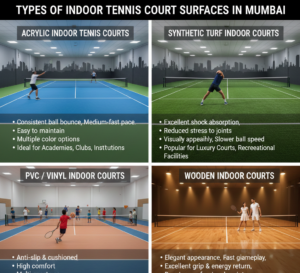
Choosing the right surface is critical to performance, comfort, and maintenance. Indoor tennis courts in Mumbai are built using several high-performance surface systems, each suited to different needs and budgets.
Acrylic Indoor Tennis Courts
Acrylic surfaces are the most widely used option for indoor tennis courts.
-
Consistent ball bounce and medium-fast pace
-
Smooth, seamless finish
-
Easy to maintain and repair
-
Available in multiple color combinations
Synthetic Turf Indoor Tennis Courts
Synthetic turf offers a cushioned playing experience that resembles natural grass.
-
Excellent shock absorption
-
Reduced stress on joints
-
Visually appealing and comfortable
-
Slower ball speed, ideal for training
This option is popular for luxury indoor courts and recreational facilities focused on comfort and aesthetics.
PVC / Vinyl Indoor Tennis Courts
-
Anti-slip and cushioned backing
-
High comfort underfoot
-
Suitable for multi-sport use
-
Controlled ball bounce
Wooden Indoor Tennis Courts
Wooden surfaces represent the premium segment of indoor tennis courts.
-
Elegant appearance and fast gameplay
-
Excellent grip and energy return
-
Used mainly in private clubs and luxury homes
-
Requires professional maintenance
Indoor Tennis Court Design and Construction Process
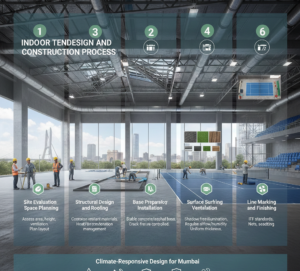
Building an indoor tennis court in Mumbai requires technical expertise, precise planning, and climate-specific engineering. A structured construction process ensures durability, safety, and international-standard performance.
1. Site Evaluation and Space Planning
Engineers assess the available indoor area, ceiling height, ventilation potential, and structural feasibility. Layout planning ensures compliance with standard tennis court dimensions and safety clearances.
2. Structural Design and Roofing
For new constructions, steel or reinforced concrete structures are designed with corrosion-resistant materials to withstand Mumbai’s humidity and saline air. Roofing systems are planned to manage heat and prevent condensation.
3. Base Preparation
A stable concrete or asphalt base is constructed and leveled precisely. Crack-free, moisture-controlled bases are essential for long-term surface performance.
4. Surface Installation
The selected tennis surface—acrylic, synthetic turf, PVC, or wood—is installed using professional systems that ensure uniform thickness, adhesion, and elasticity.
5. Lighting and Ventilation
LED sports lighting systems provide uniform, shadow-free illumination. Ventilation systems regulate airflow, temperature, and humidity for optimal playing comfort.
6. Line Marking and Finishing
Nets, posts, seating, and safety padding complete the setup.
Climate-Responsive Design for Mumbai
Indoor tennis courts in Mumbai must address unique environmental challenges:
-
Anti-humidity materials prevent swelling, peeling, or mold growth
-
Rust-proof structural components resist corrosion
-
Vapor barriers and sealants protect flooring systems
-
Efficient ventilation maintains air quality and comfort
These features ensure that indoor courts remain functional and visually appealing for years.
Cost of Building an Indoor Tennis Court in Mumbai
The cost of an indoor tennis court varies based on surface type, structural complexity, lighting, and customization.
Approximate Cost Range
-
Acrylic indoor tennis court: ₹12–18 lakh
-
Synthetic turf or PVC court: ₹15–25 lakh
-
Premium wooden indoor court: ₹25 lakh and above
Final costs depend on site conditions, ceiling height, climate control systems, and additional features.
Maintenance of Indoor Tennis Courts
Maintenance Best Practices
-
Regular surface cleaning
-
Periodic inspection of seams and markings
-
Recoating or resurfacing as needed
-
Lighting and ventilation system checks
With proper maintenance, an indoor tennis court in Mumbai can deliver consistent performance for 10–15 years or more.
Applications of Indoor Tennis Courts in Mumbai
Indoor tennis courts are suitable for a wide range of facilities:
-
Private villas and luxury residences
-
Tennis academies and coaching centers
-
Schools and universities
-
Clubs, resorts, and fitness centers
-
Real estate developments and gated communities
Each application benefits from controlled conditions, professional aesthetics, and long-term durability.
Conclusion
By offering year-round playability, protection from harsh weather, and professional-grade conditions, indoor tennis courts meet the growing demand for high-quality sports infrastructure in the city.
With the right surface selection, climate-responsive design, and expert construction, an indoor tennis court becomes a space that inspires athletes, enhances properties, and delivers consistent excellence for years to come.
Frequently Asked Questions (FAQ) – Indoor Tennis Court in Mumbai
1. What are the standard dimensions of an indoor tennis court?
A standard singles tennis court measures 23.77 m × 8.23 m, and a doubles court measures 23.77 m × 10.97 m. Additional clearance of at least 6–7 meters around the court is recommended for safe gameplay.
2. What types of surfaces are available for indoor tennis courts?
Indoor tennis courts can have various surfaces:
-
Hard courts (PU or acrylic) – durable and low maintenance
-
Synthetic grass / artificial turf – softer on joints, good for multi-use
-
Wooden flooring – rarely used, mostly for multipurpose indoor sports
-
Rubber or cushioned synthetic flooring – shock-absorbing and professional-grade
3. Why choose an indoor tennis court in Mumbai?
-
All-weather play – unaffected by rain, heat, or humidity
-
Extended playing hours with proper indoor lighting
-
Consistent surface quality for training and professional matches
-
Reduced maintenance costs compared to outdoor clay or grass courts
4. What is the ideal ceiling height for an indoor tennis court?
The minimum recommended ceiling height is 9–12 meters to allow proper ball clearance and unrestricted gameplay.
5. Can indoor tennis courts be used for other sports?
Yes, indoor tennis courts with synthetic or cushioned surfaces can often be multi-purpose, supporting badminton, futsal, or recreational activities with temporary line markings.
6. How long does it take to construct an indoor tennis court?
Construction time depends on surface type:
-
Synthetic or acrylic courts: 7–12 days
-
PU cushioned courts: 10–15 days
-
Specialty turf courts: 12–20 days
7. What is the cost of building an indoor tennis court in Mumbai?
Costs vary depending on surface, size, and design. On average, ₹1,500 to ₹5,000 per sq. meter, including flooring, lighting, and infrastructure.
8. How is drainage handled in indoor tennis courts?
Even indoors, proper subfloor drainage and moisture-proofing are important to prevent water seepage, surface damage, or mold, especially in Mumbai’s humid climate.
9. What maintenance does an indoor tennis court require?
-
Regular cleaning to remove dust and debris
-
Surface inspections to repair minor damage or wear
-
Periodic resurfacing depending on court usage
-
Humidity control to protect synthetic or cushioned flooring
10. Are indoor tennis courts suitable for tournaments in Mumbai?
Yes, professionally built indoor tennis courts can meet national and international standards, making them suitable for training, competitions, and professional matches.
11. Who installs indoor tennis courts in Mumbai?
Indoor tennis courts are installed by specialized sports flooring companies that provide design, material supply, installation, and maintenance guidance according to international tennis federation standards.
12. How long does an indoor tennis court last?
With proper maintenance, indoor synthetic or PU tennis courts last 8–12 years, while high-quality cushioned courts can last even longer.