Players sprint, pivot, jump, and land repeatedly in short bursts of high-intensity movement. The game’s fluidity and safety depend significantly on the quality and construction of the court floor. A poorly built surface can compromise player performance, increase injury risk, and deteriorate quickly. Conversely, a well-engineered court enhances traction, shock absorption, ball response, and overall longevity. But what goes into making a high-quality basketball court floor?
Designing and constructing a basketball court involves a meticulous blend of engineering, materials science, and sports-specific knowledge. From the base preparation to the final protective coatings, each layer of the floor plays a critical role in achieving the ideal balance of durability, comfort, and performance. This guide explores the construction processes for different types of basketball courts, the materials involved, the key steps in installation, and the distinctions between indoor and outdoor systems.
Why Basketball Court Floor Construction Matters
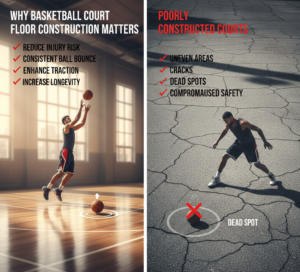
Basketball is a physically demanding sport. Players perform rapid sprints, sudden stops, and explosive jumps, putting intense stress on their muscles and joints. A high-quality basketball floor is designed to:
-
Reduce Injury Risk: Shock-absorbing subfloor systems lessen the impact on knees, ankles, and lower back.
-
Provide Consistent Ball Bounce: A uniform surface ensures predictable ball behavior, essential for professional gameplay.
-
Enhance Traction: Proper finishes and materials prevent slips, allowing players to change direction safely.
-
Increase Longevity: Durable materials withstand repeated use, reducing maintenance costs over time.
Poorly constructed courts, on the other hand, often develop uneven areas, cracks, and “dead spots” where the ball does not bounce correctly. Such flaws compromise the safety and performance of athletes, highlighting the importance of professional design and installation.
Types of Basketball Court Floors and Construction Methods
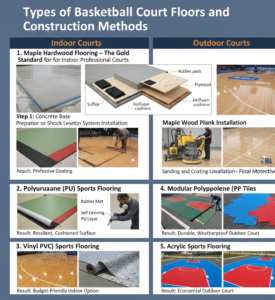
Basketball floors can be broadly categorized into indoor and outdoor types. Each type has multiple construction systems designed to meet different performance, durability, and budget requirements.
1. Maple Hardwood Flooring – The Gold Standard for Indoor Professional Courts
Maple hardwood is the premium material used in professional basketball arenas worldwide, including the NBA. Its hardness, density, and resilience provide unmatched performance, durability, and aesthetic appeal. The construction of a maple hardwood court is a highly technical process that requires precision at every step.
Step 1: Concrete Base Preparation
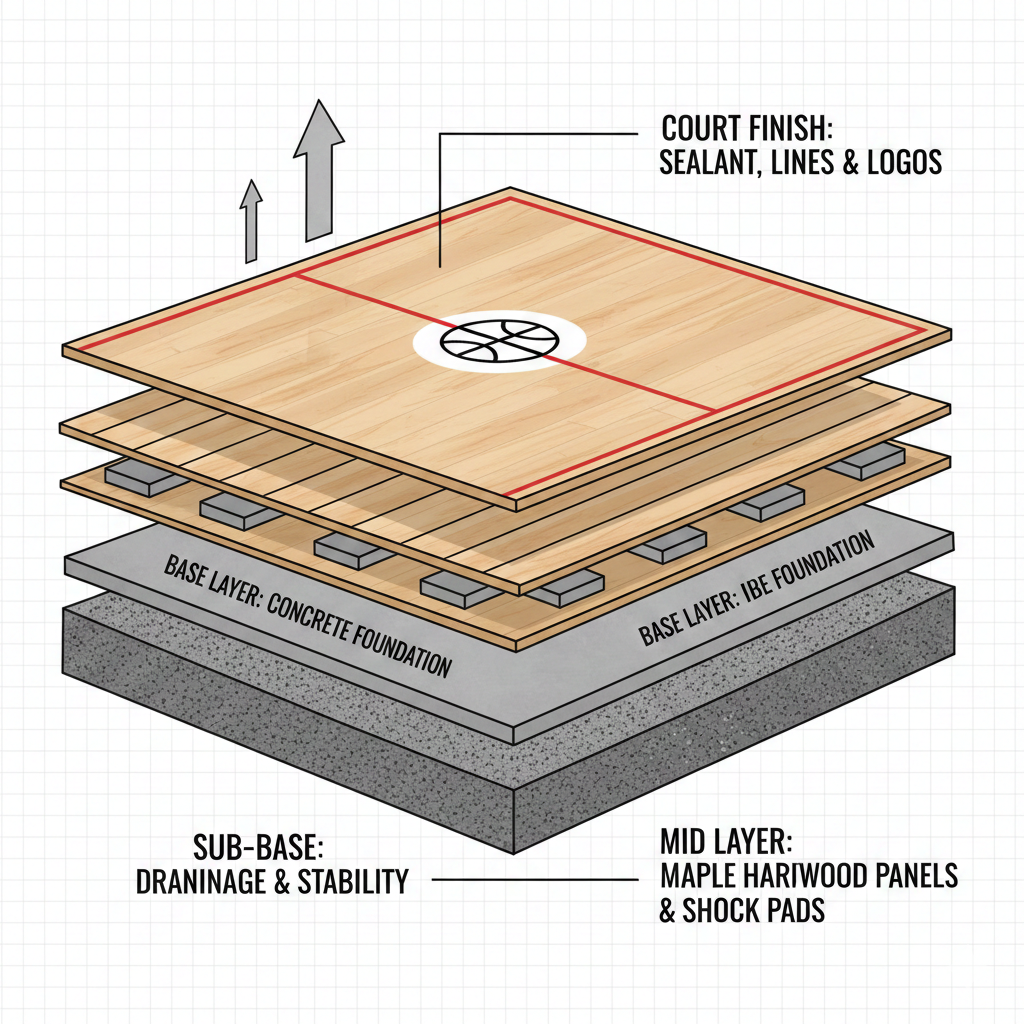
A flat, stable concrete slab is the foundation for any indoor hardwood court. The slab must be level to within millimeters to ensure uniform ball bounce. Moisture barriers are applied to prevent humidity from warping the wood. Proper slab preparation ensures the longevity of the court and prevents early damage.
Subfloor or Shock Absorption System Installation
Professional hardwood courts incorporate a shock-absorbing subfloor system. This typically consists of:
-
Rubber pads or mats for impact absorption.
-
Multiple layers of plywood for strength and stability.
-
Air or foam cushions to provide flexibility and reduce joint stress.
Maple Wood Plank Installation
Premium-grade, kiln-dried maple boards are tongue-and-groove fitted and securely fastened to the subfloor using nails or staples. This precise installation prevents gaps, warping, or uneven surfaces.
Sanding and Surface Leveling
Once the boards are in place, the surface undergoes multiple rounds of machine sanding to create a smooth, uniform finish. This eliminates minor height variations and imperfections, ensuring consistent ball behavior.
Sealing and Coating
The hardwood is coated with high-performance polyurethane or UV-resistant sealants to:
-
Protect against scratches and scuffs
-
Provide moisture resistance
-
Enhance shine and aesthetic appeal
Line Marking
Court markings—including the center circle, free-throw lines, three-point arcs, sidelines, and baselines—are applied using sports-grade paints that adhere to hardwood surfaces.
Final Protective Coating
One or more clear top coats are applied to ensure durability, anti-slip performance, and long-lasting visual appeal.
Result: A professional-grade court that delivers exceptional bounce, traction, and player comfort, making it suitable for competitive indoor basketball.
2. Polyurethane (PU) Sports Flooring – High-Performance Indoor Alternative
PU sports flooring is increasingly popular for indoor courts in schools, gyms, and multipurpose arenas. It combines shock absorption with a smooth, seamless surface ideal for high-intensity play.
Concrete Subfloor Preparation
The base slab must be repaired, leveled, cleaned, and primed with a bonding agent to ensure adhesion of the PU layers.
Rubber Base Mat Installation
A cushioned rubber mat is glued to the concrete, providing elasticity, comfort, and impact absorption.
Self-Leveling PU Layer Application
Liquid polyurethane is poured onto the subfloor, self-leveling to form a uniform, seamless surface. This ensures consistent ball bounce and eliminates joints or cracks that could interfere with gameplay.
Top Coats and Texture Layer
The texture layer ensures anti-slip performance for players.
Result: A resilient, cushioned surface that balances performance, comfort, and long-term wear, suitable for professional-level indoor basketball.
3. Vinyl (PVC) Sports Flooring – Budget-Friendly Indoor Option
Subfloor Preparation
Concrete must be moisture-free, crack-free, and leveled to ensure proper installation.
Seam Welding
Hot welding ensures seamless joints, preventing water ingress and bacterial growth.
4. Modular Polypropylene (PP) Tiles – Outdoor Courts
PP modular tiles are interlocking synthetic tiles designed for outdoor use. They are highly durable, weatherproof, and easy to maintain.
5. Acrylic Sports Flooring – Economical Outdoor Option
Acrylic coatings are ideal for public, school, or community courts where budget constraints exist.
Base Construction
A robust asphalt or concrete base forms the foundation.
Acrylic Resurfacer Coat
This layer levels the surface, improves adhesion, and fills minor imperfections.
Acrylic Color Coats
UV-resistant colored layers provide grip, weather resistance, and aesthetic appeal.
Result: An affordable, weather-resistant outdoor court suitable for recreational and school-level basketball, combining functionality and aesthetics.
Indoor vs. Outdoor Court Construction – Key Differences
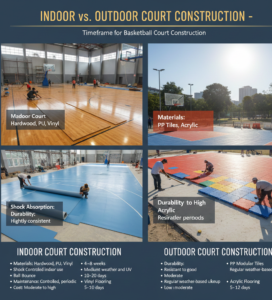
| Feature | Indoor Floors | Outdoor Floors |
|---|---|---|
| Materials | Hardwood, PU, Vinyl | PP Tiles, Acrylic |
| Shock Absorption | High | Medium to High |
| Durability | Controlled indoor use | Resistant to weather and UV |
| Ball Bounce | Highly consistent | Moderate to good |
| Maintenance |
Controlled, periodic |
Regular weather-based upkeep |
| Cost | Moderate to high | Low to moderate |
Timeframe for Basketball Court Construction
The construction timeline varies depending on the type of floor, base condition, and environmental factors:
-
Maple Hardwood: 4–8 weeks
-
PU Sports Flooring: 10–20 days
-
Vinyl Flooring: 5–10 days
-
PP Modular Tiles: 1–3 days
-
Acrylic Flooring: 5–12 days
Longer timelines reflect professional-grade installations with precise subfloor preparation and multiple protective layers.
Conclusion: Precision, Quality, and Performance
-
High-quality materials suited to the environment (indoor/outdoor)
-
Shock absorption and traction systems for safety
-
Finishing layers for durability, aesthetics, and performance
A well-constructed basketball court elevates the game experience, protects athletes, and withstands years of rigorous use.