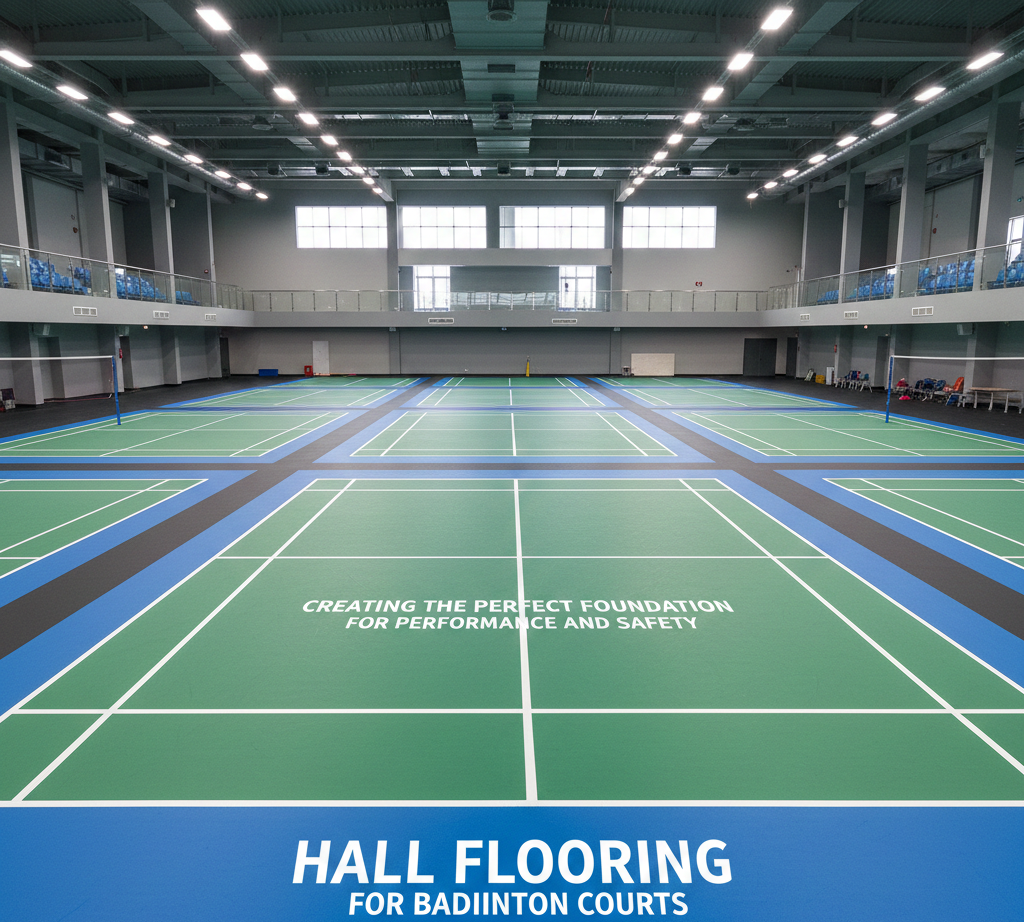
In any indoor badminton facility, the hall flooring plays a decisive role in defining the quality of play, athlete safety, and long-term usability of the court. Badminton is a sport that demands speed, agility, balance, and precision. Players constantly perform rapid directional changes, explosive jumps, lunges, and quick stops—movements that place significant stress on the body. The right hall flooring absorbs impact, provides reliable grip, and ensures consistent playing conditions.
Selecting the ideal badminton hall flooring is not just a design decision; it is a technical investment that affects performance standards, injury prevention, maintenance costs, and the overall reputation of the sports facility. From traditional wooden floors to modern vinyl, PU, PVC, and acrylic systems, each flooring solution offers unique benefits depending on usage, budget, and facility requirements.
This comprehensive guide explains everything you need to know about hall flooring for badminton courts, including material options, performance characteristics, installation practices, maintenance needs, and cost considerations.
1. Why Hall Flooring Is Critical for Badminton Courts
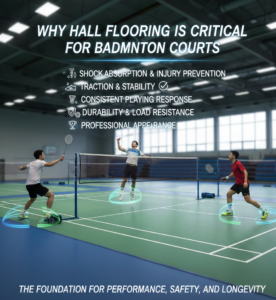
Badminton is one of the fastest racket sports in the world. Unlike outdoor sports, it is played indoors where surface conditions remain constant—making flooring quality even more important. A professionally designed badminton hall floor supports both athletic performance and player well-being.
Key reasons why flooring quality matters:
Shock Absorption and Injury Prevention
Proper sports flooring reduces impact stress on joints, knees, ankles, and the lower back. This is especially important for regular training and competitive play.
Traction and Stability
Players rely on consistent grip for fast footwork, quick turns, and sudden stops. Poor traction increases the risk of slips and muscle strain.
Consistent Playing Response
Uniform surface behavior ensures predictable movement and bounce, allowing fair and balanced gameplay.
Durability and Load Resistance
Indoor badminton halls experience constant foot traffic. The flooring must withstand wear without losing performance properties.
Professional Appearance
High-quality flooring enhances the visual appeal of the hall, contributing to a professional, tournament-ready environment.
In short, hall flooring is the foundation upon which performance, safety, and longevity are built.
2. Common Types of Hall Flooring for Badminton Courts
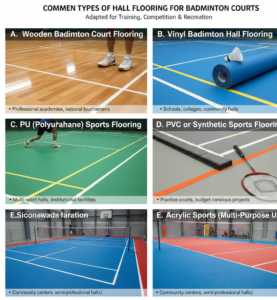
Different badminton facilities require different flooring solutions depending on their purpose—training, competition, recreation, or multi-sport use. Below are the most widely used badminton hall flooring options.
A. Wooden Badminton Court Flooring
Wooden flooring is the gold standard for professional badminton courts and international competitions. Its natural elasticity and comfort make it a preferred surface for elite players.
Key Characteristics:
-
Manufactured using hardwoods such as maple, teak, or oak
-
Installed over a shock-absorbing under-structure
-
Provides excellent grip and energy return
Advantages:
-
Outstanding playing comfort
-
Natural shock absorption
-
Long lifespan with proper care
-
Premium appearance
Best Suited For:
Professional academies, national and international tournament venues, high-end indoor sports complexes.
B. Vinyl Badminton Hall Flooring
Vinyl sports flooring is one of the most popular modern alternatives to wooden courts. It combines performance, safety, and affordability, making it suitable for a wide range of facilities.
Key Characteristics:
-
Multi-layer PVC construction with fiberglass reinforcement
-
Cushioned backing for shock absorption
-
Anti-slip surface coating
Advantages:
-
Comfortable and safe for players
-
Moisture-resistant and easy to maintain
-
Cost-effective compared to wood
-
Available in roll formats for seamless installation
Best Suited For:
Schools, colleges, community halls, training centers, and recreational facilities.
C. PU (Polyurethane) Sports Flooring
PU flooring is a seamless, poured-in-place system widely used in multi-purpose indoor sports halls. It offers durability, flexibility, and a clean, modern finish.
Key Characteristics:
-
Liquid-applied polyurethane layers
-
Joint-free and smooth surface
-
Installed over concrete or cushioned sub-base
Advantages:
-
Excellent elasticity and impact resistance
-
Hygienic and easy to clean
-
Long service life with minimal maintenance
-
Supports multiple indoor sports
Best Suited For:
Multi-sport halls, institutional facilities, schools, and indoor training centers.
D. PVC or Synthetic Sports Flooring
PVC flooring is a versatile and budget-friendly solution designed to replicate professional sports performance at a lower cost.
Key Characteristics:
-
Available in various thickness levels (typically 4.5 mm to 8 mm)
-
Anti-slip wear layer with cushioned backing
-
High resistance to abrasion and moisture
Advantages:
-
Quick installation
-
Good shock absorption and grip
-
Wide color and design options
-
Low maintenance
Best Suited For:
Practice courts, budget-conscious projects, indoor badminton halls with moderate usage.
E. Acrylic Sports Flooring (Multi-Purpose Use)
Acrylic flooring systems are commonly used in indoor halls that host badminton along with other activities.
Key Characteristics:
-
Water-based acrylic coating over concrete
-
Textured, slip-resistant finish
-
Durable and color-stable
Advantages:
-
Economical solution
-
Easy to maintain
-
Customizable colors and layouts
Best Suited For:
Community centers, semi-professional halls, and multi-purpose indoor spaces.
3. Construction and Installation Considerations
The performance of a badminton hall floor depends as much on installation quality as on material selection. Professional installation ensures safety, durability, and compliance with standards.
Important installation elements include:
-
Precise leveling of the subfloor
-
Proper shock-absorption layers
-
Seamless joints and uniform surface texture
-
Accurate court dimensions and line markings
-
Moisture control and vapor barriers
Incorrect installation can lead to uneven bounce, surface damage, and increased injury risk.
4. Maintenance and Longevity
Regular maintenance extends the life of badminton hall flooring and preserves its playing characteristics.
Maintenance Best Practices:
-
Daily dry cleaning to remove dust
-
Periodic damp mopping with recommended cleaners
-
Avoiding sharp or non-sport footwear
-
Using entrance mats to reduce dirt entry
-
Maintaining indoor humidity and temperature levels
With proper care:
-
Wooden floors can last 15–20 years
-
Vinyl, PVC, and PU floors typically last 10–12 years
5. Benefits of Professional Badminton Hall Flooring
Investing in professional hall flooring delivers long-term advantages:
-
Improved player performance and comfort
-
Reduced injury risks
-
Lower maintenance and repair costs
-
Enhanced facility reputation
-
Support for multi-sport usage
-
Custom design and branding options
A well-designed badminton hall floor adds value not just to the sport but to the entire facility.
6. Cost of Hall Flooring for Badminton Courts (India)
The cost of badminton hall flooring varies depending on material, thickness, and installation complexity.
Approximate cost range:
-
Wooden Flooring: ₹300 – ₹500 per sq. ft.
-
Vinyl Flooring: ₹120 – ₹250 per sq. ft.
-
PU Flooring: ₹250 – ₹400 per sq. ft.
-
PVC Flooring: ₹100 – ₹180 per sq. ft.
-
Acrylic Flooring: ₹90 – ₹150 per sq. ft.
For a standard badminton court, total installation costs generally range from ₹1.5 lakhs to ₹4.5 lakhs, depending on the chosen system.
7. Factors to Evaluate Before Choosing Flooring
Before selecting hall flooring, consider:
-
Purpose of the court (training, competition, recreation)
-
Budget and long-term value
-
Maintenance capabilities
-
Indoor climate and humidity conditions
-
Warranty and material certification
Consulting a sports flooring professional ensures the most suitable and cost-effective solution.
8. Importance of Professional Installation
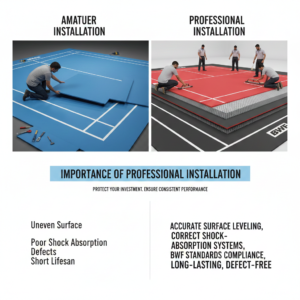
Even premium materials can fail without proper installation. Experienced installers ensure:
-
Accurate surface leveling
-
Correct shock-absorption systems
-
Compliance with BWF court standards
-
Long-lasting, defect-free flooring
Professional installation protects your investment and ensures consistent performance over time.
9. Conclusion
Hall flooring is the backbone of any indoor badminton court. The right surface enhances safety, comfort, and performance while ensuring durability and visual appeal. Whether you choose wooden, vinyl, PU, PVC, or acrylic flooring, the key lies in selecting a system that matches your facility’s needs and installing it with professional expertise.
With the right flooring solution, expert installation, and proper maintenance, a badminton hall can deliver years of reliable performance—supporting athlete development, competitive play, and a premium sporting experience.