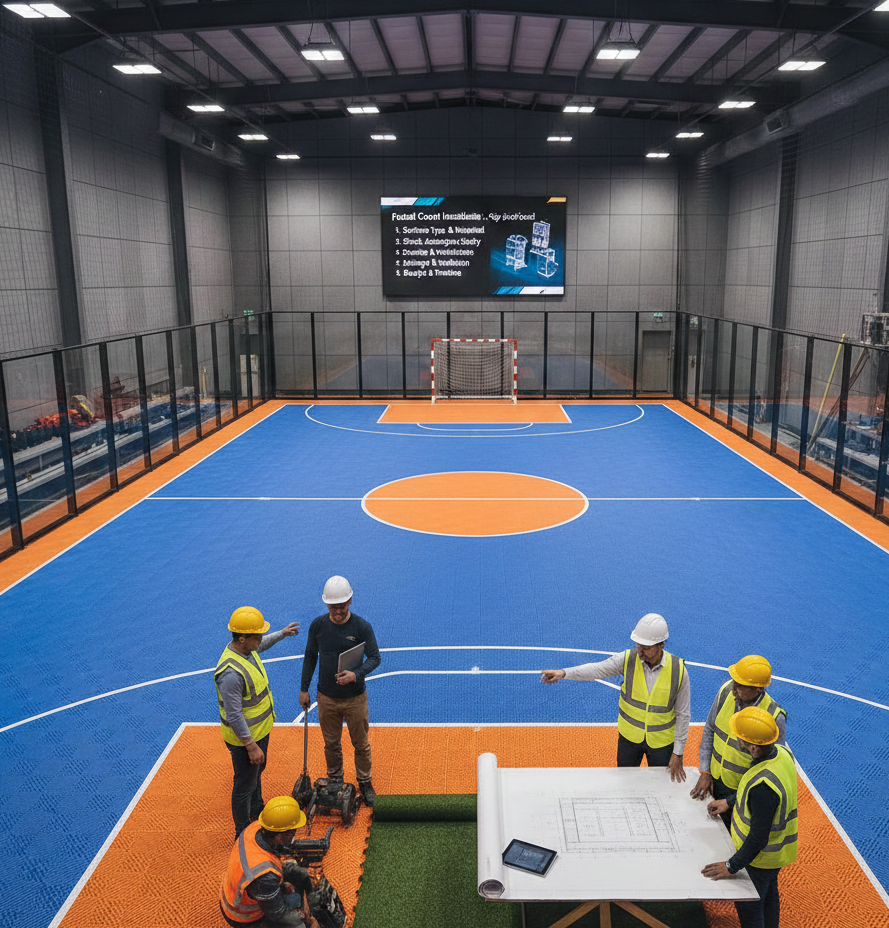
Futsal has rapidly evolved from a niche indoor sport into one of the fastest-growing forms of football worldwide. In India, its popularity is rising across schools, academies, residential communities, corporate campuses, and professional sports complexes. However, the success of a futsal facility depends not just on enthusiasm for the game, but on how well the court itself is designed and built.
Installing a futsal court is a technical process that demands careful planning, precise engineering, and the right choice of materials. A properly constructed court ensures consistent ball behavior, player safety, durability, and low maintenance costs over the long term. From groundwork to flooring selection and from lighting to safety compliance, every stage plays a vital role.
This guide explains the most important factors to consider when planning and executing a futsal court installation, helping project owners make informed decisions and achieve professional-quality results.
1. Site Selection and Ground Preparation
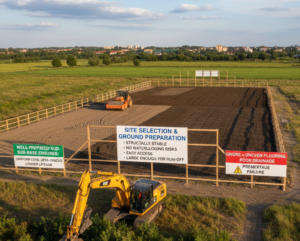
Every successful futsal court begins with the right location. Site selection directly influences drainage, surface stability, and long-term performance.
The chosen area should be:
-
Structurally stable
-
Free from waterlogging risks
-
Easily accessible for players and spectators
-
Large enough to accommodate safety run-off zones
Once the site is finalized, ground preparation becomes critical. This stage involves clearing vegetation, removing debris, leveling the land, and compacting the soil to prevent settlement over time.
A well-prepared sub-base ensures:
-
Uniform load distribution
-
Reduced risk of surface cracks
-
Longer lifespan of the playing surface
Ignoring this step often leads to uneven flooring, poor drainage, and premature surface failure.
2. Strong and Reliable Base Construction
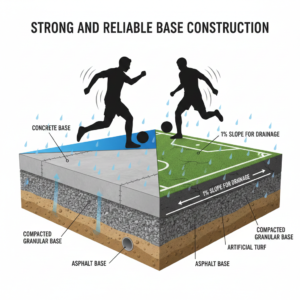
The base layer acts as the backbone of the futsal court. It determines how well the surface handles player movement, impact forces, and environmental stress.
Common base systems include:
Concrete Base
Concrete is widely used for permanent futsal courts due to its strength and stability. It offers a flat, durable foundation capable of supporting high-traffic use. Proper curing and expansion joints are essential to avoid cracking.
Asphalt Base
Asphalt provides flexibility and is easier to repair than concrete. It is suitable for outdoor courts and works well with turf or acrylic surfaces when installed with the correct slope.
Compacted Granular Base
Often used for turf systems, this base supports efficient drainage and shock absorption when layered correctly.
For outdoor courts, a gentle slope (usually around 1%) must be incorporated to allow rainwater to drain naturally without affecting gameplay.
3. Choosing the Right Futsal Flooring System
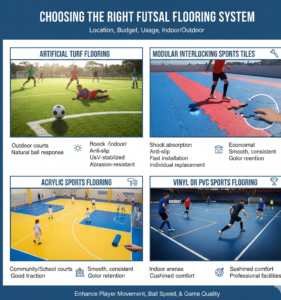
The playing surface is the most critical element of a futsal court. It influences player movement, ball speed, injury risk, and overall game quality.
Artificial Turf Flooring
Synthetic turf is one of the most popular choices for outdoor futsal courts. It offers a natural ball response, player comfort, and weather resistance. High-quality turf systems are UV-stabilized, abrasion-resistant, and designed specifically for futsal rather than football.
Modular Interlocking Sports Tiles
These tiles are ideal for rooftop, indoor, and temporary installations. They provide excellent shock absorption, anti-slip texture, and fast installation. Damaged tiles can be replaced individually, reducing maintenance costs.
Acrylic Sports Flooring
Acrylic systems are economical and suitable for community-level or school courts. They deliver a smooth, consistent surface with good traction and color retention when applied over a solid base.
Vinyl or PVC Sports Flooring
Primarily used for indoor futsal arenas, vinyl flooring offers seamless installation, cushioned comfort, and superior grip. It is commonly found in professional and training facilities.
Selecting the right flooring depends on location, budget, usage frequency, and whether the court is indoor or outdoor.
4. Court Dimensions and Line Markings
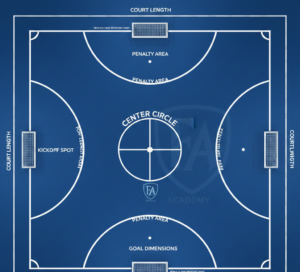
Accuracy in court dimensions is essential for fair play and official matches. Standard futsal court measurements typically follow international and national guidelines.
Key elements include:
-
Proper court length and width
-
Clearly defined penalty areas
-
Center circle and kickoff spot
-
Correct goal dimensions
Line markings must be:
-
Highly visible
-
Non-slip
-
Resistant to fading and weather exposure
Using professional-grade paints or pre-colored flooring systems ensures long-lasting clarity and a polished appearance. Custom branding or academy logos can also be integrated without affecting playability.
5. Lighting, Fencing, and Surrounding Infrastructure
A futsal court is not complete without the right supporting infrastructure. Lighting, fencing, and drainage systems significantly enhance usability and safety.
Lighting
LED sports lighting is preferred due to energy efficiency and consistent illumination. Adequate brightness ensures clear visibility during evening or night games, reducing eye strain and improving performance.
Fencing
Perimeter fencing keeps the ball within play and protects spectators. Chain-link or welded mesh fencing, typically 10–12 feet high, is commonly used. Powder-coated or galvanized finishes improve durability and corrosion resistance.
Drainage
An effective drainage system prevents water accumulation, surface damage, and slippery conditions. Proper slope design, side drains, and outlet channels are crucial for outdoor courts.
6. Professional Installation and Technical Supervision
Even the best materials can fail if installed incorrectly. Professional supervision ensures that every layer—from base preparation to surface finishing—is executed with precision.
Key aspects of expert installation include:
-
Accurate leveling and alignment
-
Proper curing time between layers
-
Correct joint treatment
-
Consistent surface thickness
Skilled installers follow proven methodologies and quality checks at every stage, reducing the risk of defects and ensuring compliance with sports standards.
7. Weather Resistance and Long-Term Maintenance
Futsal courts, especially outdoor ones, are exposed to sun, rain, dust, and temperature variations. Choosing weather-resistant materials is essential for maintaining performance and appearance.
Maintenance planning should include:
-
Regular surface cleaning
-
Inspection of joints, seams, and edges
-
Drainage system maintenance
-
Periodic repainting or recoating of lines
Modular or turf-based systems allow for easy repair and replacement, minimizing downtime and extending the court’s usable life.
8. Safety Standards and Regulatory Compliance
Player safety is non-negotiable. A well-designed futsal court must meet recognized safety and sports standards.
Important safety features include:
-
Shock-absorbing layers to reduce impact stress
-
Anti-skid surface textures
-
Rounded or padded goalposts
-
Adequate run-off areas around the court
Compliance with futsal regulations ensures that the court is suitable for training, competitive matches, and tournaments without compromising player well-being.
Building a Futsal Court That Delivers Long-Term Value
A futsal court is more than just a playing area—it is an investment in sports development, community engagement, and athletic performance. When planned and executed correctly, it delivers years of safe, enjoyable, and professional-level play.
From selecting the right site and base to choosing the appropriate flooring system and ensuring expert installation, every decision contributes to the court’s success. Cutting corners at any stage often results in higher maintenance costs and reduced lifespan.
By focusing on quality materials, precise engineering, and adherence to standards, futsal courts can serve players of all ages and skill levels while maintaining excellent performance and aesthetics over time.