Executive Summary
Futsal, the fast-paced variant of football played on smaller courts, has been gaining significant traction globally due to its accessibility, low land requirements, and suitability for urban environments. Consequently, futsal court construction has emerged as a rapidly growing segment within the broader sports facility construction and sports flooring markets. The combination of rising urbanization, expanding school and community sports programs, and increasing investments in sports infrastructure—particularly in Asia—has fueled the demand for futsal courts across the globe.
Using a transparent, proxy-based methodology, this report estimates the global futsal court construction market at approximately USD 0.7 billion in 2024. Two forecast scenarios have been developed to illustrate potential growth trajectories over the next decade:
-
Conservative Scenario (CAGR ~6.2%) → Market projected to reach ~USD 1.20 billion by 2033.
-
Aggressive Scenario (CAGR ~9.6%) → Market projected to reach ~USD 1.60 billion by 2033.
These ranges are informed by growth in the sports flooring and artificial turf markets, as well as the increasing share of futsal within the overall sports infrastructure ecosystem. The report provides actionable insights for suppliers, contractors, and investors, highlighting market opportunities, drivers, challenges, and strategic recommendations.
Market Definition and Scope
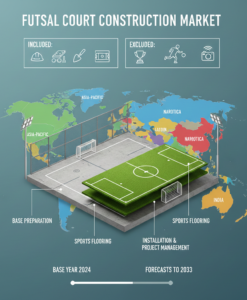
For the purpose of this report, the futsal court construction market includes all construction, installation, and related materials and services specifically associated with futsal courts. This encompasses:
-
Base preparation: concrete or asphalt foundations, grading, and drainage.
-
Sports flooring: artificial turf, modular interlocking tiles, acrylic, vinyl/PVC surfaces.
-
Court accessories: goals, fencing, lighting, and line markings.
-
Installation labor and project management.
Excluded from this market are operational aspects such as tournament organization, event management, apparel, or broadcast rights.
Geography: Global, with specific regional focus on Asia-Pacific, Europe, North America, Latin America, and Middle East & Africa, alongside a dedicated subsection on India.
Time Horizon: Base year 2024, with forecasts extending to 2033.
Methodology and Assumptions
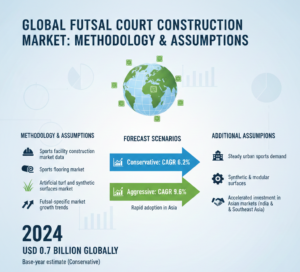
Since there is no single public source tracking global futsal court construction revenues, estimates were derived using a proxy-based approach integrating multiple high-quality market data points:
-
Sports facility construction market data – To understand overall construction spend for athletic infrastructure.
-
Sports flooring market – Capturing the installation and replacement value of surfaces commonly used for futsal.
-
Artificial turf and synthetic surfaces market – Significant contributor to outdoor futsal court costs.
-
Futsal-specific market growth trends – Informing the aggressive scenario projection.
Base-year estimate (2024): USD 0.7 billion globally. This is conservative relative to the combined size of sports flooring and synthetic turf markets but reflects the emerging share of futsal within sports infrastructure investments.
Forecast Scenarios:
-
Conservative: CAGR 6.2% (aligning with general sports flooring growth trends).
-
Aggressive: CAGR 9.6% (reflecting rapid futsal adoption in Asia and other growth regions).
Additional assumptions:
-
Steady urban sports demand in schools, communities, and commercial complexes.
-
Continued preference for synthetic and modular surfaces due to low maintenance.
-
Accelerated investment in Asian markets, particularly India and Southeast Asia, driven by government programs, public-private partnerships, and private sector sports initiatives.
Limitations: Figures are estimates suitable for strategic planning, not audited financial statements. For exact market valuation, proprietary datasets or commissioned research may be required. Sensitivity analysis can be provided to model alternative scenarios.
Market Size Forecast (Summary)
| Year | Conservative (USD B) @ 6.2% CAGR | Aggressive (USD B) @ 9.6% CAGR |
|---|---|---|
| 2024 | 0.700 | 0.700 |
| 2025 | 0.743 | 0.767 |
| 2026 | 0.789 | 0.841 |
| 2027 | 0.838 | 0.922 |
| 2028 | 0.890 | 1.010 |
| 2029 | 0.946 | 1.107 |
| 2030 | 1.004 | 1.213 |
| 2031 | 1.067 | 1.330 |
| 2032 | 1.133 | 1.457 |
| 2033 | 1.203 | 1.597 |
Market Drivers
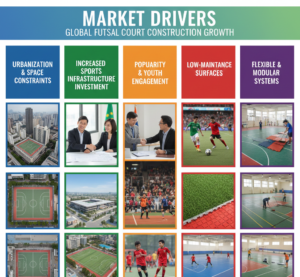
Several key factors are propelling growth in futsal court construction globally:
-
Urbanization and Space Constraints: Futsal courts require significantly less space than traditional football fields, making them ideal for schools, residential complexes, rooftop installations, and multi-use urban developments.
-
Increased Sports Infrastructure Investment: Governments, municipalities, and private organizations, especially in Asia, are investing in community sports facilities, creating demand for both indoor and outdoor futsal courts.
-
Popularity of Futsal and Youth Engagement Programs: Growth in grassroots leagues, academies, and school-level competitions is expanding the market for dedicated futsal courts.
-
Low-Maintenance Surfaces: Synthetic turf, modular tiles, and vinyl floors reduce long-term maintenance costs compared to natural grass, enhancing adoption among budget-conscious operators.
-
Flexible and Modular Systems: Modular interlocking tiles allow quick installation, easier repairs, and adaptability for multi-use spaces, which is particularly attractive for developers and school facilities.
Market Restraints and Risks
Despite strong growth, futsal court construction faces several challenges:
-
Budget Constraints: Municipalities and schools may face competing priorities, limiting funding for new courts.
-
Installation Quality: Poor construction can compromise player safety, leading to reputational and warranty risks.
-
Regulatory Hurdles: Land-use restrictions and urban planning policies may delay or restrict court installations.
-
Raw Material Volatility: Inflation in plastics, rubber, or bitumen increases costs and can affect project profitability.
Key Trends (2024–2033)
-
Indoor and Rooftop Installations: Growing popularity of modular tile-based courts in dense urban areas.
-
Hybrid Surfaces: Turf installed over shock-absorbing underlay for enhanced safety.
-
Sustainability: Use of recyclable tiles, eco-friendly infills, and permeable systems gaining traction.
-
Turnkey Solutions: Integrated design-build-maintenance contracts offered by leading contractors.
-
Technology Integration: Early adoption of sensor-embedded courts for performance tracking and facility management.
Market Segmentation
By Surface Type:
-
Artificial turf (outdoor)
-
Modular interlocking tiles (indoor/outdoor)
-
Acrylic or polyurethane coatings
-
Vinyl/PVC (indoor)
Turf and modular tile systems dominate construction revenues due to cost, durability, and adaptability.
By End-User:
-
Residential projects (housing societies, townships)
-
Educational institutions (schools, colleges)
-
Commercial sports complexes
-
Municipal parks and public facilities
-
Corporate and hospitality sports facilities
By Geography:
-
Asia-Pacific: Fastest-growing region, led by India, Southeast Asia, and urban expansion.
-
Europe: Mature market with premium indoor facilities and retrofits.
-
North America: Rising interest in youth futsal programs; focus on indoor modular and vinyl surfaces.
-
Latin America and MEA: Opportunistic growth via municipal investments and community programs.
Competitive Landscape
Key Players:
-
Material suppliers: global and local synthetic turf manufacturers, tile producers, vinyl and PVC flooring manufacturers.
-
Specialist contractors: regional firms providing turnkey construction, installation, and maintenance.
-
Integrated facility developers: offering design, construction, and operations solutions for commercial or institutional clients.
Strategic Moves:
-
Partnerships between turf manufacturers and local installers to speed up delivery cycles.
-
Warranty and performance guarantees as differentiators in competitive markets.
-
Bundled maintenance and replacement programs to secure recurring revenue streams.
Opportunities
-
Urban Rooftop & Multi-Use Projects: Quick deployment for high-density areas.
-
Affordable Community Courts: Public-private partnership models with modular systems for scale.
-
School & Academy Packages: Bundled courts with training equipment and maintenance contracts.
-
Sustainable Product Lines: Eco-friendly materials and recyclable solutions to meet ESG requirements.
-
Aftercare Services: Maintenance, resurfacing, and repainting programs to generate long-term recurring revenue.
Go-to-Market Recommendations
For suppliers and contractors targeting 2024–2033 growth:
-
Offer diverse surface portfolios: modular tiles, turf, acrylic coatings.
-
Combine direct sales to developers and municipalities with dealer networks for remote projects.
-
Promote turnkey delivery, installation speed, warranties, and low life-cycle costs.
-
Provide flexible payment options and financing to overcome budget constraints.
-
Collaborate with architects, landscape designers, and procurement consultants to be included in tenders.
-
Highlight sustainability benefits, recycling programs, and low-VOC materials to strengthen ESG positioning.
Financial and Investment Considerations
-
Material suppliers enjoy higher gross margins than installers but installers can generate recurring revenue from maintenance.
-
Moderate CapEx is needed for installers, with working capital tied up in inventory of turf and tiles.
-
Payback periods for community and commercial projects typically range from 3–7 years, depending on utilization and revenue models.
Appendix — Data Sources
-
Global sports facility construction market reports.
-
Sports flooring market size and forecast studies.
-
Artificial turf and synthetic turf market analyses.
-
Dedicated futsal market report and CAGR projections.
-
Indian sports market outlook (Deloitte, KPMG, Google) for regional context.
Conclusion
The global futsal court construction market is poised for steady growth, driven by urbanization, expanding youth programs, and increased investment in sports infrastructure. Modular, synthetic, and hybrid surfaces offer opportunities for faster deployment, lower maintenance, and enhanced player safety. Asia-Pacific, led by India and Southeast Asia, represents the largest growth opportunity, while Europe, North America, and Latin America offer steady, premium markets.
By adopting modular solutions, turnkey service models, and sustainable materials, suppliers, contractors, and developers can capture substantial value in this emerging market. With projected global spending reaching USD 1.20–1.60 billion by 2033, futsal court construction represents a promising segment of the broader sports infrastructure landscape.